Sapphire colours: the complete shade guide
François Deprez5/8/2026



As a jeweller-dealer specialising in coloured stones — and the only French house to be a member of the ICA (International Coloured Gemstone Association) — we source our sapphires directly at origin, through our offices in Sri Lanka and Bangkok. Here is our complete guide to understanding, evaluating and choosing a teal sapphire with confidence.
The teal sapphire belongs to the corundum family, alongside blue sapphire and ruby, and reaches a hardness of 9 out of 10 on the Mohs scale. Its blue-green colour arises from the combined presence of iron and titanium. Yet "teal" is not a single hue: it is an entire spectrum, sliding from peacock blue to lagoon green. Understanding where your stone sits on that axis is already understanding the essential.

When blue prevails, the teal evokes the depths of the sea and the plumage of the peacock. A more classic shade, close to blue sapphire yet shot through with a breath of green that brings it to life. The choice of those who favour understated elegance.

When green takes over, the teal becomes a tropical lagoon or a shaded woodland. Rarer and more assertive, it appeals to those who seek a genuinely singular stone, far from the beaten path.
There is no such thing as a "good" teal in absolute terms. The most sought-after shade — the famous "mermaid", a 50/50 balance between blue and green — is not necessarily the one that will suit you. The best teal sapphire is the one whose colour speaks to you, seen in natural light. This guide gives you the tools to compare what is truly comparable.
The teal sapphire is, first and foremost, a sapphire: the same mineral species as the blue sapphire, corundum (aluminium oxide), differing only in colour. Its name comes from the English word teal — a duck whose plumage displays this same deep blue-green. Where the blue sapphire owes its hue to iron and titanium, the teal is born of a particular balance of those same elements, which shifts the colour toward green.
Its hardness of 9/10 makes it one of the most durable stones in existence, second only to diamond. In practical terms: it will not scratch on contact with everyday objects, withstands knocks, and is unaffected by water — a decisive advantage for a teal sapphire engagement ring worn daily, far more so than an emerald, which is more fragile. Another distinguishing feature: the teal sapphire is often pleochroic, meaning it can reveal subtly different nuances depending on the angle — slightly more blue from one side, slightly more green from the other. Far from being a flaw, this play of light is part of its charm.
The teal sapphire is a modern alternative to both the diamond and the classic blue sapphire. Its unique colour and relative accessibility have made it, over the course of just a few seasons, one of the most sought-after stones in contemporary jewellery — without ever forsaking the nobility and durability that have defined the sapphire's reputation for centuries.
Unlike the blue sapphire, the teal has no "Kashmir". Here, it is not so much the prestige of origin that matters as the colour signature it imparts to the stone. Four major regions dominate the market.
The luminous teal
"The island of gems" yields some of the most luminous and transparent teals, with a brilliant crystal. Balanced blue-green hues that captivate lovers of vivid stones. A proportion are heat-treated.
Accessible balance
A recent, abundant and varied source. Madagascar produces vibrant, well-balanced teals at particularly accessible prices. Often the best value for money on the market.
The connoisseur's favourite
Soft, earthy, slightly greyish teals with a highly sought-after "mossy" character — and frequently unheated. An origin that commands a premium, particularly in the United States.
The deep tones
Australia, rich in iron, yields darker, decidedly green teals that form the backbone of a large part of the commercial teal market. Nigeria and Tanzania contribute deep, saturated "petroleum" hues.
Unlike the ruby's "pigeon blood", "teal" is not a strict laboratory classification: it is a name the market invented to describe a balanced blue-green. The sub-appellations "mermaid", "lagoon" or "peacock" belong to commercial language, not to any fixed standard. Hence the importance of looking at the stone itself, in daylight, rather than the label that accompanies it.
As with any sapphire, the value of a teal is read through a few key criteria. Here, however, an additional factor comes into play: the precise balance between blue and green, which takes precedence over almost everything else.
The defining criterion. A vivid, well-saturated and harmonious blue-green — neither too dark nor too grey — commands the highest value. The 50/50 "mermaid" balance is the most coveted, though personal preference always plays a part.
Teal sapphires often display a few natural inclusions, which are discrete and lend the stone its authenticity. A perfectly "clean" teal offered at a very low price should raise suspicion: beware of synthetics.
A well-considered cut enhances colour and brilliance, and manages pleochroism to present the desired hue to the observer. The lapidary must balance retained weight against the most beautiful colour.
Fine teal sapphires remain rare in larger sizes. Above 2 carats, the price per carat rises sharply, particularly for unheated stones with perfect colour balance.
Every teal sapphire we offer is accompanied by an independent laboratory certificate (SSEF, GRS, ICA, Bellerophon…) attesting to its origin, treatment and characteristics. Our direct sourcing, with no intermediaries, guarantees you the stone at its true price.
Heating is an age-old treatment, carried out at very high temperatures to intensify colour and improve transparency. It is a time-honoured, stable process, internationally accepted provided it is declared on the certificate. The majority of teal sapphires on the market are heated, particularly Australian stones, which tend to be darker in their rough state.
An unheated teal sapphire ("no heat" or "NH" on the certificate) retains all of its natural characteristics. Rarer by nature, it commands a premium of approximately 30 to 50% for equivalent quality — a premium that is all the more pronounced when the colour is exceptional. Montana and a portion of the production from Ceylon and Madagascar offer superb examples.
Bonnot Paris offers both options — heated and unheated — always with complete transparency. We do not, however, sell any sapphire treated with beryllium or lead glass, nor any synthetic stone: these processes alter the very nature of the gem and have no place in an exceptional creation.
Good news: the teal sapphire remains more accessible than royal blue sapphire or padparadscha. Its price depends on colour balance, clarity, origin and treatment. Below are concrete reference points, expressed as price per carat for a fine-quality stone.
To put these figures in perspective: a gem-quality Kashmir blue sapphire can fetch tens of thousands of euros per carat at auction, with records exceeding one million. The teal, meanwhile, offers the same mineral nobility, the same hardness and a colour far rarer in everyday life — for a fraction of the price. This is precisely what makes it the rising star of modern jewellery.
Thanks to our direct sourcing from our offices in Sri Lanka and Bangkok, you pay the true value of the stone — not the successive margins of three or four intermediaries. For a given budget, you access a quality generally superior to that of traditional retailers.
The term "teal" encompasses a family of blue-green hues that are easily confused. Some are magnificent sapphires in their own right; others are stones of entirely different species. Here is how to tell them apart.
| Stone | What distinguishes it | Hardness |
|---|---|---|
| Teal sapphire | Corundum Blue and green blended in balance throughout the stone, with a uniform hue. | 9 / 10 |
| Green sapphire | Same mineral, but the colour has shifted to a predominantly green tone, often less saturated. Commercial demand more limited than for teal. | 9 / 10 |
| Parti-colour sapphire | Polychrome corundum displaying distinct colour zones (e.g. a blue area and a green area) visible to the naked eye. | 9 / 10 |
| Tourmaline (indicolite) | A different mineral species. Beautiful blue-green tones are possible, but it is less hard and more fragile than sapphire. | 7 – 7.5 |

The timeless classic
For those who love corundum but prefer the depth of a pure blue over the blue-green of teal. The absolute reference in jewellery, a symbol of fidelity and wisdom — also available set in a blue sapphire engagement ring.

The pink-orange rarity
The other fancy sapphire captivating contemporary jewellery: a delicate and exceptionally rare pink-orange, for those seeking a warm hue as singular as teal — also available as a padparadscha sapphire engagement ring.
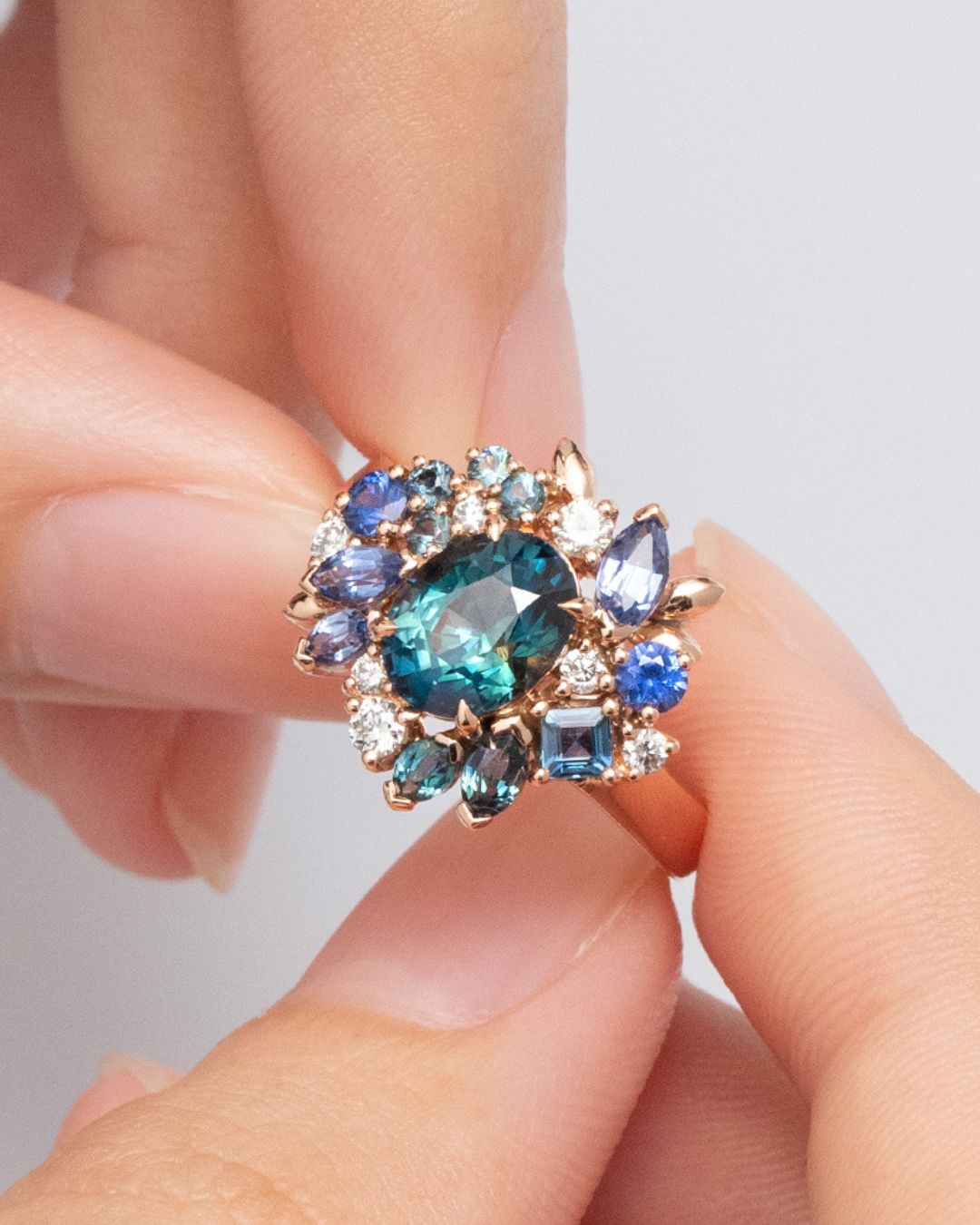
The colour of teal lends itself to every jewellery style, from the most classic to the most contemporary. Here are four bespoke creations from our atelier, featuring unheated teal sapphires from Madagascar, to inspire you.

Daisy style
A 2.03 ct teal sapphire encircled by a double halo: a first ring of mauve sapphires, then a corolla of round diamonds shaped like a flower. Romantic and colourful.

Floral style
An oval teal in a claw setting, surrounded by round and marquise F/VS diamonds forming petals, on yellow gold that warms the blue-green tones. Feminine and luminous.

Art deco style
A 1.07 ct teal in an octagonal bezel setting pavé-set with F/VS diamonds, on white gold. A geometry inspired by the 1920s, modern and graphic.

Solitaire style
A 1.53 ct oval teal in a bezel setting, on yellow gold, in total purity. The stone alone, protected and magnified, with nothing to distract the eye. Timeless.
All of these creations — and many more — can be found in our collection of teal sapphire engagement rings: 40 styles available around stones currently in stock, from €2,520, each one crafted by hand in our atelier.
Each of these rings is a one-of-a-kind piece, crafted by hand around a directly sourced stone. You may draw inspiration from them to imagine your own: we transpose the spirit of a design without ever reproducing it identically. Discover bespoke creation →
It is a natural sapphire whose colour blends blue and green in a subtle balance, evoking lagoons and forests. It belongs to the corundum family, like ruby, and its hue comes from the combined presence of iron and titanium. Its name comes from the English word teal, the common teal, a duck with blue-green plumage.
Absolutely. With a hardness of 9/10, the teal sapphire withstands daily wear with ease. Its blue-green colour offers a modern, personal alternative to both the diamond and the classic blue sapphire — an ideal choice for an engagement ring unlike any other.
At Bonnot Paris, our teal sapphire engagement rings start at around €2,500, with the heart of the collection ranging from €3,000 to €9,000 depending on carat weight, the intensity of the blue-green colour, treatment (heated or unheated) and the craftsmanship of the setting. Every stone is natural, certified by an independent laboratory, and every ring is handcrafted in our atelier.
Sri Lanka (luminous, transparent teals), Madagascar (well-balanced and accessible), Montana (soft, earthy, often unheated) and Australia (darker and greener). Nigeria and Tanzania round out the more recent sources. Bonnot Paris sources directly through its offices in Sri Lanka and Bangkok.
Teal blends blue and green in a smooth, uniform balance. A green sapphire has shifted to a distinctly green dominance. Parti-colour, by contrast, displays distinct colour zones visible to the naked eye. Three different looks from the same mineral species.
Expect around €600 to €1,200 per carat for a good-quality heated teal (~1 ct), €1,200 to €3,000 per carat for a beautifully balanced stone of 1 to 2 carats, and €3,000 to €8,000 per carat for an exceptional unheated stone above 2 carats. It remains more accessible than the royal blue sapphire or the padparadscha.
Three safeguards: a certificate from an independent laboratory (SSEF, GRS, GIA, ICA), examination under a x10 loupe that reveals the natural inclusions absent in synthetic stones, and purchasing from a trusted professional — a dealer-jeweller who is a member of the ICA. Be wary of any teal that is too transparent, too perfect and too inexpensive.
Share this post