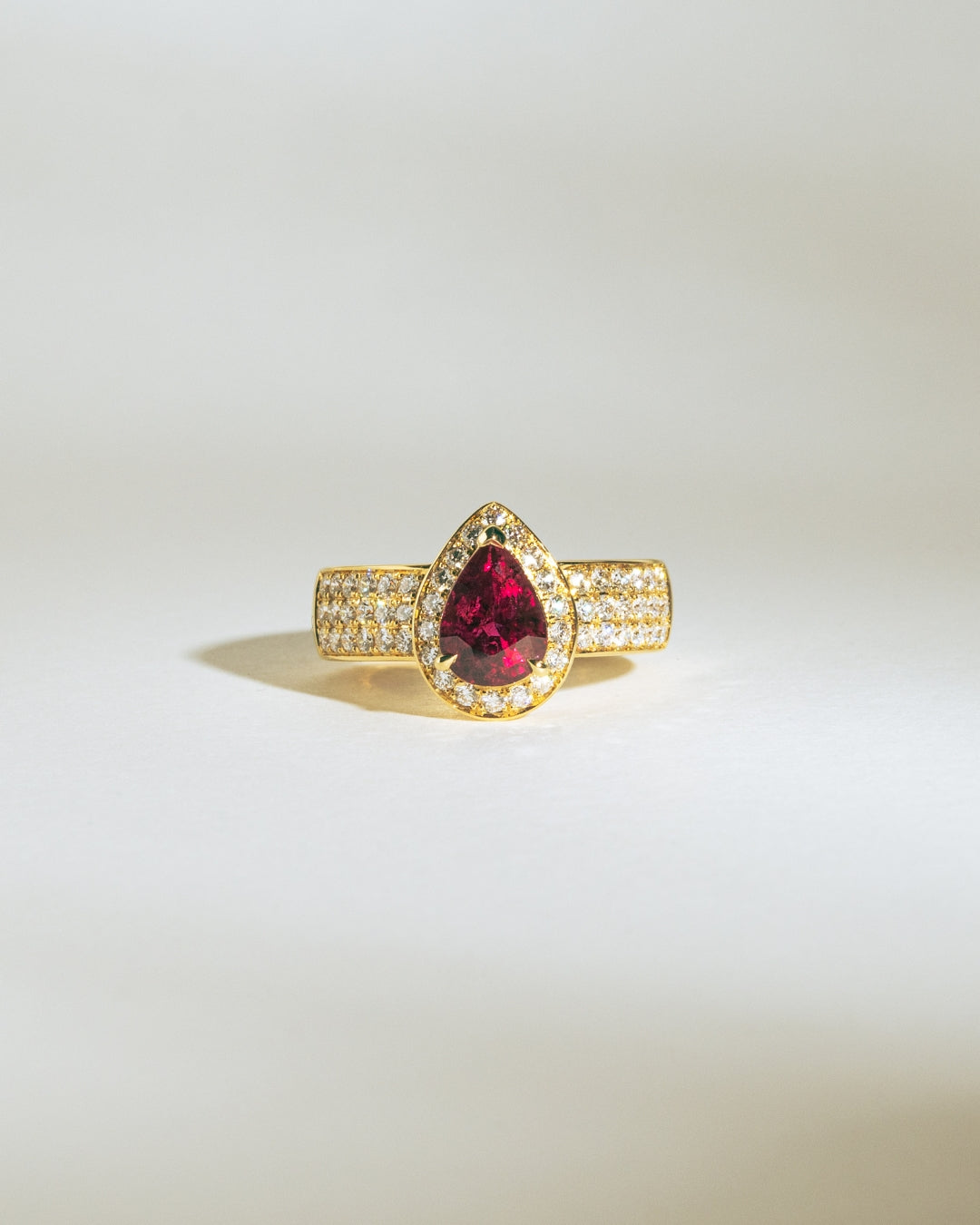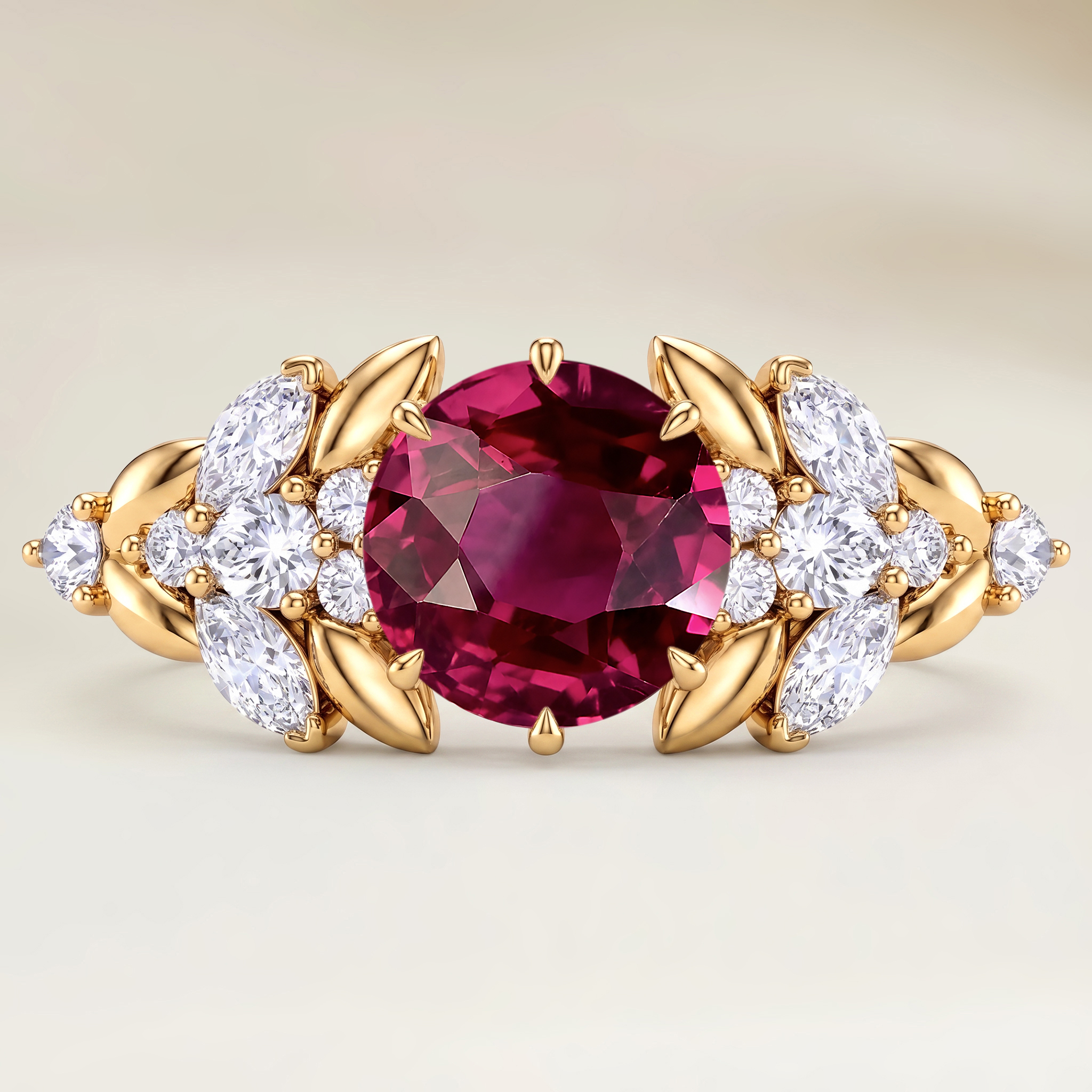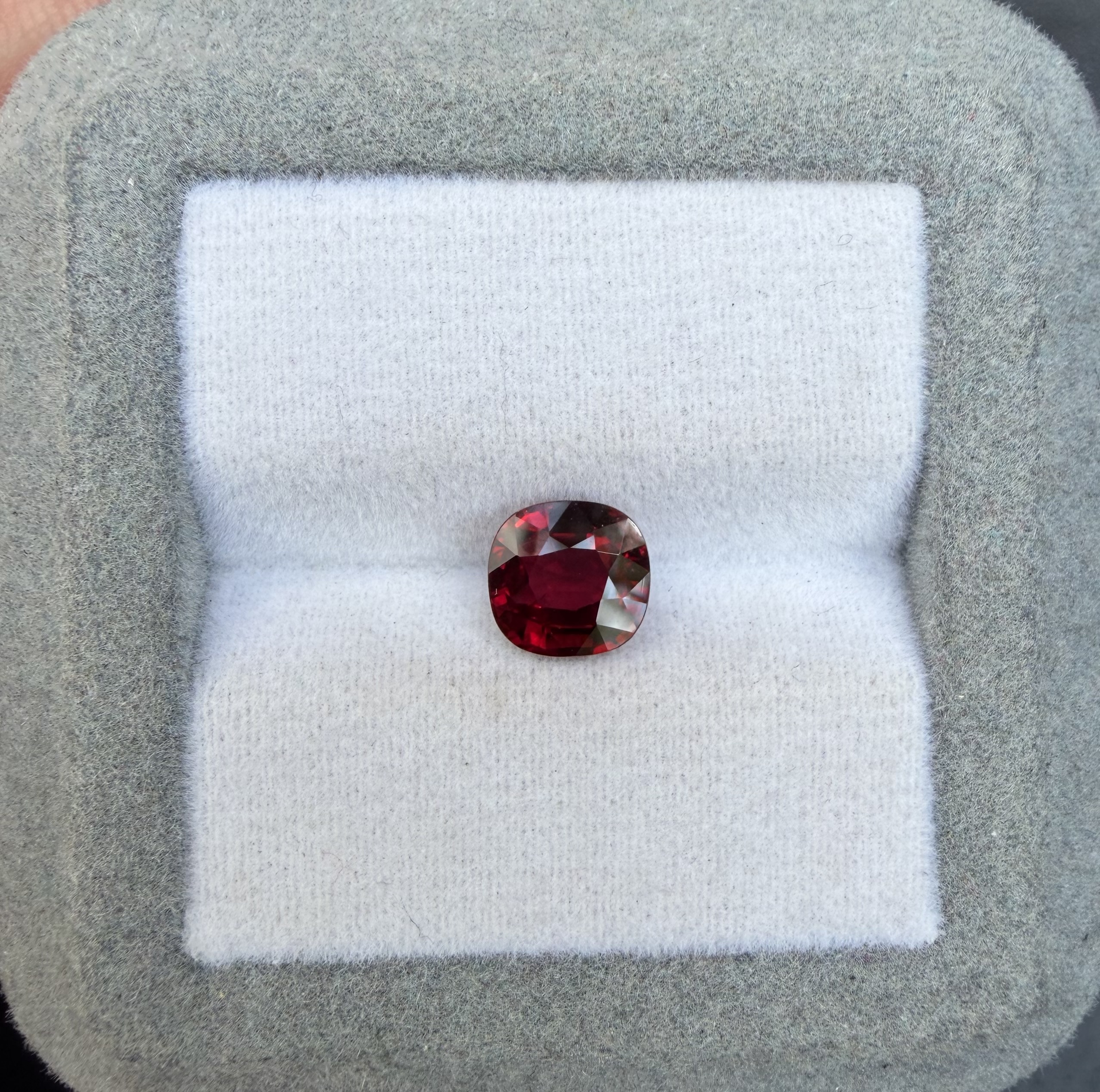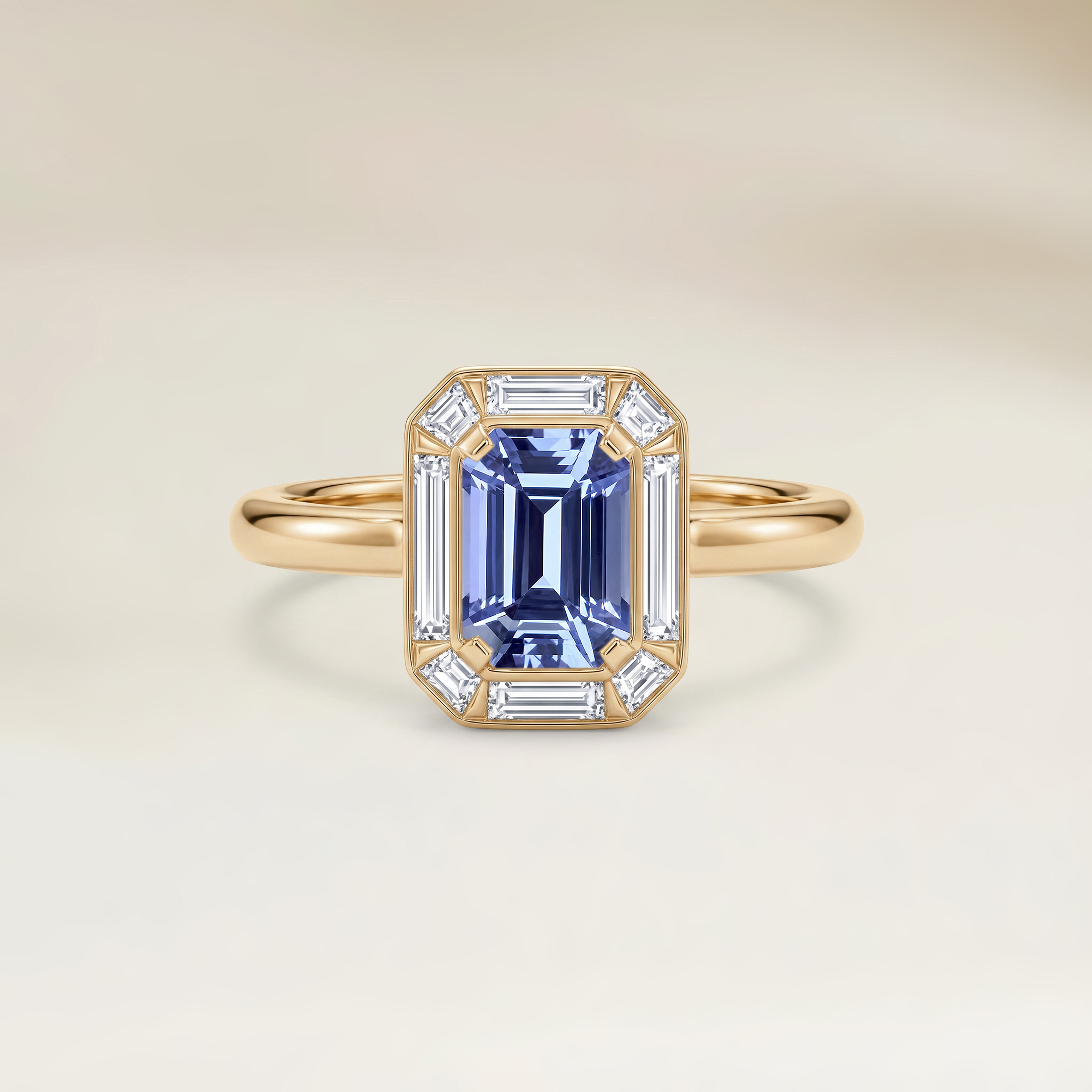

As a coloured-stone dealer and the only French member of the ICA (International Coloured Gemstone Association), we source our rubies directly at origin, in Burma and Mozambique. This is our complete guide to understanding, evaluating and choosing a ruby with confidence.
Ruby belongs to the same mineral family as sapphire and reaches a hardness of 9 out of 10 on the Mohs scale. It is chromium that gives ruby its red: the higher its concentration, the deeper the colour moves toward blood red. But at equivalent quality, it is above all origin that shapes character — and price.
The historic benchmark

The birthplace of ruby for over 800 years. A vivid red with a faint violet undertone, intense fluorescence, and the celebrated "pigeon's blood" hue. Production is now marginal, making these stones a coveted and patrimonial rarity.
The modern source

The world's second major source since 2009. Rubies with vivid, luminous colour at an excellent price-to-quality ratio — the finest entry point into a truly exceptional stone.
There is no "good" or "bad" origin in absolute terms: there is the stone that suits your project and your budget. A fine Mozambique ruby will often outshine a mediocre Burmese one. This guide gives you the keys to compare what is truly comparable.
The ruby and the sapphire are in fact the same mineral species. The only distinction between them is colour: the red variety is called ruby; every other hue is a sapphire. It is the presence of chromium that produces the red — and that same chromium is what makes ruby so rare in larger sizes, as it disrupts the growth of the crystal.
Its hardness of 9/10 makes it one of the most durable stones in existence, second only to the diamond. In practical terms: it does not scratch on contact with everyday objects, withstands knocks and has no fear of water. For a ring worn every day, this is a decisive advantage — far more so than for the emerald, for example, which is considerably more fragile.
Ruby is rarer than diamond at equivalent quality levels. Beyond 3 carats, a fine-colour untreated ruby becomes a collector's piece — and one of the best-performing assets in the precious stone market over the long term.
Four regions produce the great majority of gem-quality rubies. Each imprints on the stone a colour signature that laboratories can identify with certainty.
The absolute benchmark
Marble deposits, a high concentration of chromium and low iron content yield a vivid, slightly violetish red and a fluorescence that amplifies the stone's brilliance. This is where "pigeon blood" is born.
2nd largest source worldwide
In production since 2009, this region is now the market's leading supplier of rubies. Vivid, luminous hues, excellent clarity, and an unbeatable value for money.
Velvety pinkish tones
Lighter rubies, often tending towards pink, with a characteristic velvety brilliance. Sitting at the boundary of the pink sapphire, they appeal to those drawn to softer, more delicate shades.
The historic sources
Thailand produces darker rubies (rich in iron) and was long the world centre for cutting and heating. Vietnam offers delicate pinkish-reds that closely resemble Burmese stones.
"Pigeon blood" (pigeon blood) describes a ruby with an intense, slightly violetish red at maximum saturation. This is not a marketing term but a strict qualification issued by reference laboratories (SSEF, GRS, AGL, Gübelin). Not every Burmese ruby receives it: the designation commands a premium of 30 to 100% over an otherwise equivalent standard ruby.
As with the diamond, a ruby's value is read through a handful of key criteria. But unlike the diamond, here colour takes precedence over everything else.
Hue, tone and saturation. The ideal: a pure to slightly violetish red, vivid and deep, without tipping into darkness. This alone determines 50 to 70% of the value.
Ruby almost always contains natural inclusions (rutile "silk"). When discreet, these authenticate the stone. A perfectly "clean" ruby should raise suspicion.
A well-proportioned cut revives the red and the brilliance. The cutter always arbitrates between retaining weight and revealing the finest colour possible.
Ruby is rare in larger sizes. Beyond 1 to 2 carats, the price per carat rises exponentially, particularly for unheated stones.
Every ruby we offer is accompanied by an independent laboratory certificate attesting to its origin, treatment and characteristics. Our direct sourcing, without intermediaries, ensures you receive the stone at its true market price.
Heat treatment is an age-old practice, carried out for centuries at very high temperatures to intensify colour and improve transparency. Approximately 95% of rubies on the market are heated: this is an internationally accepted standard, and there is nothing misleading about it provided it is declared on the certificate.
An unheated ruby (noted as "no heat" or "NH" on the certificate) retains all of its natural characteristics. Rarer by nature, it commands a premium of 50% to five times the price at equivalent quality — and the finer the stone, the greater that premium.
Bonnot Paris offers both options — heated and unheated — always with complete transparency. We do not, however, sell any ruby treated with beryllium or lead glass: these contested treatments alter the very structure of the stone and have no place in a piece of true distinction.
The price of a ruby varies enormously according to origin, colour, clarity and treatment. Below are concrete reference points, expressed as a price per carat for a stone of fine quality.
At the very top of the market, unheated pigeon's-blood rubies above 3 carats regularly achieve several hundred thousand euros per carat at auction. As a point of reference, a 25-carat Burmese ruby sold for close to 30 million dollars at Sotheby's in 2015 — a record that speaks to the extreme rarity of the finest stones.
Through our direct sourcing in Burma and Mozambique, you pay the true value of the stone — not the successive margins of three or four intermediaries. For any given budget, you gain access to a quality that typically surpasses what traditional resellers can offer.
Several red gemstones can be mistaken for a ruby. Some are magnificent stones in their own right — others mere imitations. Here is how to find your bearings.
| Stone | What sets it apart | Hardness |
|---|---|---|
| Ruby | Corundum The most intense red, fluorescence, exceptional rarity. | 9 / 10 |
| Spinel | Long confused with ruby (the "Black Prince's Ruby" in the British Crown Jewels is one). A slightly softer red, often untreated. | 8 / 10 |
| Garnet | More accessible in price, with a red that often tends towards brown or orange, and none of the fluorescence of a ruby. | 6.5 – 7.5 |
| Pink sapphire | The same mineral as ruby (corundum), but with a pink rather than a true red hue — the boundary between the two is a matter of debate. | 9 / 10 |
The noble alternative
The finest alternative to ruby: a vibrant red, typically natural and unheated, at a more accessible price. A stone that is steadily earning its place among the great names of fine jewellery.
The romantic shade
For those who love the stone but prefer a softer hue over true red. Elegant and delicate, it forms a natural bridge between ruby and rose.
Absolutely. With a hardness of 9/10, a ruby offers the same exceptional durability as sapphire and stands up perfectly to daily wear. Symbolically, it embodies passion, courage and absolute commitment — a powerful statement for an engagement ring.
Burma (the Mogok Valley) remains the historic benchmark for its "pigeon's blood" rubies. Mozambique (Montepuez) is the world's second major source, offering an excellent quality-to-price ratio. Sri Lanka, Thailand and Vietnam round out the principal origins. Bonnot Paris sources directly in Burma and Mozambique.
It is a ruby displaying an intense red, slightly tinged with violet, at maximum saturation. This strict designation is awarded by the leading laboratories (SSEF, GRS, AGL, Gübelin). Reserved for a fraction of the finest stones, it commands a premium of 30 to 100% over an equivalent standard ruby.
Heat treatment intensifies colour and transparency: around 95% of rubies are heated, which is a widely accepted standard. An unheated ruby retains its entirely natural character and can be worth 50% to five times more at equivalent quality. Bonnot Paris offers both and excludes any beryllium or lead-glass treatment.
Expect roughly €1,000 to €3,000 per carat for a good-quality heated ruby from Mozambique, €3,000 to €10,000 per carat for a fine-quality stone of 1 to 2 carats, and €10,000 to €50,000 per carat for a gem-quality unheated Burmese ruby. Collector pieces comfortably exceed these ranges.
Three safeguards: a certificate from an independent laboratory (SSEF, GRS, GIA, AGL); examination under a x10 loupe, which reveals natural inclusions (rutile silk) absent from synthetic stones; and purchasing from a trusted professional — a dealer or jeweller who is a member of the ICA. Be wary of any ruby that appears too clean and too inexpensive.
Partagez ce post
Découvrez d'autres articles qui peuvent vous intéresser pour approfondir votre passion pour la joaillerie !
View all


As a coloured-stone dealer and the only French member of the ICA (International Coloured Gemstone Association), we source our rubies directly at origin, in Burma and Mozambique. This is our complete guide to understanding, evaluating and choosing a ruby with confidence.
Ruby belongs to the same mineral family as sapphire and reaches a hardness of 9 out of 10 on the Mohs scale. It is chromium that gives ruby its red: the higher its concentration, the deeper the colour moves toward blood red. But at equivalent quality, it is above all origin that shapes character — and price.
The historic benchmark

The birthplace of ruby for over 800 years. A vivid red with a faint violet undertone, intense fluorescence, and the celebrated "pigeon's blood" hue. Production is now marginal, making these stones a coveted and patrimonial rarity.
The modern source

The world's second major source since 2009. Rubies with vivid, luminous colour at an excellent price-to-quality ratio — the finest entry point into a truly exceptional stone.
There is no "good" or "bad" origin in absolute terms: there is the stone that suits your project and your budget. A fine Mozambique ruby will often outshine a mediocre Burmese one. This guide gives you the keys to compare what is truly comparable.
The ruby and the sapphire are in fact the same mineral species. The only distinction between them is colour: the red variety is called ruby; every other hue is a sapphire. It is the presence of chromium that produces the red — and that same chromium is what makes ruby so rare in larger sizes, as it disrupts the growth of the crystal.
Its hardness of 9/10 makes it one of the most durable stones in existence, second only to the diamond. In practical terms: it does not scratch on contact with everyday objects, withstands knocks and has no fear of water. For a ring worn every day, this is a decisive advantage — far more so than for the emerald, for example, which is considerably more fragile.
Ruby is rarer than diamond at equivalent quality levels. Beyond 3 carats, a fine-colour untreated ruby becomes a collector's piece — and one of the best-performing assets in the precious stone market over the long term.
Four regions produce the great majority of gem-quality rubies. Each imprints on the stone a colour signature that laboratories can identify with certainty.
The absolute benchmark
Marble deposits, a high concentration of chromium and low iron content yield a vivid, slightly violetish red and a fluorescence that amplifies the stone's brilliance. This is where "pigeon blood" is born.
2nd largest source worldwide
In production since 2009, this region is now the market's leading supplier of rubies. Vivid, luminous hues, excellent clarity, and an unbeatable value for money.
Velvety pinkish tones
Lighter rubies, often tending towards pink, with a characteristic velvety brilliance. Sitting at the boundary of the pink sapphire, they appeal to those drawn to softer, more delicate shades.
The historic sources
Thailand produces darker rubies (rich in iron) and was long the world centre for cutting and heating. Vietnam offers delicate pinkish-reds that closely resemble Burmese stones.
"Pigeon blood" (pigeon blood) describes a ruby with an intense, slightly violetish red at maximum saturation. This is not a marketing term but a strict qualification issued by reference laboratories (SSEF, GRS, AGL, Gübelin). Not every Burmese ruby receives it: the designation commands a premium of 30 to 100% over an otherwise equivalent standard ruby.
As with the diamond, a ruby's value is read through a handful of key criteria. But unlike the diamond, here colour takes precedence over everything else.
Hue, tone and saturation. The ideal: a pure to slightly violetish red, vivid and deep, without tipping into darkness. This alone determines 50 to 70% of the value.
Ruby almost always contains natural inclusions (rutile "silk"). When discreet, these authenticate the stone. A perfectly "clean" ruby should raise suspicion.
A well-proportioned cut revives the red and the brilliance. The cutter always arbitrates between retaining weight and revealing the finest colour possible.
Ruby is rare in larger sizes. Beyond 1 to 2 carats, the price per carat rises exponentially, particularly for unheated stones.
Every ruby we offer is accompanied by an independent laboratory certificate attesting to its origin, treatment and characteristics. Our direct sourcing, without intermediaries, ensures you receive the stone at its true market price.
Heat treatment is an age-old practice, carried out for centuries at very high temperatures to intensify colour and improve transparency. Approximately 95% of rubies on the market are heated: this is an internationally accepted standard, and there is nothing misleading about it provided it is declared on the certificate.
An unheated ruby (noted as "no heat" or "NH" on the certificate) retains all of its natural characteristics. Rarer by nature, it commands a premium of 50% to five times the price at equivalent quality — and the finer the stone, the greater that premium.
Bonnot Paris offers both options — heated and unheated — always with complete transparency. We do not, however, sell any ruby treated with beryllium or lead glass: these contested treatments alter the very structure of the stone and have no place in a piece of true distinction.
The price of a ruby varies enormously according to origin, colour, clarity and treatment. Below are concrete reference points, expressed as a price per carat for a stone of fine quality.
At the very top of the market, unheated pigeon's-blood rubies above 3 carats regularly achieve several hundred thousand euros per carat at auction. As a point of reference, a 25-carat Burmese ruby sold for close to 30 million dollars at Sotheby's in 2015 — a record that speaks to the extreme rarity of the finest stones.
Through our direct sourcing in Burma and Mozambique, you pay the true value of the stone — not the successive margins of three or four intermediaries. For any given budget, you gain access to a quality that typically surpasses what traditional resellers can offer.
Several red gemstones can be mistaken for a ruby. Some are magnificent stones in their own right — others mere imitations. Here is how to find your bearings.
| Stone | What sets it apart | Hardness |
|---|---|---|
| Ruby | Corundum The most intense red, fluorescence, exceptional rarity. | 9 / 10 |
| Spinel | Long confused with ruby (the "Black Prince's Ruby" in the British Crown Jewels is one). A slightly softer red, often untreated. | 8 / 10 |
| Garnet | More accessible in price, with a red that often tends towards brown or orange, and none of the fluorescence of a ruby. | 6.5 – 7.5 |
| Pink sapphire | The same mineral as ruby (corundum), but with a pink rather than a true red hue — the boundary between the two is a matter of debate. | 9 / 10 |
The noble alternative
The finest alternative to ruby: a vibrant red, typically natural and unheated, at a more accessible price. A stone that is steadily earning its place among the great names of fine jewellery.
The romantic shade
For those who love the stone but prefer a softer hue over true red. Elegant and delicate, it forms a natural bridge between ruby and rose.
Absolutely. With a hardness of 9/10, a ruby offers the same exceptional durability as sapphire and stands up perfectly to daily wear. Symbolically, it embodies passion, courage and absolute commitment — a powerful statement for an engagement ring.
Burma (the Mogok Valley) remains the historic benchmark for its "pigeon's blood" rubies. Mozambique (Montepuez) is the world's second major source, offering an excellent quality-to-price ratio. Sri Lanka, Thailand and Vietnam round out the principal origins. Bonnot Paris sources directly in Burma and Mozambique.
It is a ruby displaying an intense red, slightly tinged with violet, at maximum saturation. This strict designation is awarded by the leading laboratories (SSEF, GRS, AGL, Gübelin). Reserved for a fraction of the finest stones, it commands a premium of 30 to 100% over an equivalent standard ruby.
Heat treatment intensifies colour and transparency: around 95% of rubies are heated, which is a widely accepted standard. An unheated ruby retains its entirely natural character and can be worth 50% to five times more at equivalent quality. Bonnot Paris offers both and excludes any beryllium or lead-glass treatment.
Expect roughly €1,000 to €3,000 per carat for a good-quality heated ruby from Mozambique, €3,000 to €10,000 per carat for a fine-quality stone of 1 to 2 carats, and €10,000 to €50,000 per carat for a gem-quality unheated Burmese ruby. Collector pieces comfortably exceed these ranges.
Three safeguards: a certificate from an independent laboratory (SSEF, GRS, GIA, AGL); examination under a x10 loupe, which reveals natural inclusions (rutile silk) absent from synthetic stones; and purchasing from a trusted professional — a dealer or jeweller who is a member of the ICA. Be wary of any ruby that appears too clean and too inexpensive.
Partagez ce post
Découvrez d'autres articles qui peuvent vous intéresser pour approfondir votre passion pour la joaillerie !
View all