Bague de fiançailles saphir : le guide Bonnot — budget, nuances et atelier
Bonnot Paris1/8/2026



As a coloured-stone dealer — and the only French house to hold membership of the ICA (International Colored Gemstone Association) — we select our sapphires directly at source, from our offices in Sri Lanka and Bangkok. This is our complete guide to understanding, evaluating and choosing a blue sapphire with confidence.
Blue sapphire belongs to the same family as ruby, and reaches a hardness of 9 out of 10 on the Mohs scale. Its colour comes from the combined presence of iron and titanium. Two shades reign at the top of the market: royal blue, deep and saturated, and cornflower blue, lighter and velvety. From rough gemstone to finished jewel, here are the two faces of the blue sapphire.

An intense, deep and saturated blue: the most coveted shade in fine sapphires. Here, a 3.60 ct stone from Sri Lanka, ready to become the heart of a bespoke creation. The absolute benchmark for blue.

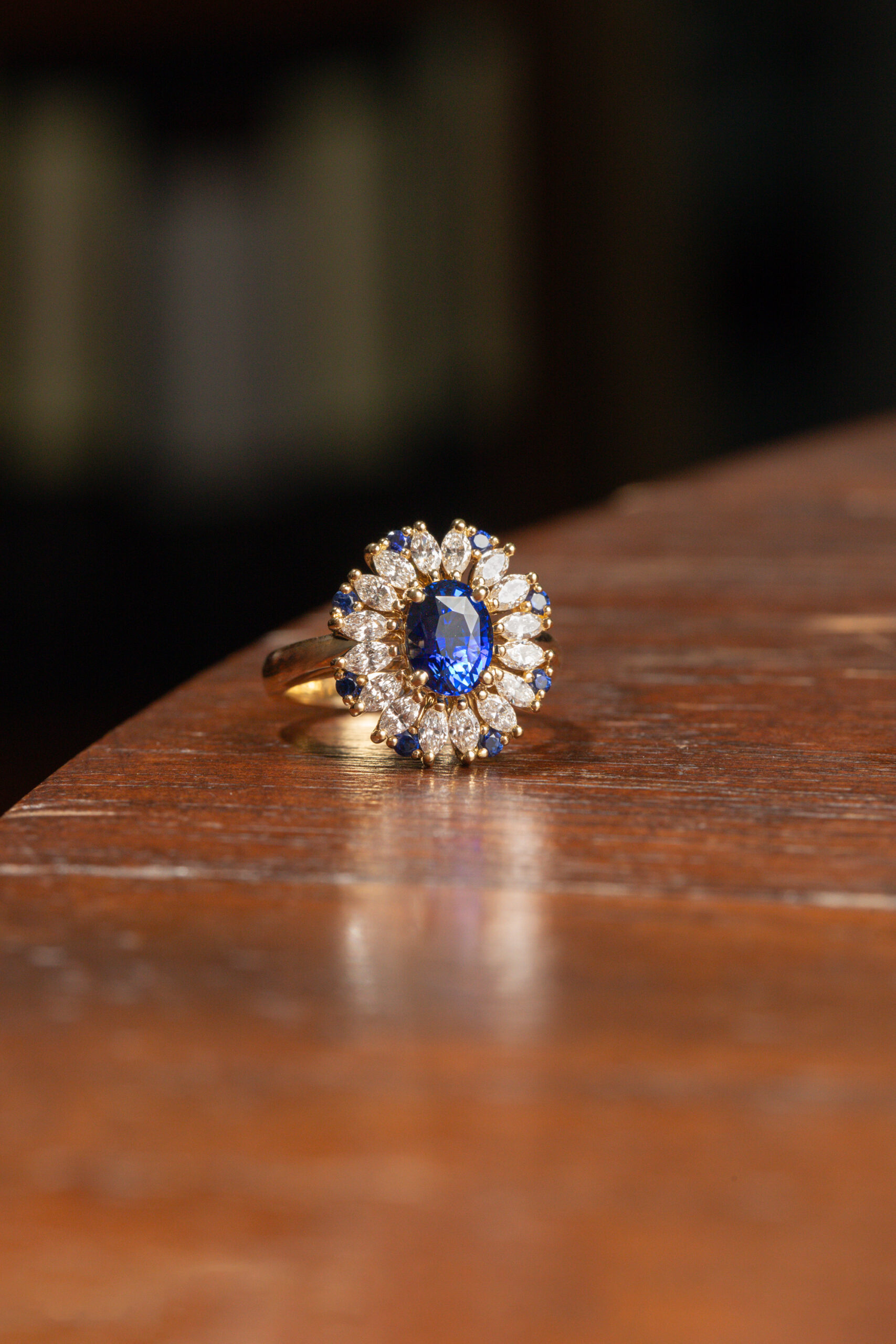
The same blue, magnificently showcased: a 1.72 ct royal blue sapphire encircled by a halo of marquise-cut diamonds, set in yellow gold. A bespoke creation conceived for a client.
Royal blue or cornflower blue, Ceylon or Madagascar: there is no single "best" blue in absolute terms. The most beautiful sapphire is the one whose shade speaks to you, observed in natural light. This guide gives you the keys to compare what is truly comparable — and to pay a fair price for every stone.
The word "sapphire" comes from the Latin sapphirus, itself derived from the Greek sappheiros, which referred to a blue stone. Without any colour qualifier, "sapphire" still means blue by default. It belongs to the same mineral family as the ruby — only colour sets them apart, and here it is the iron-titanium combination that produces the blue.
Its hardness of 9/10 makes it one of the most durable stones in existence, second only to the diamond. In practical terms: it will not scratch on contact with everyday objects, withstands knocks and has no fear of water — a decisive advantage for a blue sapphire engagement ring worn every day, far more so than an emerald, which is considerably more fragile.
Since antiquity, the blue sapphire has symbolised fidelity, wisdom, sincerity and protection. Long worn by kings and clergy, it embodies lasting commitment — hence its place on some of the most celebrated engagement rings in history. It is also the birthstone of September and the gem of the 45th wedding anniversary.
For blue sapphires more than for any other colour, origin leaves a recognisable signature — and weighs heavily in the value. Four major provenances structure the market.
The legend
The most coveted sapphires in the world: a velvety cornflower blue with a slight violet hue and an incomparable brilliance. Production today is negligible, making these stones of extreme rarity and collector status.
The living reference
The principal supplier of high-quality sapphires for centuries. From pale blue to royal blue, with that distinctive velvety brilliance and a characteristic hint of mauve — the hallmark of the "Ceylon blue".
2nd global source
Now the second largest source in the world, the island offers blues that are often more saturated, of a quality comparable to modern Ceylon — and excellent value for money, subject to export moratoria.
The complementary sources
Burma (Mogok) yields intense, luminous royal blues. Australia and Thailand produce darker blues with a high iron content. Montana (United States) rounds out the global picture.
Two terms come up time and again. Royal blue describes a deep, intense, highly saturated blue — the benchmark of great sapphires. Cornflower blue, emblematic of Kashmir, is a lighter, velvety blue with a delicate, slightly violet nuance. Both designations are awarded by laboratories and command a significant premium; between the two, it is entirely a matter of taste.
As with the diamond, the value of a blue sapphire is read through a few key criteria. But unlike the diamond, here colour takes precedence over everything else — with origin coming a close second.
Hue, tone and saturation. The ideal: a vivid, deep blue — neither too dark nor greyish. A greyish or overly dark blue can lose half its value. Colour is the single greatest driver of price.
Sapphires often contain fine natural inclusions (known as "silk") — discreet traces that authenticate the stone. A sapphire that is perfectly "clean" and suspiciously inexpensive should give pause for thought.
A well-proportioned cut brings the blue to life, enhances brilliance and distributes colour evenly across the stone. The cutter must always weigh preserving carat weight against revealing the finest possible hue.
Price rises exponentially with weight: a 3 ct sapphire is worth far more than three times a 1 ct stone. Beyond 2 carats, rarity drives the per-carat price sharply upward.
Every sapphire we offer is accompanied by an independent laboratory certificate (SSEF, GRS, ICA, Bellerophon…) attesting its origin, treatment and characteristics. Our direct sourcing, with no intermediaries, ensures you receive the stone at its true market value.
Heating is an age-old treatment, practised since antiquity at very high temperatures (up to 1,800 °C) to intensify colour and improve clarity. Around 90% of sapphires on the market are heated: this is an internationally accepted standard, and entirely above board provided it is declared on the certificate.
An unheated sapphire ("no heat" or "NH") retains all of its natural characteristics. Rarer by nature, it commands a premium of around 30% for stones between 1 and 2 carats — a premium that can multiply tenfold or more for larger weights and finer colours.
Bonnot Paris offers both options — heated and unheated — always with complete transparency. We do not, however, carry any sapphire treated with beryllium or lead glass, nor any synthetic stone: these contested processes alter the very nature of the gem and have no place in a piece of true distinction.
The price of a blue sapphire varies enormously depending on origin, colour, clarity and treatment. The following benchmarks are expressed as price per carat for a stone of fine quality.
At the very top of the market, Kashmir sapphires trade at several tens of thousands of euros per carat. By way of illustration, a 27-carat Kashmir blue sapphire sold for nearly 2.1 million euros at auction in 2021 — a figure that speaks to the extraordinary rarity of the finest stones.
Through our direct sourcing from Sri Lanka and Bangkok, you pay the true value of the stone — not the successive margins of three or four intermediaries. For any given budget, you gain access to a quality that typically surpasses what traditional retailers can offer.
Several blue gemstones can be mistaken for sapphire. Some are beautiful stones in their own right — yet none matches its hardness or rarity. Here is how to tell them apart.
| Stone | What sets it apart | Hardness |
|---|---|---|
| Blue sapphire | Corundum The most noble blue, exceptional rarity and outstanding hardness. | 9 / 10 |
| Tanzanite | Intense blue-violet yet far softer and more fragile, and found nowhere else on earth (Tanzania). Less suited to everyday wear. | 6 – 7 |
| Blue spinel | Often natural and unheated, with a more steely or greyish blue. A fine alternative, and rarer in jewellery. | 8 / 10 |
| Aquamarine | A clear, fresh and luminous blue, on the softer side. Accessible, yet less saturated in colour and less hard than sapphire. | 7.5 – 8 |

The modern shade
For those who love sapphire but seek a more singular hue: a blue-green between ocean and lagoon, the rising star of contemporary jewellery — also available as a teal sapphire engagement ring.

The pink-orange rarity
The other great fancy sapphire: a delicate and exceptionally rare pink-orange, among the most coveted hues in the world, for those wishing to step beyond blue — also available as a padparadscha sapphire engagement ring.
Timeless by nature, the blue sapphire lends itself to every style — from the purest solitaire to the most elaborate halo setting. Here are four directions drawn from bespoke creations, to help you imagine your own. Browse all our designs in the blue sapphire engagement ring collection.
An oval sapphire encircled by a rosette of marquise-cut diamonds, set in yellow gold. Romantic and radiant, a style that lets the centre stone truly bloom.
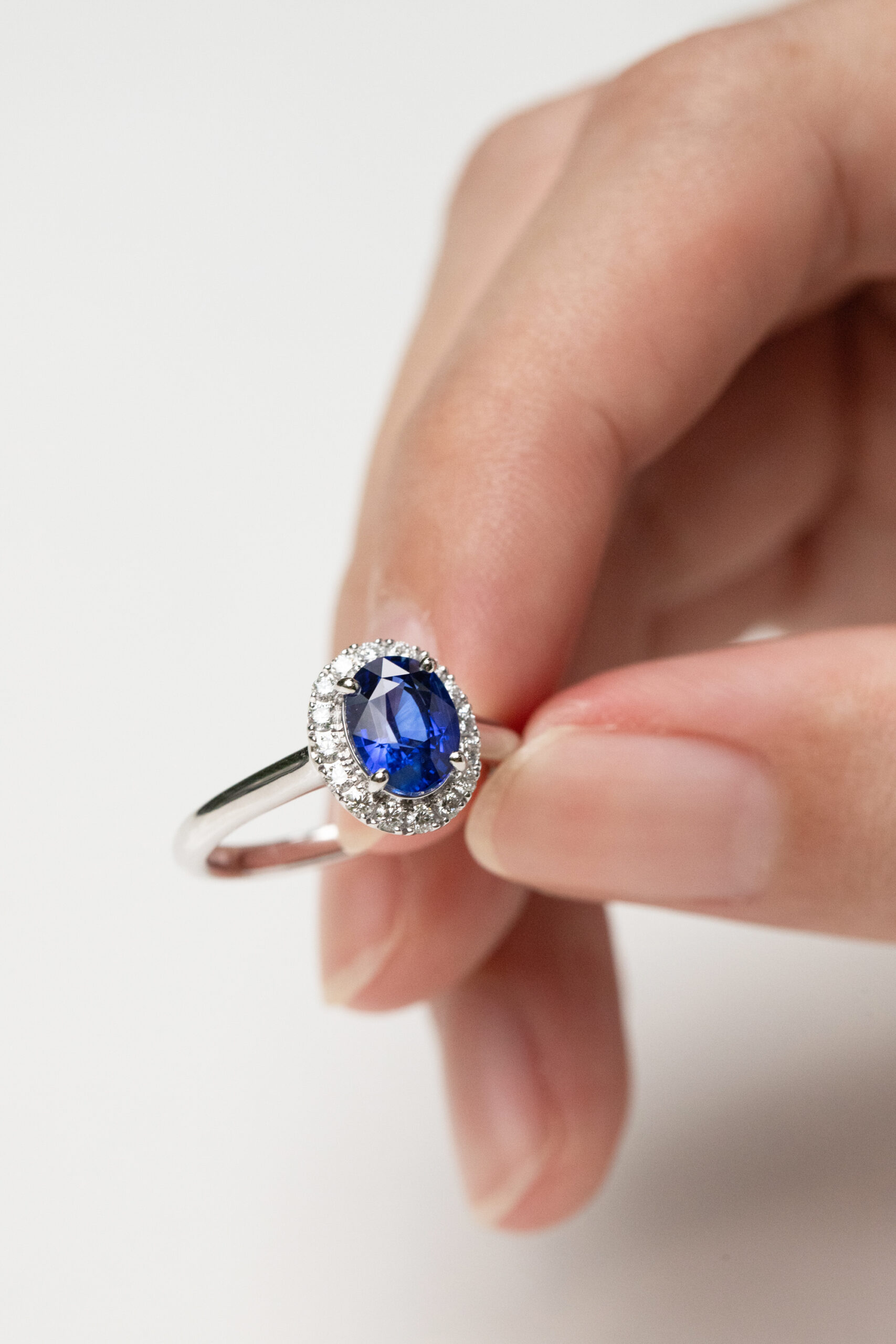
The stone alone, set in platinum, in complete purity. A Sri Lankan blue given full presence, undistracted. Timeless and refined.
A warm and contemporary contrast: the deep blue of the sapphire softened by the warmth of rose gold. Elegant and very much of the moment.
For purists: a wholly natural, unheated blue sapphire, set with quiet restraint so the stone speaks for itself.
Each of these rings is a one-of-a-kind piece, individually made around a directly sourced stone. You are welcome to draw inspiration from them when imagining your own: we capture the spirit of a design without ever reproducing it exactly. Discover bespoke creation →
It is the most iconic variety of the sapphire, belonging to the same mineral family as ruby. Its blue colour comes from iron and titanium. With a hardness of 9/10, it ranks among the most durable stones in existence, second only to diamond, and ranges in shade from sky blue to royal blue.
Since antiquity, it has stood for fidelity, wisdom and sincerity. Long associated with royalty, it embodies lasting commitment — a powerful message for a blue sapphire engagement ring. It is also the birthstone for September and the gem of the 45th wedding anniversary.
Kashmir (velvety cornflower blue) remains the most prized origin, though production there is now negligible. Sri Lanka (Ceylon) is the leading source of top-quality stones, and Madagascar the second largest source worldwide. Burma, Australia and Montana round out the major origins. Bonnot Paris sources directly through its offices in Sri Lanka and Bangkok.
Royal blue is a deep, intense and saturated blue — the benchmark of great sapphires. Cornflower blue is lighter and velvety, with a delicate violet undertone, emblematic of Kashmir. Both are highly sought after and command premium prices; the choice comes down to personal taste.
Expect roughly €800 to €1,500 per carat for a good-quality heated blue sapphire (~1 ct), €1,500 to €4,000 per carat for a fine royal blue or cornflower blue between 1 and 2 carats, and €5,000 to €20,000 per carat (and well beyond) for a gem-quality unheated stone. Kashmir is in a category of its own.
Heat treatment enhances colour and transparency: around 90% of sapphires are heated, an accepted and widely recognised standard. An unheated sapphire retains its entirely natural characteristics and commands roughly 30% more in value (considerably more at larger weights). Bonnot Paris offers both and excludes all beryllium and lead-glass treatments.
Partagez ce post
Découvrez d'autres articles qui peuvent vous intéresser pour approfondir votre passion pour la joaillerie !
View all