Zambian or Colombian Emerald?
Bonnot Paris22/9/2026



The sapphire marks sixteen years and embodies constancy; the ruby marks thirty-five and embodies ardour. Yet they are exactly the same mineral — corundum —, separated only by their concentration of chromium. Thirty-five years on, the red version of the stone of fidelity is celebrated.
This article explains what the ruby represents, what a ring really costs, where stones come from today, and what to check before buying — because it is the most treated gemstone on the market.
The red of the ruby has always been associated with blood, and therefore with life, courage and passion. It was found on armour and crowns long before it was found on rings: it was a warrior’s stone before becoming a lover’s stone.
What makes the association interesting, at thirty-five years, is that it is not self-evident. One might have expected a stone of endurance — and it is the stone of intensity that arrives. After thirty-five years, celebrating ardour rather than constancy says something truer than yet another symbol of permanence.
To place this thirty-fifth year among the anniversaries associated with a gemstone — the only ones that truly concern us.
| Year | Anniversary | What it offers |
|---|---|---|
| 16 years | Sapphire | Ten colours, hardness 9, the deepest supply. |
| 20 years | Porcelain | Not a gemstone: the choice remains entirely open. |
| 26 years | Jade | A stone we do not work with. |
| 35 years | Ruby | Red corundum, the rarest of the four precious stones. |
| 40 years | Emerald | The green of beryl; a protective setting should be considered. |
If you come across this list for a more distant anniversary, note that sapphire anniversaries, at 16 years of marriage, follow exactly the same logic — and offer ten colours where ruby offers only one.
Three directions, depending on what you are looking for and what she already wears.
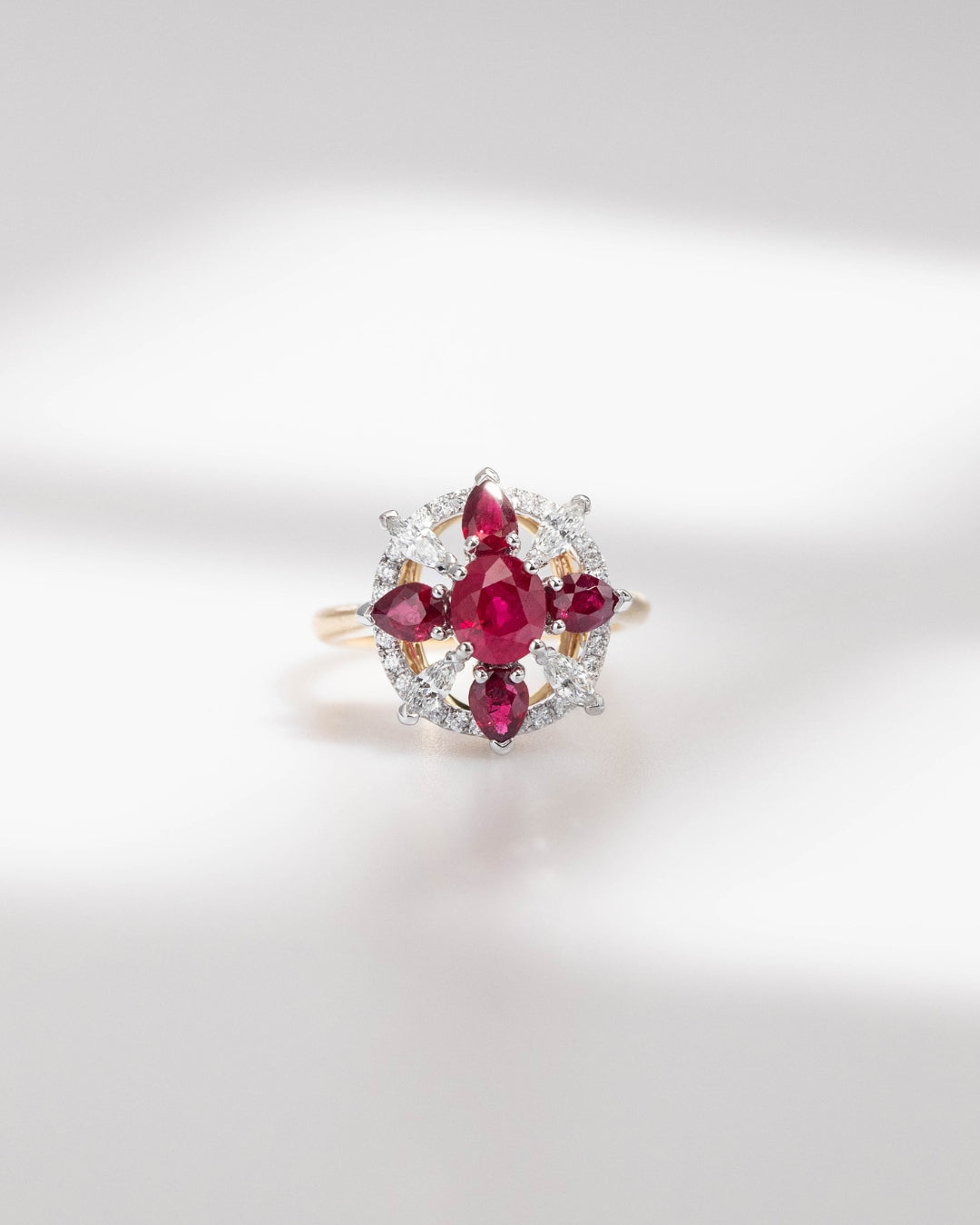
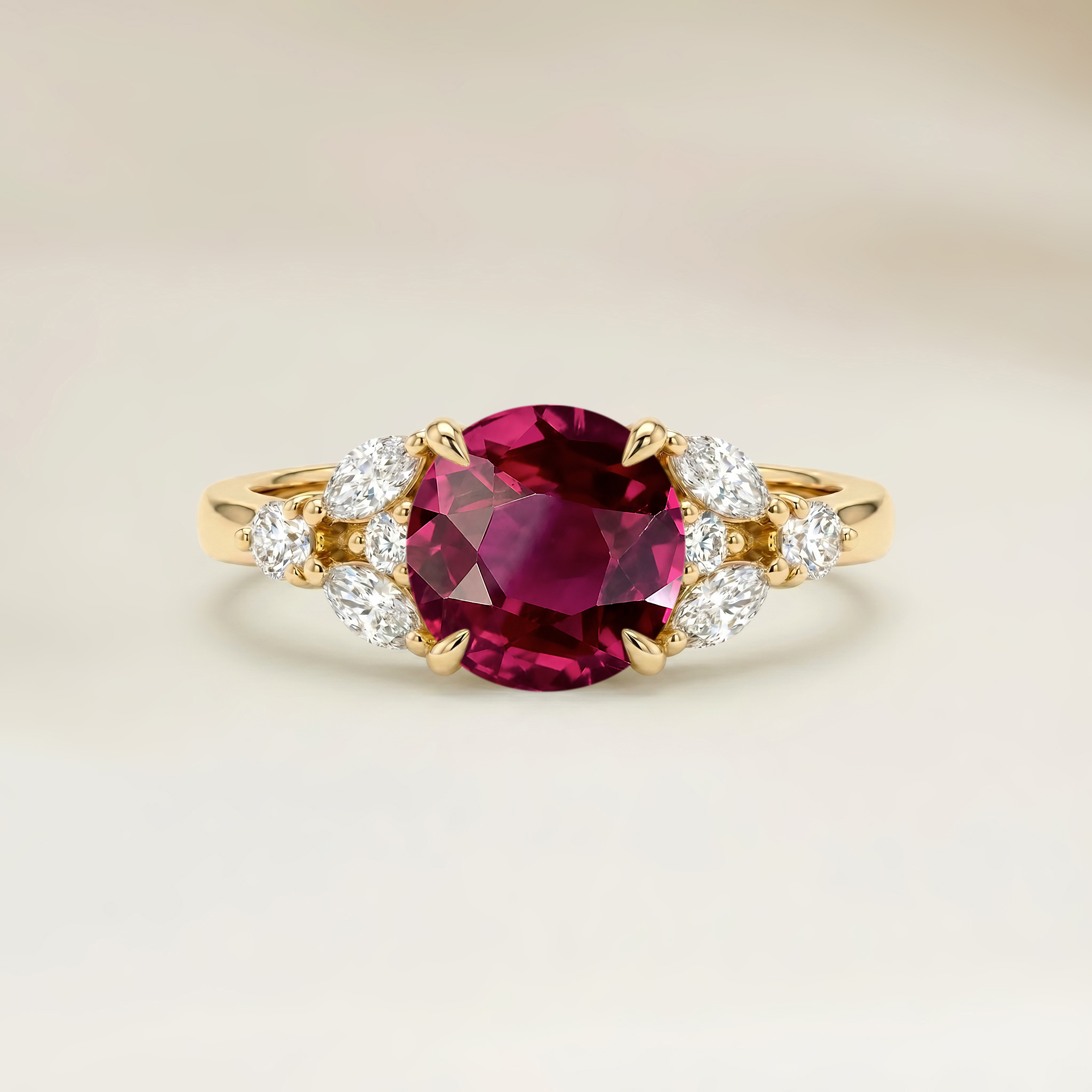
The central stone. The most classic, and most costly, gesture: a ruby engagement ring — it is from this collection that we draw, as settings do not change according to the occasion — built around a one- to two-carat ruby. Allow from €8,000.
The composition. Several smaller rubies, set in a cluster or daisy design. For a given budget, the result is more spectacular on the finger than a single central stone — and it does not compete with the engagement ring she already wears.
Remodelling. Thirty-five years of daily wear is when the setting begins to show its age while the stone remains intact. Reworking the original ring costs the price of the setting alone, and it is often the most meaningful project.
If she already wears a solitaire, avoid offering a second, larger one: a difference in shape tells of a new chapter, a difference in size tells of catching up. A composition, another hand, another finger — difference is better than escalation.
A corundum coloured red by chromium. The same formula as a sapphire, the same hardness of 9 out of 10, no cleavage planes, sometimes from the same deposit — only the concentration of chromium separates them, and the tipping point is debated between laboratories.
The practical consequence: everything said about a sapphire’s resistance applies word for word to a ruby. A ruby ring can be worn for thirty years without any particular precautions, with only diamond performing better on the Mohs scale.
The commercial consequence, however: ruby is the rarest of the four precious stones beyond two carats, and that is what explains the difference in starting price. All our certified natural rubies come with an independent laboratory report, with their characteristics and prices published online.
| Creation set with stones from | Stone | Why this difference |
|---|---|---|
| 1 700 € | Emerald | Less dense: at the same weight, it appears larger. |
| 2 500 € | Sapphire | Ten colours, active deposits, deep supply. |
| 8 000 € | Ruby | The rarest of the four beyond two carats. |
Ruby geography shifted some fifteen years ago, and many people still do not know it.
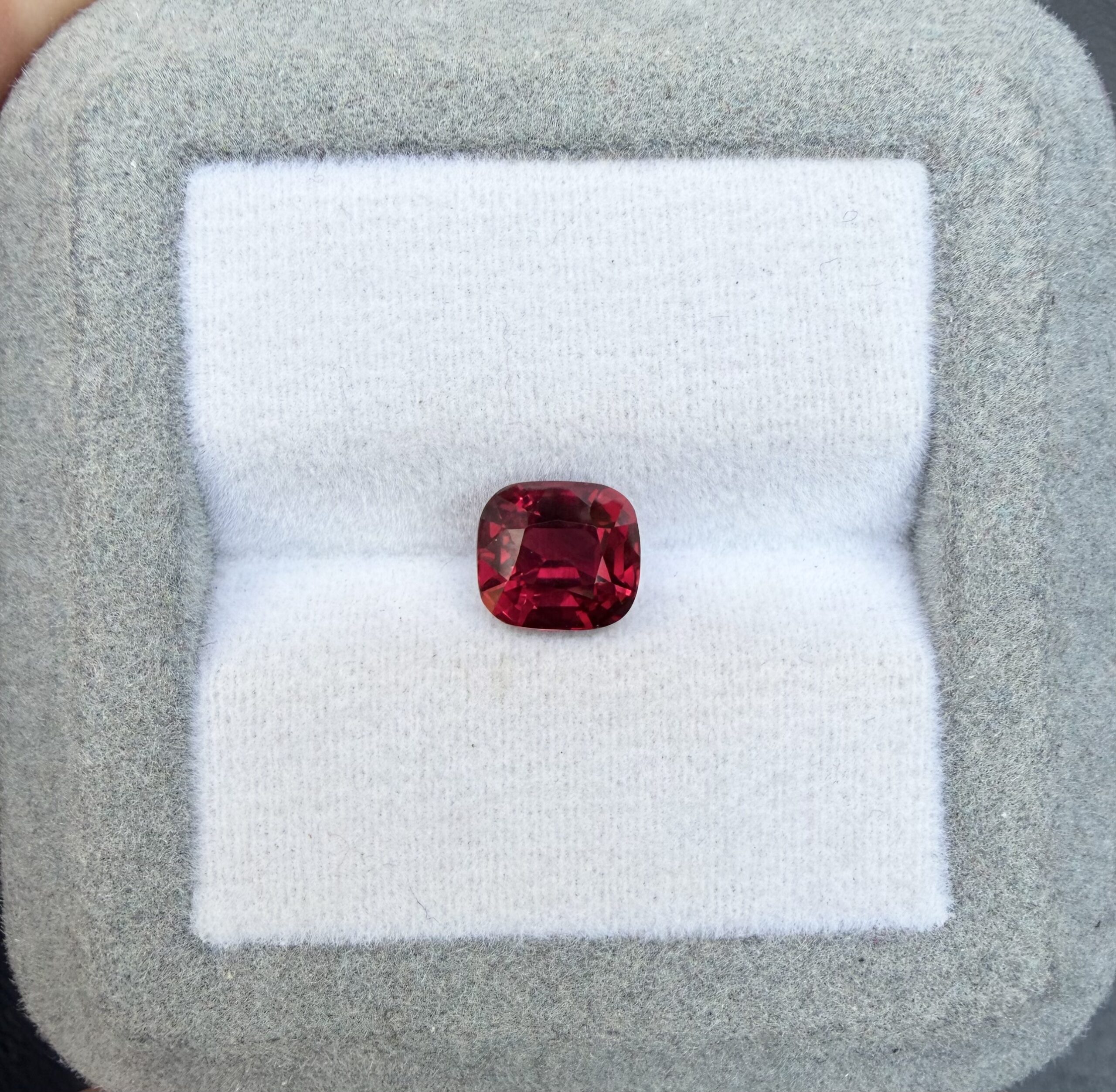
The Burma retains its historic prestige, that of the stones from the Mogok Valley that made the gem's reputation. But these stones are rare on the market, and their sourcing is subject to constraints that make traceability difficult.
Most of the beautiful stones available today come from Mozambique. Our Mozambique rubies range from one and a half to two and a half carats, in pure reds, with certificates documenting their treatments.
And as always: origin explains character, never quality. A beautiful Mozambique stone surpasses an average Burmese stone, whatever story accompanies it.
Ruby is the most imitated and most treated gemstone on the market. Three checks are essential, in this order.
A pure red, without brown or orange undertones, that holds in the evening. This accounts for most of its value.
Heating is accepted and disclosed. Lead-glass filling is not: it changes everything in terms of value.
Natural or synthetic. Ruby has been produced industrially since the beginning of the 20thcentury century.
In millimetres, not carats. Corundum is dense: at the same weight, it appears smaller.
Lead-glass treatment warrants a particular warning. Heavily fractured stones, impregnated with glass to make them visually presentable, have been widely available since the 2000s. Their value bears no comparison with that of a simply heated ruby — and they are unusually fragile: no ultrasonic cleaning, heat or acidic products. For full details on criteria, origins and price ranges, our ruby guide takes over from this section.
A project is better than a sales pitch. This one began with a simple request: a red stone.
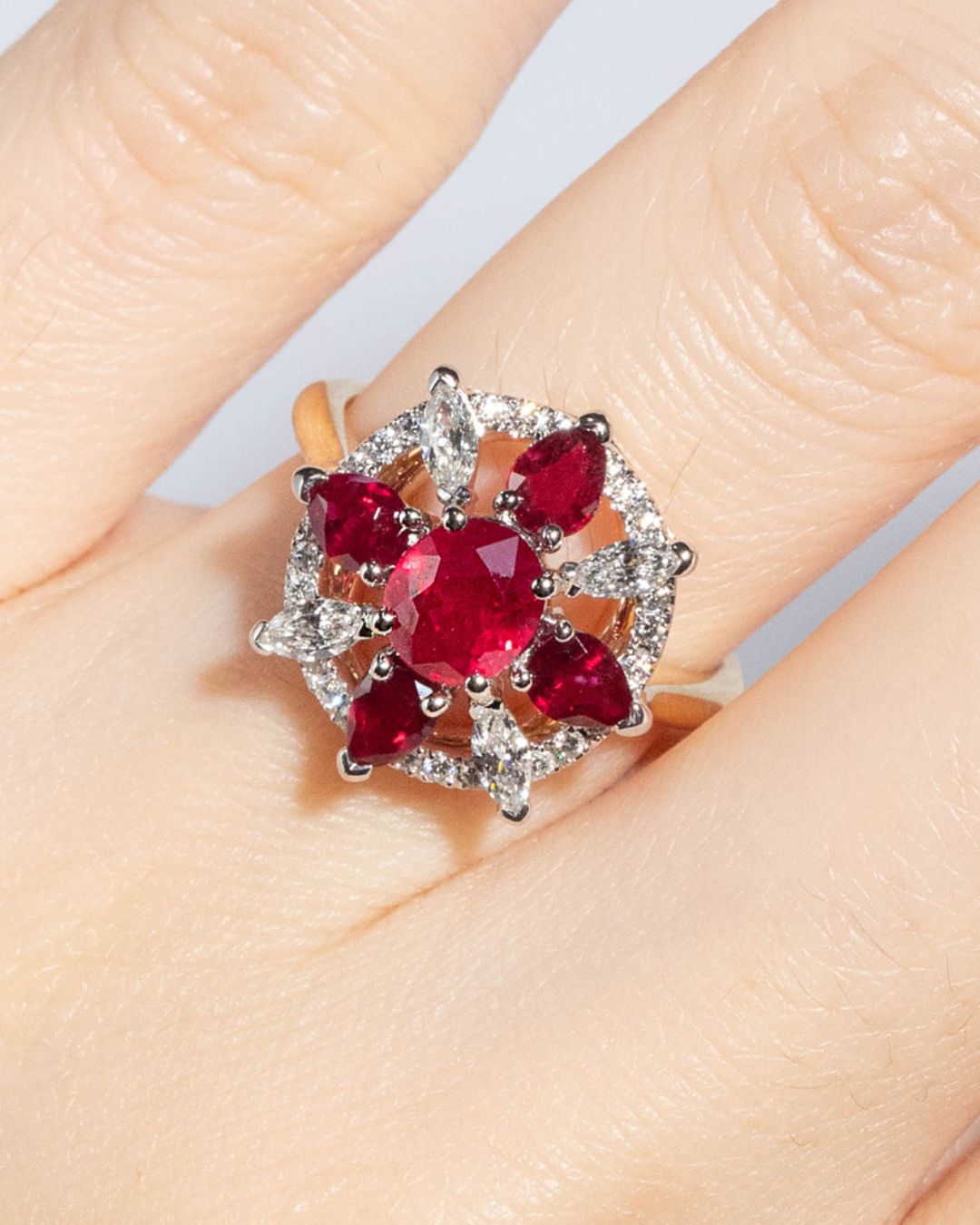
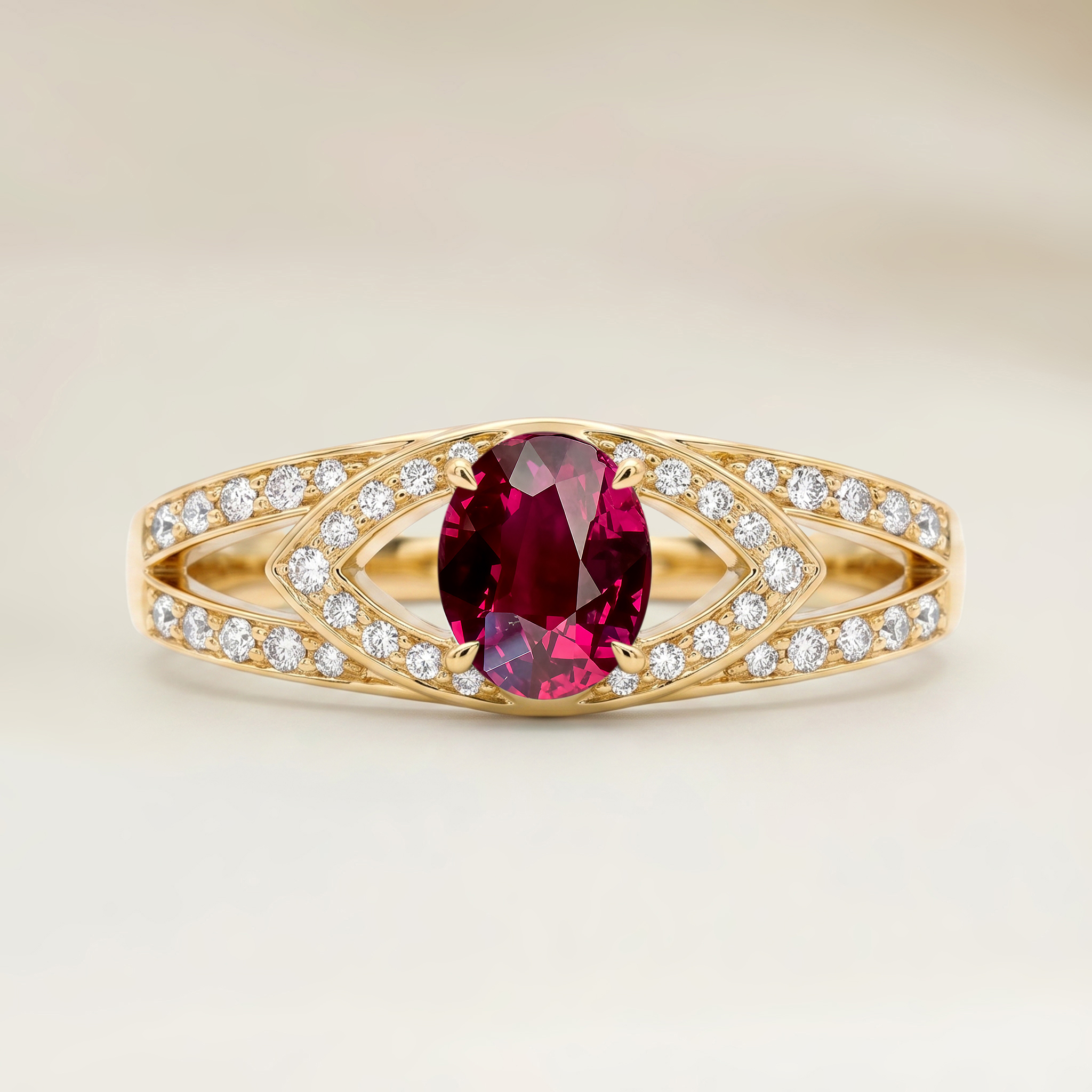
Arthur contacted us for a ring set with a red stone, with no fixed idea as to the gem. We recommended ruby — one of our favourite stones — then sourced the stone and designed the platinum setting around it.
This is the order we advocate for every project: the stone first, the design afterwards. The setting is adapted to the gem’s actual dimensions, never the other way around. Allow six to eight weeks between the first appointment and delivery of the jewel.
Thirty-five years of marriage. In the French nomenclature, each year is associated with a material or a stone: sapphire at sixteen years, porcelain at twenty, emerald at forty. Ruby, the stone of passion, falls at thirty-five years.
Passion, ardour and courage — the opposite symbolism to that of sapphire, which represents constancy, although they are the same mineral. Celebrating thirty-five years with the stone of ardour rather than that of wisdom: the nomenclature has its reasons.
Our set creations start at around €8,000, compared with €2,500 for sapphire and €1,700 for emerald. This difference is explained by genuine rarity: above two carats, a ruby of fine colour is the most difficult to find of the four major gemstones.
Mainly from Mozambique, which has supplied the majority of fine stones for around fifteen years. Burma retains its historical prestige, but its stones are rare and subject to sourcing constraints. A fine Mozambique stone surpasses an average Burmese stone.
Yes, and at thirty-five, it is often the most fitting project: the setting has aged, while the stone remains intact. We examine the gem, take its exact measurements and design a new setting around it. The cost is limited to the setting.
Yes, without reservation: hardness of 9 on the Mohs scale, excellent toughness, no cleavage planes. Only diamond performs better. A setting check every two years is sufficient.
Three points: its nature — natural or synthetic —, any treatments it has undergone, in particular the absence of lead-glass filling, and its origin where the laboratory is able to determine it.
Share this post