Red spinel or ruby?
Bonnot Paris22/9/2026
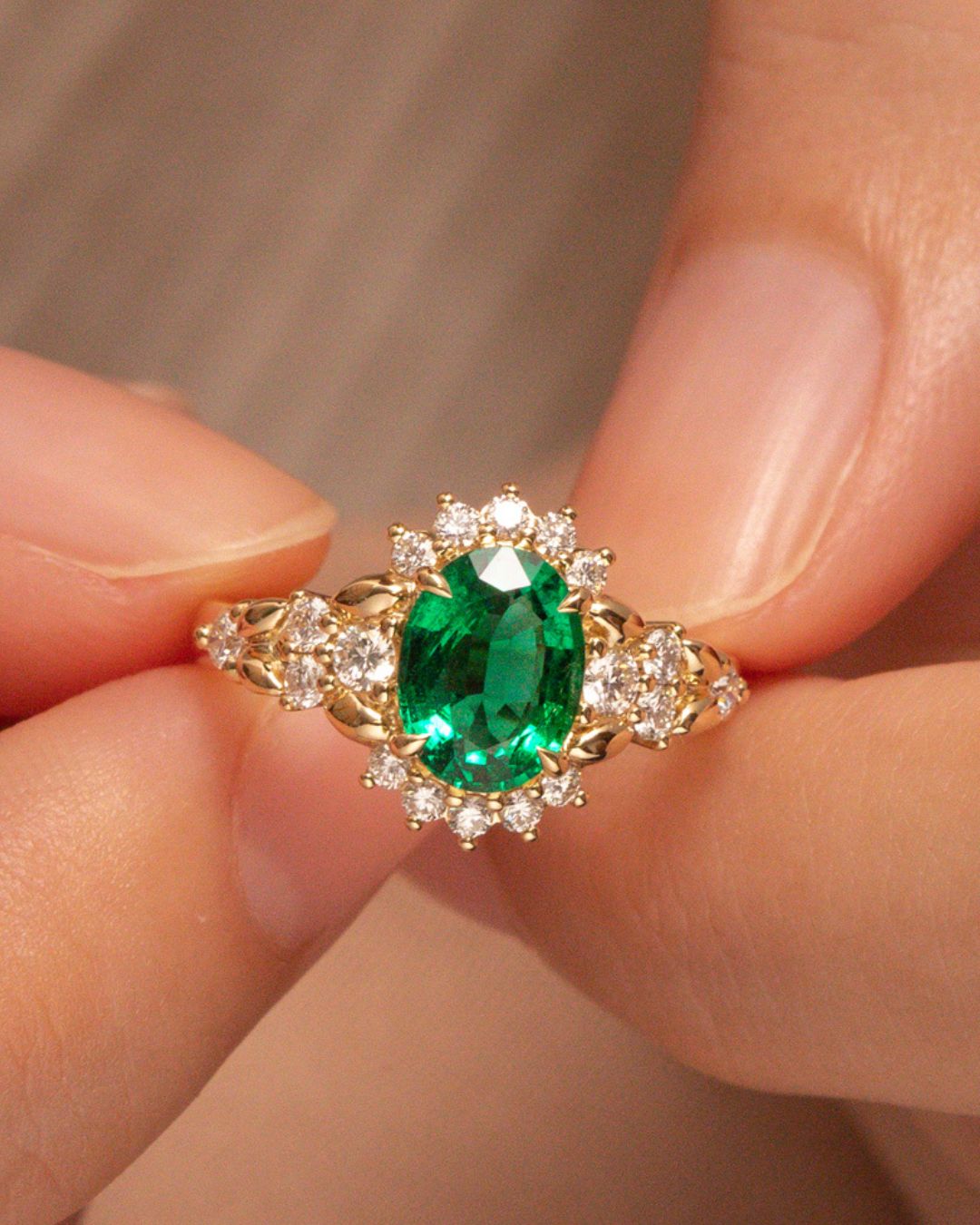



The natural emeralds on the market come primarily from three countries: Colombia, Zambia and Brazil. The first two dominate fine jewellery, and they embody two different ideas of green.
This comparison sets out what distinguishes them — colour, inclusions, geology, price — before recalling the rule that takes precedence over all others: origin explains a character, never a quality.
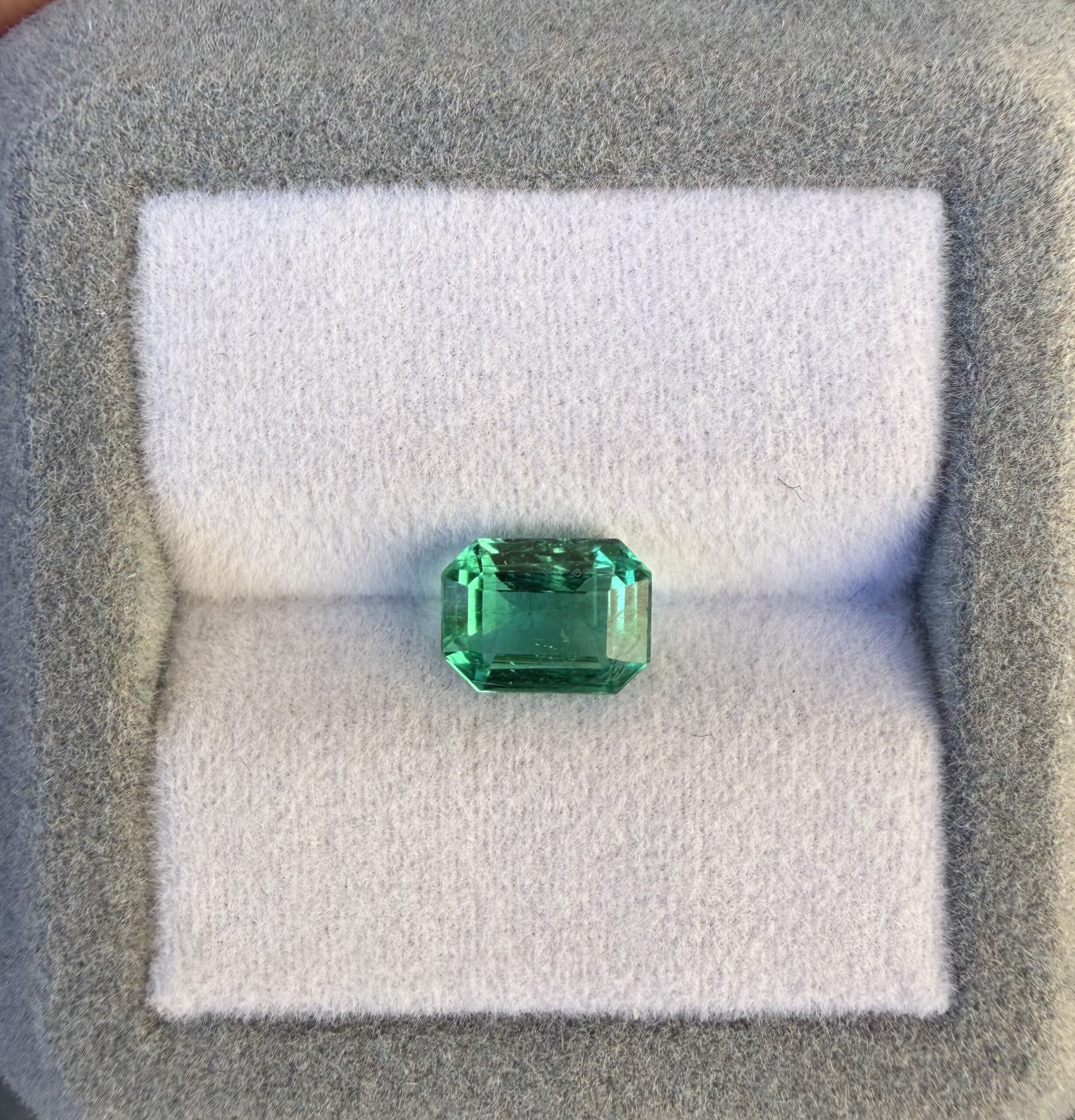
An emerald is a beryl coloured green by traces of chromium, sometimes vanadium. To form, it requires the coming together of two ingredients that almost never meet in nature: beryllium, found in certain granitic rocks, and chromium, which comes from very different rocks. It is this unlikely encounter that makes the emerald rare.
Colombia Colombia is an exception to every rule. Its emeralds formed in sedimentary black shales, through the circulation of hot fluids — a geological setting found virtually nowhere else.
Zambia Zambia follows the more common pattern: a metamorphicsetting, at the contact of pegmatite veins and rocks rich in chromium and iron. This is what iron, more abundant, which makes all the difference to the colour.
The mines of Muzo, Chivor and Coscuez have supplied Europe since the 16thth century, when the conquistadors discovered deposits that had been worked long before their arrival. The emeralds of the Mughals, and those in the Spanish royal treasures, already came from there.
Green. Coloured by chromium and vanadium, with very little iron: a pure, warm and luminousgreen, sometimes slightly yellow. The low iron content also allows a red fluorescence to emerge, seeming to “light up” the stone from within — this is what gives fine Colombian emeralds their distinctive brilliance.
The garden. Colombian emeralds are renowned for their three-phase inclusions : tiny cavities with jagged edges containing a liquid, a gas bubble and a salt crystal. On average, they are more included than Zambian emeralds, and therefore more often oiled.
We have no Colombian emeralds on display today — our selection is Zambian. This is why this section is not illustrated with any photographs: we prefer to show nothing rather than pass off a Zambian stone as a Colombian one. At our house, a Colombian emerald is sourced through a dedicated search.
In just a few decades, Zambia has become one of the world’s leading producers, with the mining belt of Kafubu and the Kagemmine, among the largest emerald operations in the world.
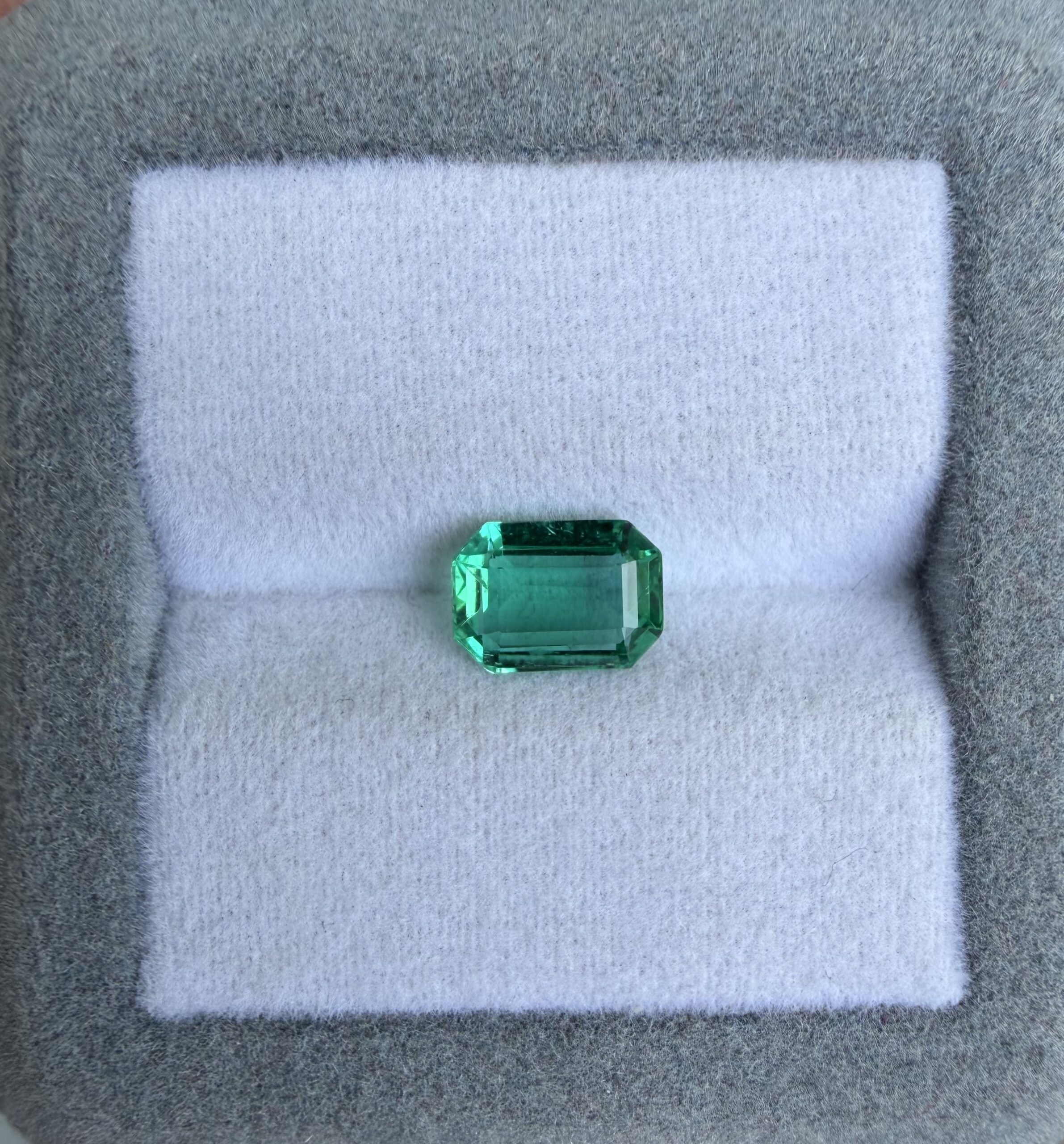
Green. More iron than in Colombian emeralds, resulting in a deeper, slightly bluishgreen, sometimes darker. This iron also dulls fluorescence: a Zambian emerald does not “light up” like a Colombian one, but it retains its colour more consistently in all lighting.
The garden. Zambian emeralds are, on average, cleaner, with characteristic inclusions of mica flakes and fine needles. They tend to be less fractured, generally require less oiling—the two origins are both commonly oiled—and are better suited to step cuts, which require transparency.
This is the selection we have made. Our Zambian emeralds are purchased in Jaipur, where they are cut, and selected for their consistent colour and transparency.
| Colombia | Zambia | |
|---|---|---|
| Geology | Sedimentary, black schists | Metamorphic, pegmatite contact |
| Colouring agents | Chromium, vanadium, little iron | Chromium, more iron |
| Colour | Pure, warm green, sometimes yellow | Deep green, slightly bluish |
| Fluorescence | Often visible | Quenched by iron |
| Typical inclusions | Three-phase, jagged cavities | Mica flakes |
| Oiling | More significant on average | Lighter on average |
| Hardness | 7,5 – 8 | 7,5 – 8 |
| Price | Origin premium | Better value for money |
One line deserves closer attention: hardness. It is exactly the same. Origin makes no difference to an emerald’s resistance, nor to the setting it requires.
Colombian origin carries a price premium, often significant for comparable visual quality. It rests on three factors: a warm green that the market ranks at the very top, five centuries of history supporting demand, and more limited production than Zambia’s.
For Zambia, we can provide precise figures, as these are from our own stock in September 2026:
| Weight | Price per carat |
|---|---|
| 1 to 1.35 ct | €2,090 to €6,940/ct |
| 1.4 to 1.75 ct | €2,070 to €5,420/ct |
| 2 ct and above | €3,200 to €6,100/ct |
Zambian emeralds in stock, September 2026, prices including VAT. We do not publish figures for Colombia: we have none on display, and we do not quote prices we do not charge.
Look at the range within each row: from one to three times the price, at the same weight. This difference does not come from origin, but from the vibrancy of the green and the degree of oiling. A detailed breakdown of what determines the price of an emerald, bracket by bracket, can be found in our dedicated guide.
says. An emerald’s origin cannot be guessed by eye—it must be demonstrated. An independent laboratory cross-references two types of evidence: inclusions, observed under a microscope, andchemical analysis of trace elements, which reveals the source rock.
In most cases, it reaches a conclusion. When the evidence is insufficient, the report states “origin undetermined” —which is not a flaw in the stone, merely a limitation of the measurement.
An emerald sold as “Colombian” without a laboratory report is Colombian only on the seller’s word. Given the premium attached to this origin, this is precisely the kind of statement that should be set down in writing by an independent third party.
For a ring, both origins require exactly the same thing: a setting that protects the edges of a stone rated 7.5–8 on the Mohs scale, often with inclusions. An emerald engagement ring is therefore designed in the same way, whatever its provenance—a bezel setting or a low setting, decided at the design stage.
| What you are looking for | Our answer |
|---|---|
| Warm green and the stone’s history | Colombia. By dedicated sourcing, with an origin report. |
| A deep green and beautiful transparency | Zambia. Cleaner on average, less oiled. |
| The best value for money | Zambia. No origin premium to pay. |
| Impeccable step cutting | Zambia. Its transparency is better suited to it. |
And if the green matters more than the emerald itself, another family is worth considering: a green garnet, even more transparent and never treated. We compare the two in our article emerald or tsavorite.
First, the colour: pure, warm greens in Colombia, coloured by chromium and vanadium with very little iron; deeper, slightly bluish greens in Zambia. Then the geology, sedimentary on one side, metamorphic on the other. And the inclusions, which allow a laboratory to identify the origin.
More prestigious, but not inherently better. A fine Zambian stone surpasses an average Colombian stone: quality is judged stone by stone, not by country.
A warm green that the market places at the very top, five centuries of history supporting demand, and more limited production. At comparable visual quality, Colombian origin is generally significantly more expensive.
On average, yes, and they generally require less significant oiling. This is not an absolute rule: each stone is judged individually.
A laboratory can usually do so by combining inclusion analysis and chemical analysis. When the evidence is insufficient, the report states “origin undetermined” — this is not a flaw in the stone.
Our current selection is Zambian, purchased in Jaipur. A Colombian emerald is sourced by us through dedicated research, with the lead time this entails.
Both have the same hardness and require the same protective setting. The choice comes down to colour and budget: the warm green and history of Colombia, or the deep green, transparency and best value for money of Zambia.
Share this post