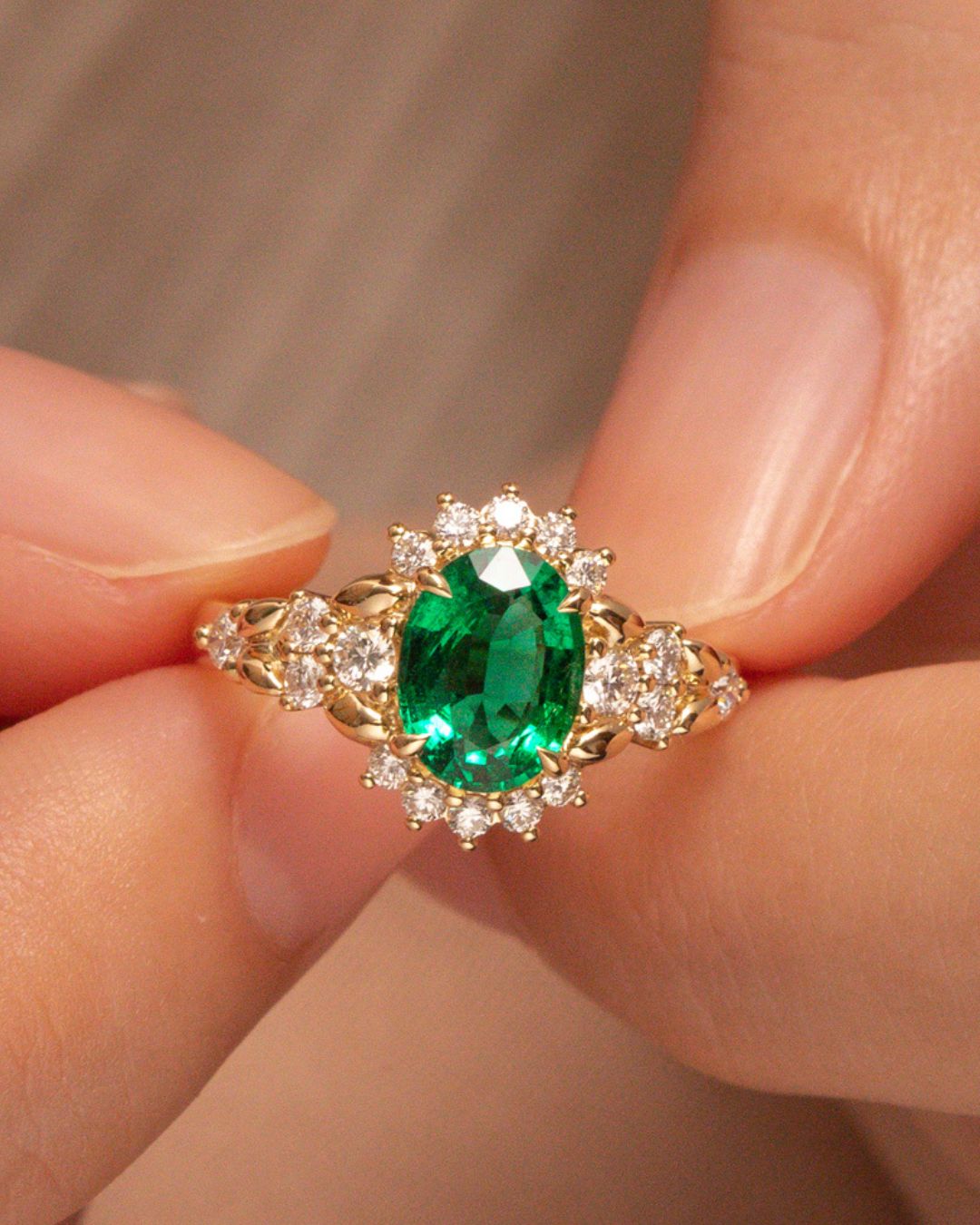
Zambian or Colombian Emerald?
Bonnot Paris22/9/2026
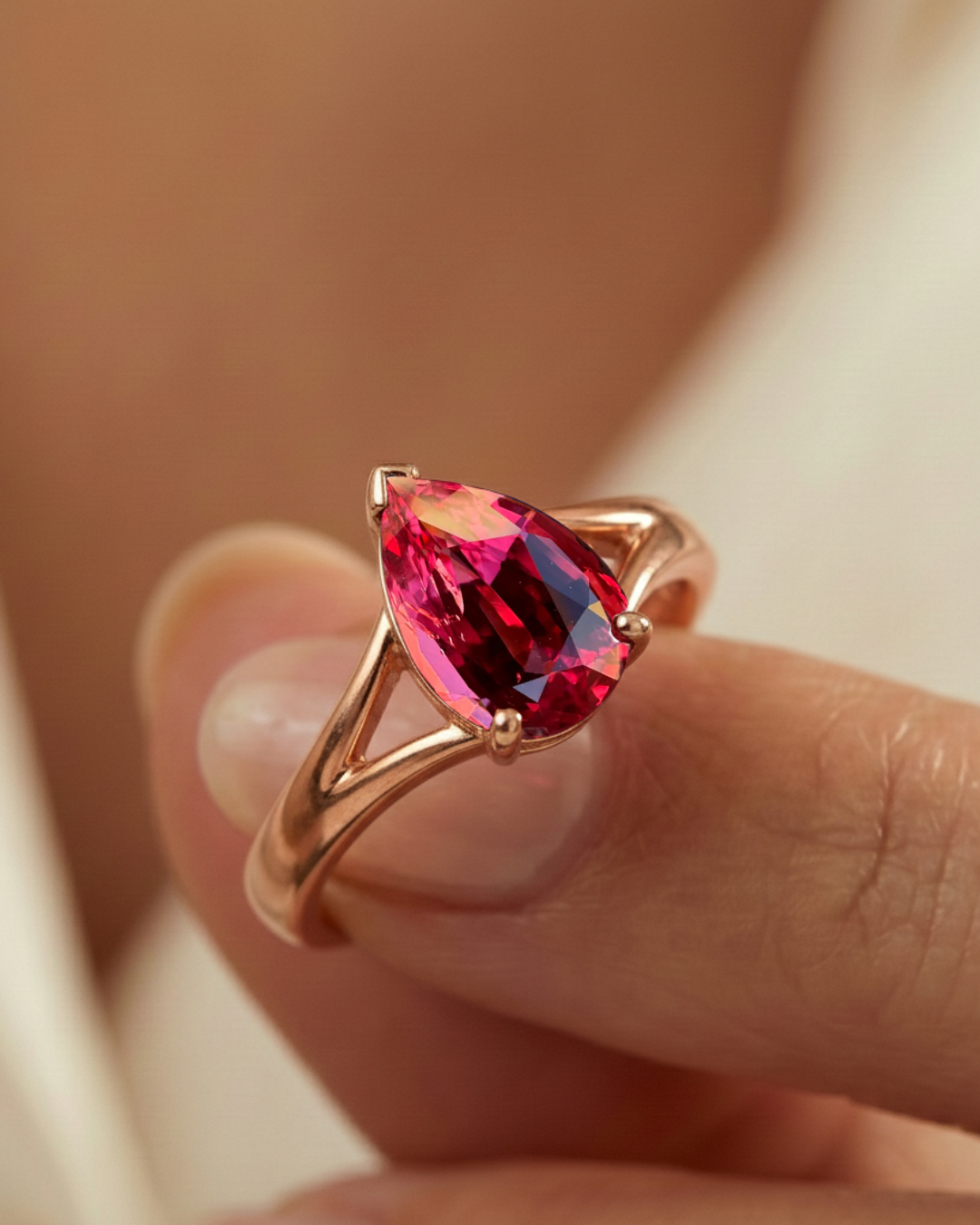



The ruby and red spinel resemble each other closely enough to have deceived Europe’s finest jewellers for centuries. They share the same colouring agent, chromium, and sometimes the same deposits. Yet they do not have the same hardness, the same commercial history, or the same price.
This comparison does not seek to name a winner: both are very beautiful stones. It explains what sets them apart, what each truly costs, and for which project one is more appropriate than the other.

Until the end of the 18thth century, red stones were not distinguished by their mineral species, but by their colour. Everything red and precious was called ruby — or “balas”, after a region of Central Asia from which many spinels came.
It took the emergence of mineralogy to distinguish the two species. In the meantime, several of Europe’s most famous stones had been called rubies: the Black Prince’s Ruby, set in the British Imperial Crown, the Timur Ruby from the Royal Collection, or the Côte-de-Bretagne kept at the Louvre. All are spinels.
This history tells today’s buyer one useful thing: spinel is not a substitute for ruby. It is a stone that sovereigns chose for its beauty, without even knowing that it was another one.
| Ruby | Red spinel | |
|---|---|---|
| Species | Corundum | Spinel |
| Colouring agent | Chromium | Chromium |
| Mohs hardness | 9 | 8 |
| Optics | Birefringent, dichroic | Isotropic, a single hue |
| Common treatment | Heating, very common | Rarely |
| Median price per carat | ≈ 17 000 € | ≈ 4 900 € |
| Everyday wear | Without reservation | Without reservation |
Prices per carat recorded from our stock in September 2026, including VAT.
Two lines almost always determine the choice: the price and the treatment. As for durability, however, the difference is negligible for a piece of jewellery — both can be worn on the finger every day.
To the naked eye, nothing is reliable. Place them side by side and you will see two reds; perhaps one warmer red, another more pinkish, but no rule makes it possible to tell which is which.
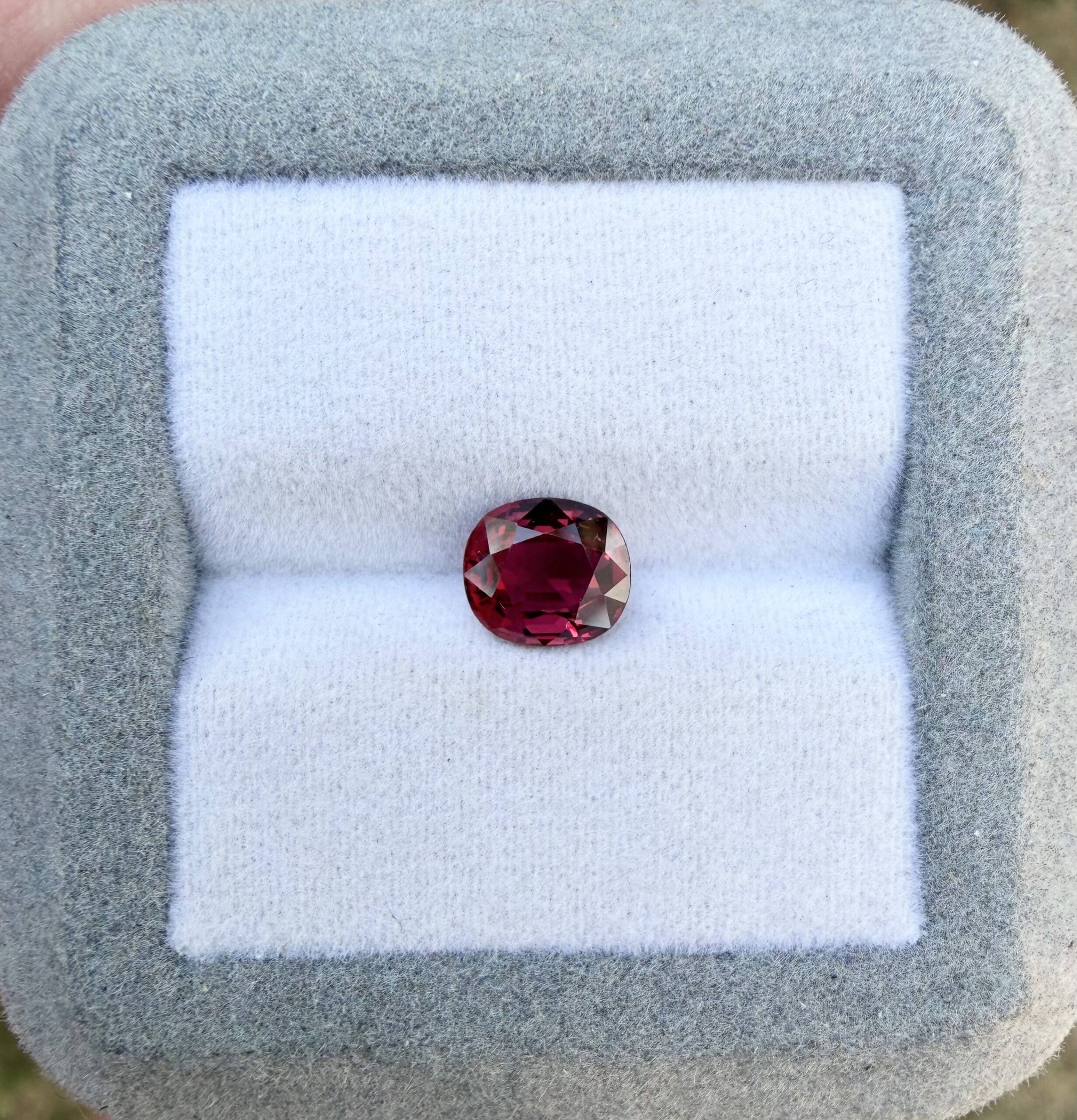
Birefringent: viewed from two angles, it reveals two slightly different shades of red. Mozambique ruby — 30 060 €.
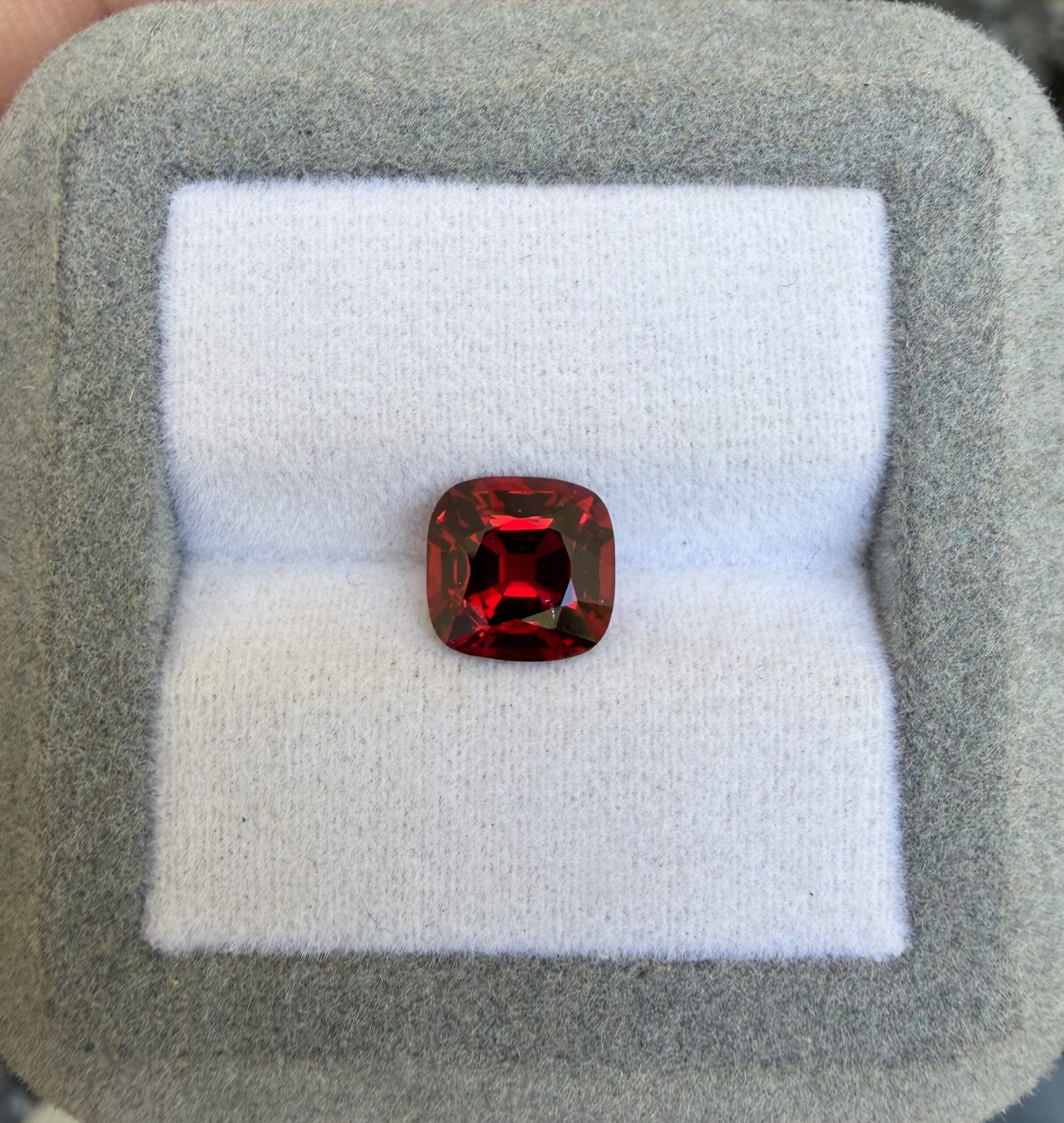
Isotropic: the same colour from every angle. Larger than the ruby opposite, for less than half its price. Red cushion — 11 700 €.
The real difference is optical. Ruby is birefringent, and therefore dichroic : it displays two shades depending on the axis from which it is viewed. Spinel is isotropic and displays only one. A dichroscope — a small pocket instrument — settles the question in seconds; a refractometer confirms.
Inclusions also help a trained eye: fine interwoven rutile needles, the silk, point towards ruby; tiny octahedron-shaped crystals point towards spinel. For a valuable stone, it is the laboratory report that is definitive. Fluorescence, however, settles nothing: both stones fluoresce red under ultraviolet light.
This is where the gap becomes spectacular. In our stock in September 2026:
| Stone | Weight | Price | Price per carat |
|---|---|---|---|
| Red spinel, emerald cut | 1.09 ct | 2 940 € | €2,700/ct |
| Red spinel, cushion cut | 2.24 ct | 13 116 € | €5,855/ct |
| Red spinel, cushion cut | 2.39 ct | 11 700 € | €4,895/ct |
| Ruby, median | 1.5 to 2.5 ct | — | ≈ €17,000/ct |
Three red spinels and six Mozambican rubies in stock. Prices include VAT.
The ratio is approximately one to three and a half. In other words, for the price of a 1.5-carat ruby, one can afford a considerably larger red spinel — or a spinel of the same size and an entirely bespoke setting. In our own display, the 2.39 ct spinel costs less than half the price of the 1.53 ct ruby.
What this figure does not reveal: ruby is the rarest of the four great gemstones above two carats, and its colour matters so much that its price per carat can decrease as the weight increases. The details, stone by stone, appear in our article on the ruby price.
This is spinel’s strongest argument, and it is rarely highlighted: it is generally untreated. Heating does exist, but remains uncommon and can be detected in the laboratory; a red spinel is most often sold as it came out of the mine, apart from cutting.
Ruby, meanwhile, is the most treated gemstone on the market. Heating is traditional, stable, declared, and poses no problem—the vast majority of rubies undergo it. But part of the market also circulates with lead glass filling: highly fractured stones made presentable, whose value bears no comparison with that of a heated ruby, and which withstand heat and acids poorly.
For those who refuse on principle for a stone to have been altered, the question is therefore settled from the outset. For others, it calls for one simple rule: never buy a ruby without a certificate specifying its treatments.
Between the red of ruby and the pink of a sapphire, there is a third path, and it comes from Tanzania.

The Mahenge spinel, named after a region in southern Tanzania, is renowned for its almost electric pinks and pinkish reds. These stones have done much for spinel’s recent reputation, long eclipsed by ruby.
Notably, and counterintuitively: in our stock, these spinels are priced at around €6,900 per carat —above more classic red spinels. Proof that within this family, as in all others, it is the intensity of the colour that determines the price, far more than its exact hue.
For a ring worn every day, both stones are suitable without reservation. Ruby, at 9 on the Mohs scale, is slightly more resistant to scratches; spinel, at 8, nevertheless imposes no setting constraints. The choice therefore lies elsewhere.
| What you are looking for | Our answer |
|---|---|
| The name, the history, the place among the great gemstones | Ruby. No spinel will replace it in this respect. |
| A larger stone for the same budget | Spinel. Around three and a half times more carats for the same price. |
| A stone with no treatment at all | Spinel. Nothing to declare, nothing to spare. |
| A vivid pinkish red, almost neon | Mahenge spinel. A colour ruby does not offer. |
In budgetary terms, a ruby engagement ring starts at around €8,000 in our creations, with the core of projects ranging from €15,000 to €25,000 for a 1 to 1.5-carat stone in a strong red. A red spinel engagement ring begins considerably lower — from €6,240 for the creation illustrated in this article.
We place a ruby and a spinel of the same budget side by side, under the same light. The decision rarely takes more than three minutes — and it does not always match what the person had planned when they arrived.
Two distinct mineral species. Ruby is a corundum, with a hardness of 9; spinel has a hardness of 8. Both owe their red colour to chromium. Ruby displays two shades depending on the viewing axis, while spinel shows only one.
Considerably: around €4,900/ct as a median value in our stock, compared with approximately €17,000/ct for ruby, a ratio of around one to three and a half.
Not reliably: several rubies in royal crowns are in fact spinels. A gemmologist can distinguish them in a few minutes using a dichroscope; for a valuable stone, the laboratory report is decisive.
Rarely: heating does exist, but it remains uncommon and can be detected. This is its strongest advantage over ruby, the vast majority of which is heated and some stones of which are filled with lead glass.
Yes. With a hardness of 8 and no pronounced cleavage plane, it can be worn every day without any particular precautions.
A spinel from the Mahenge region of Tanzania, renowned for its pinks and pinkish reds of almost fluorescent intensity. In our stock, around €6,900/ct.
For the name and the history: ruby. For the red, the size and the absence of treatment: spinel. At the same budget, spinel offers a significantly larger stone, most often untreated.
Share this post