Zambian or Colombian Emerald?
Bonnot Paris22/9/2026




This difference is neither a market accident nor a bargain: it has a specific reason, and a trade-off that must be understood before buying. The natural tanzanites we offer are all published online with their weight and price — the figures in this article are based on them.
It explains what a tanzanite costs per carat, what makes this price vary, why it remains so accessible compared with blue sapphire, and why its hardness determines its use far more than its budget.

Let us begin with what we actually have in our showcase, rather than with a range copied from one website to another.
| Stone | Weight | Price | Price per carat |
|---|---|---|---|
| Rectangular tanzanite | 2.60 ct | 2 364 € | €909/ct |
| Oval tanzanite | 6.80 ct | 6 600 € | €971/ct |
Bonnot Paris stock, September 2026, prices including VAT. Only two stones: this is an observation, not a market quotation.
Two observations, to be taken with the caution required by such a small sample. First, a fine tanzanite is around €900 to €1,000 per carat in these sizes. Paler, greyer or lighter stones fall significantly below this level; the deepest colours rise above it.
Then, and more interestingly: the price per carat barely changes between 2.6 and 6.8 carats. Two stones do not make a rule, but the trend is well known throughout the market, and it sets tanzanite apart from almost all other gemstones. We return to this in section 03.
Four factors, in order of their actual weight on the bill.
A rich blue-violet is worth far more than a pale lavender. This is by far the foremost factor.
The market pays more for stones that lean towards blue than for those that lean towards violet.
Tanzanite is generally eye-clean. A visible inclusion carries more weight than it does in a sapphire.
A poorly oriented stone loses its colour. The crystal orientation matters as much as the shape.
The second point requires an explanation. Tanzanite is strongly trichroic : it displays three different colours depending on the axis from which it is viewed — a blue, a violet, and a third bronze hue. The lapidary must choose which face to display, and this choice is often made at the expense of weight. A stone oriented for blue often weighs less than one oriented to preserve carats.
You will see them everywhere. They are a commercialgrading system, not a laboratory standard: each seller applies it in their own way, and two AAA-graded stones may have nothing comparable about them. Trust the stone itself, in video and under several lighting conditions, rather than a letter.
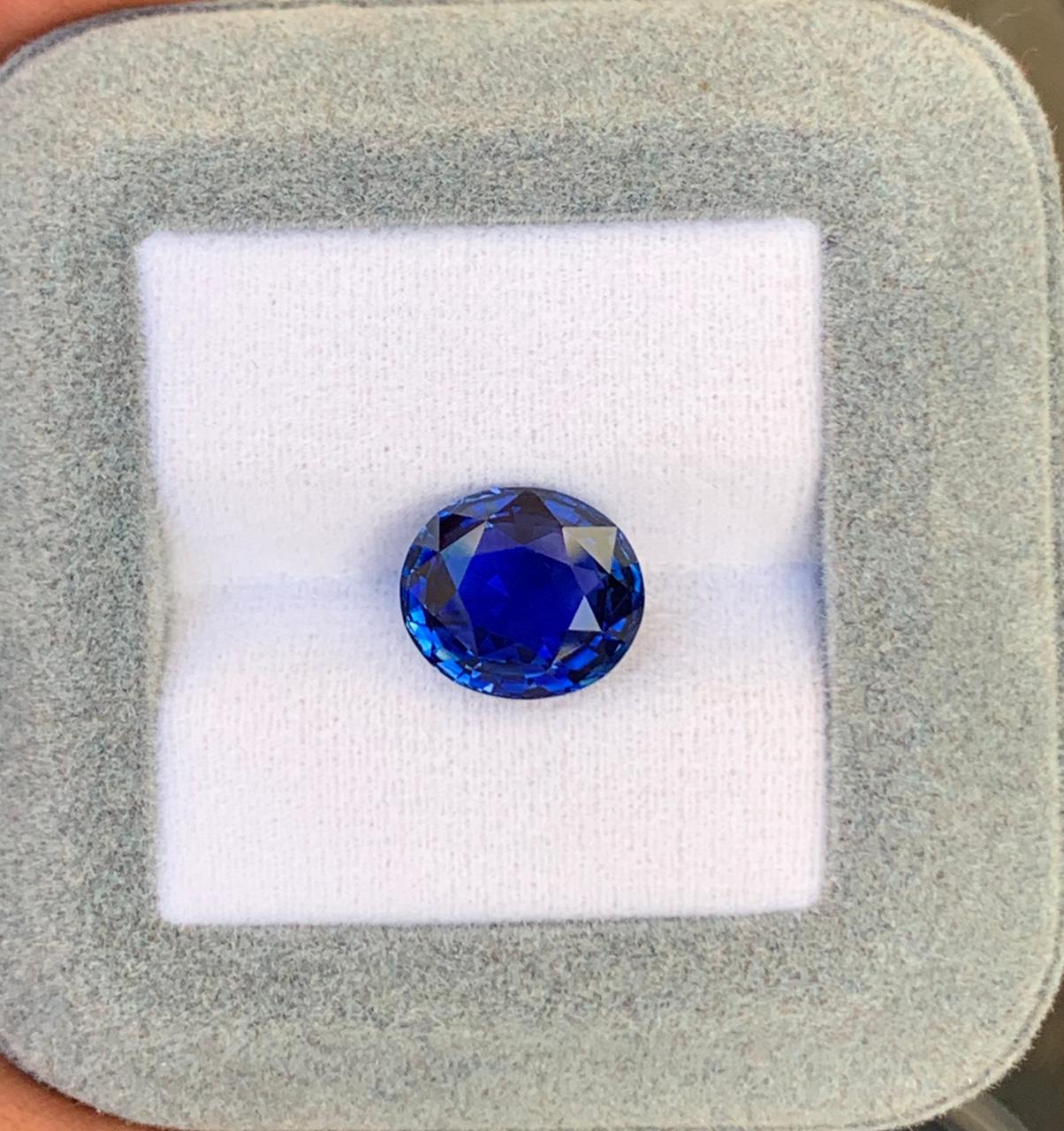
It is the comparison everyone makes, and it is a legitimate one: two deep blues, two ring stones, prices that are worlds apart.
| Tanzanite | Blue sapphire | |
|---|---|---|
| Species | Zoisite | Corundum |
| Mohs hardness | 6 – 7 | 9 |
| Cleavage plane | Yes | No |
| Common treatment | Heating, almost systematic | Heating, common |
| Price per carat, above 2.5 ct | ≈ €900 to €1,000 | ≈ €3,860 (median) |
| Deposits | Only one in the world | Sri Lanka, Madagascar, and many others |
The price difference has a simple explanation: large tanzanite crystals are far less rare than large sapphires. A six-carat tanzanite is a common stone; a blue sapphire of six carats in a fine colour is not. In our inventory, the per-carat price of blue sapphire is multiplied by nearly three between the one-carat size and the three-carat size — that of tanzanite barely changes.
The practical consequence: tanzanite is unbeatable for those seeking size in blue stones. No other gemstone offers a five- or six-carat stone of such deep blue for a few thousand euros. Provided you accept the following.
This is the most important part of this article, and the one sellers mention least.
Tanzanite ranks between 6 and 7 on the Mohs scale, compared with 9 for sapphire. In other words, ordinary dust — which contains quartz, at 7 — can scratch its surface over time. Above all, it has a cleavage plane : a sharp impact in the wrong direction, against a worktop or a door handle, can split it cleanly.
This does not disqualify it, but it determines how it should be worn. In a pendant or pair of earrings, there is no concern: the stone is never exposed to impacts. In an occasionally worn ring, it is perfectly reasonable. In an engagement ring worn every day, however, it requires a setting that fully encloses it — and accepting that it must be removed for most activities.
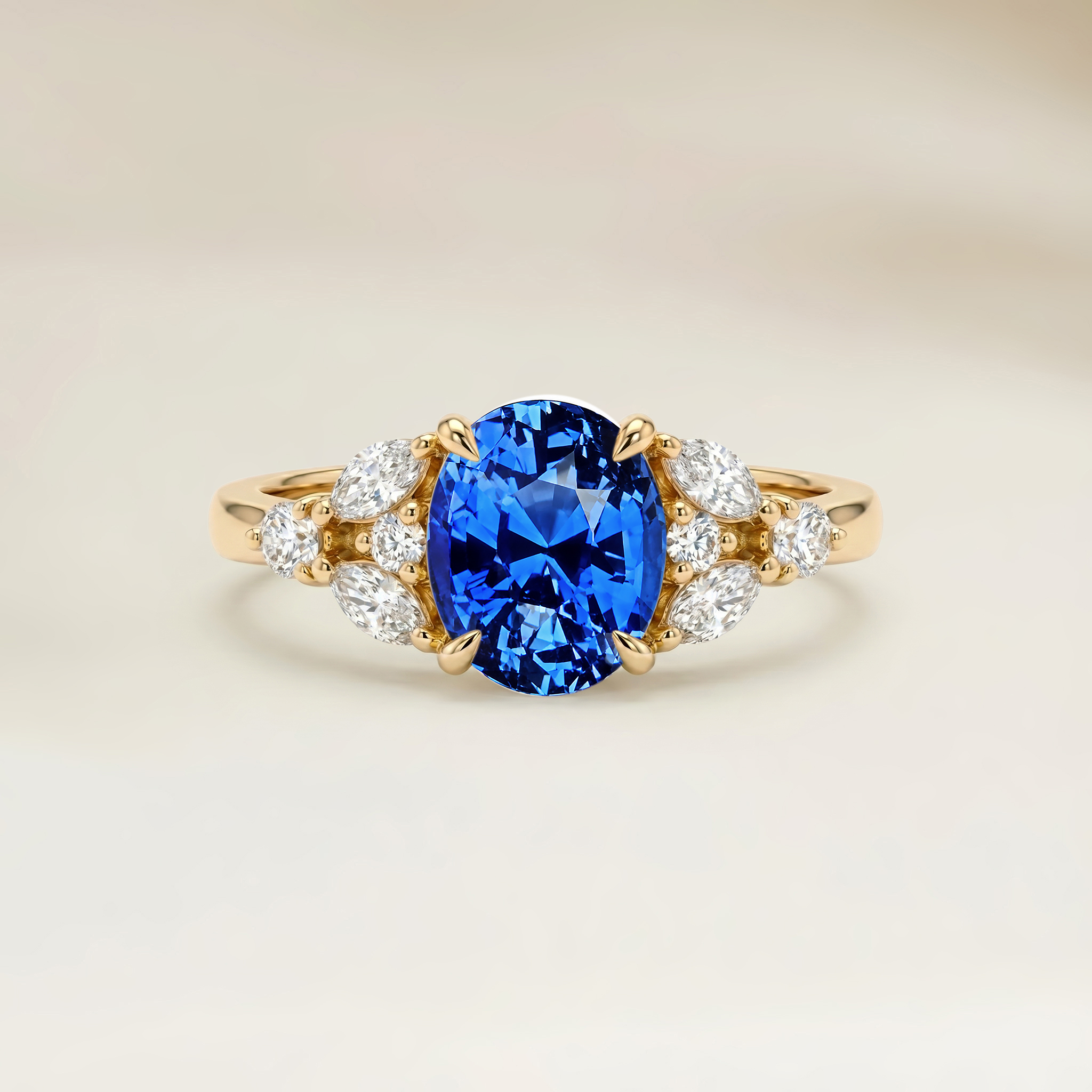
For those seeking a blue stone that is more durable for everyday wear, the answer is corundum. A blue sapphire engagement ring costs more per carat, but can be worn for thirty years without particular precautions and accommodates every setting, including the most openwork designs.
“Will I take this ring off to do the cleaning?” If the answer is no, tanzanite is not the right choice for an everyday ring — and this is not a judgement on the stone, only on its use.
Tanzanite has one characteristic that no other jewellery gemstone shares: it comes from only one place. The Merelani Hills, in northern Tanzania, at the foot of Kilimanjaro — an area of just a few square kilometres.
It was discovered there in 1967, then named and launched by Tiffany the following year, after the only country that produces it. It is therefore a very young stone by jewellery standards: barely sixty years of history, compared with more than two thousand for sapphire.
This single source has two consequences. It makes supply sensitive to the decisions of a single state — Tanzania had the mining area enclosed by a 24-kilometre wall, completed in 2018, to control production. And it fuels a rarity argument that must be handled with caution: yes, the deposit is finite; no, that does not make tanzanite an investment.
Heating is almost systematic. When extracted, most crystals display a brown hue; moderate heating removes it and reveals the blue-violet colour. This treatment is stable, permanent, and accepted throughout the market. It does not diminish the value of ordinary stones.
However, it does have implications for care: no thermal shock. No ultrasonic cleaning, no steam, and no sudden transition from heat to cold. Lukewarm water, mild soap, a soft brush — that is all.
As for imitations, the most common are coloured glass and certain synthetic stones. The most deceptive is synthetic forsterite, with a very similar colour, which reveals itself under magnification through strong doubling of the facet edges. As with any valuable gemstone, an independent laboratory report settles the matter in a matter of minutes.
Tanzanite is also the youngest stone on the calendar. It joined the reference list in 2002, alongside turquoise and zircon, and has since been the December birthstone most often given in jewellery.
Its symbolism is therefore recent, and it is chiefly associated with what its colour evokes: calm, depth, transition — a blue that turns violet when the light changes. For a December birth or birthday gift, it is a perfectly suited stone for a pendant or earrings, where its hardness poses no problem.
We are dealers and jewellers, not valuation experts. To have a tanzanite valued that you have inherited or purchased, our article explains whom to contact and in what order. However, resetting it in a mount that protects it is our métier.
For our stones in stock in September 2026, between €900 and €1,000 per carat for tanzanites of 2.6 to 6.8 ct in a saturated violet-blue. Paler stones trade for considerably less, while the deepest colours command considerably more.
Because large crystals are far less rare. A six-carat tanzanite is common; a six-carat blue sapphire in a beautiful colour is not. The per-carat price of blue sapphire increases by almost threefold between one and three carats; that of tanzanite barely changes.
With care. Its hardness is between 6 and 7, compared with 9 for sapphire, and it has a cleavage plane. It is better suited to a ring worn occasionally, a pendant or earrings.
Almost always: heating removes the brown tint present at extraction and reveals the violet-blue. It is stable and accepted, but it rules out thermal shocks during care—no ultrasonic cleaning or steam.
From a single place in the world: the Merelani Hills in northern Tanzania. Discovered in 1967, it was named and launched by Tiffany the following year. No other commercial deposit has been found since.
It is a commercial grading scale, not a laboratory standard. Each seller applies it in their own way, and two stones graded AAA may have nothing in common.
Yes, since 2002. It joined turquoise and zircon on the reference list, making it the most recent of all the calendar stones.
Share this post