Zambian or Colombian Emerald?
Bonnot Paris22/9/2026
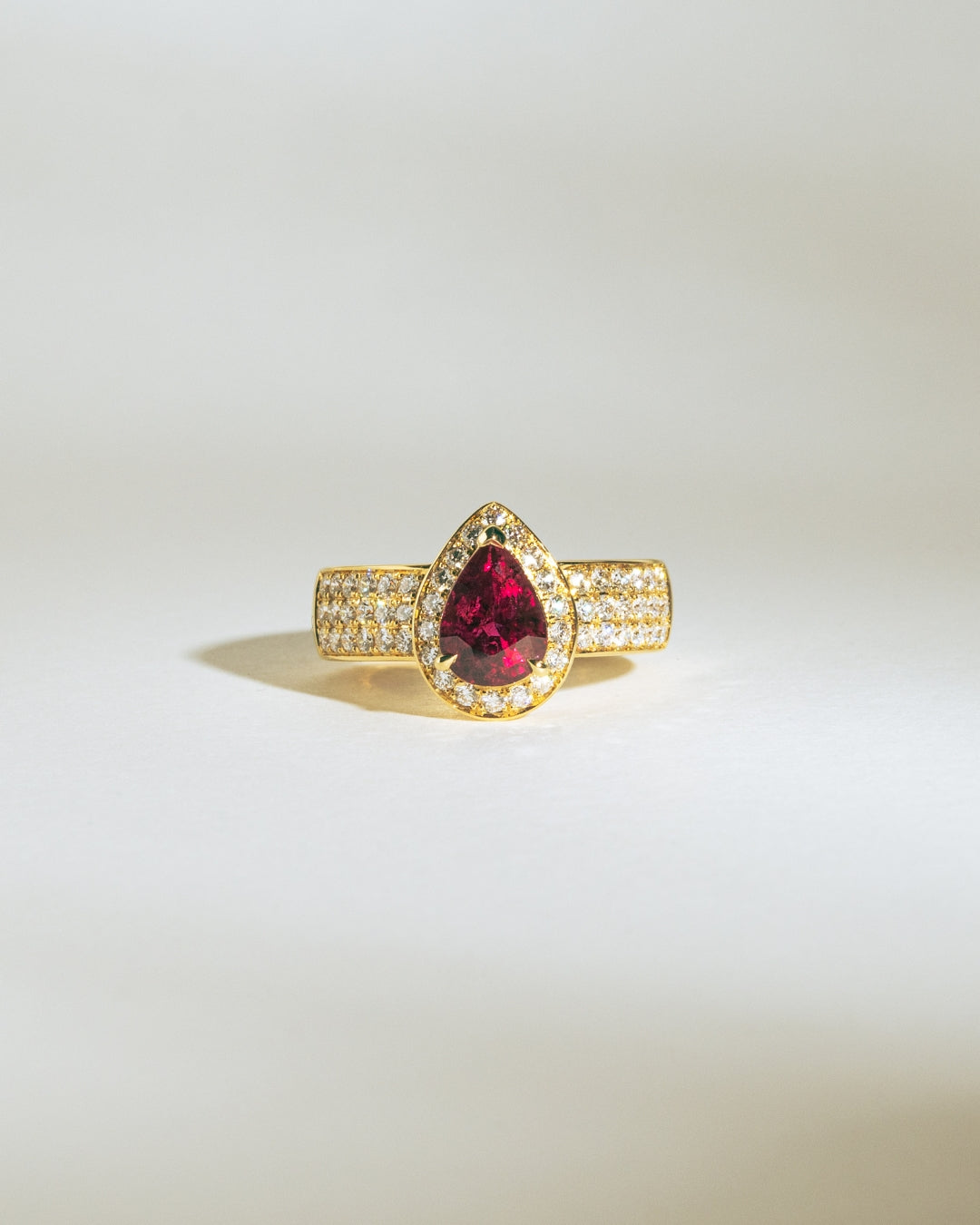



Rarity creates counterfeiting, and a ruby of fine colour is genuinely rare: above two carats, it is the hardest to find of the four historic gemstones. Hence a market where the certificate matters as much as the stone.
This guide explains what a ruby is, where those bought today come from, how its quality is assessed, what commercial designations are worth — and what it really costs, supported by figures from our stock.
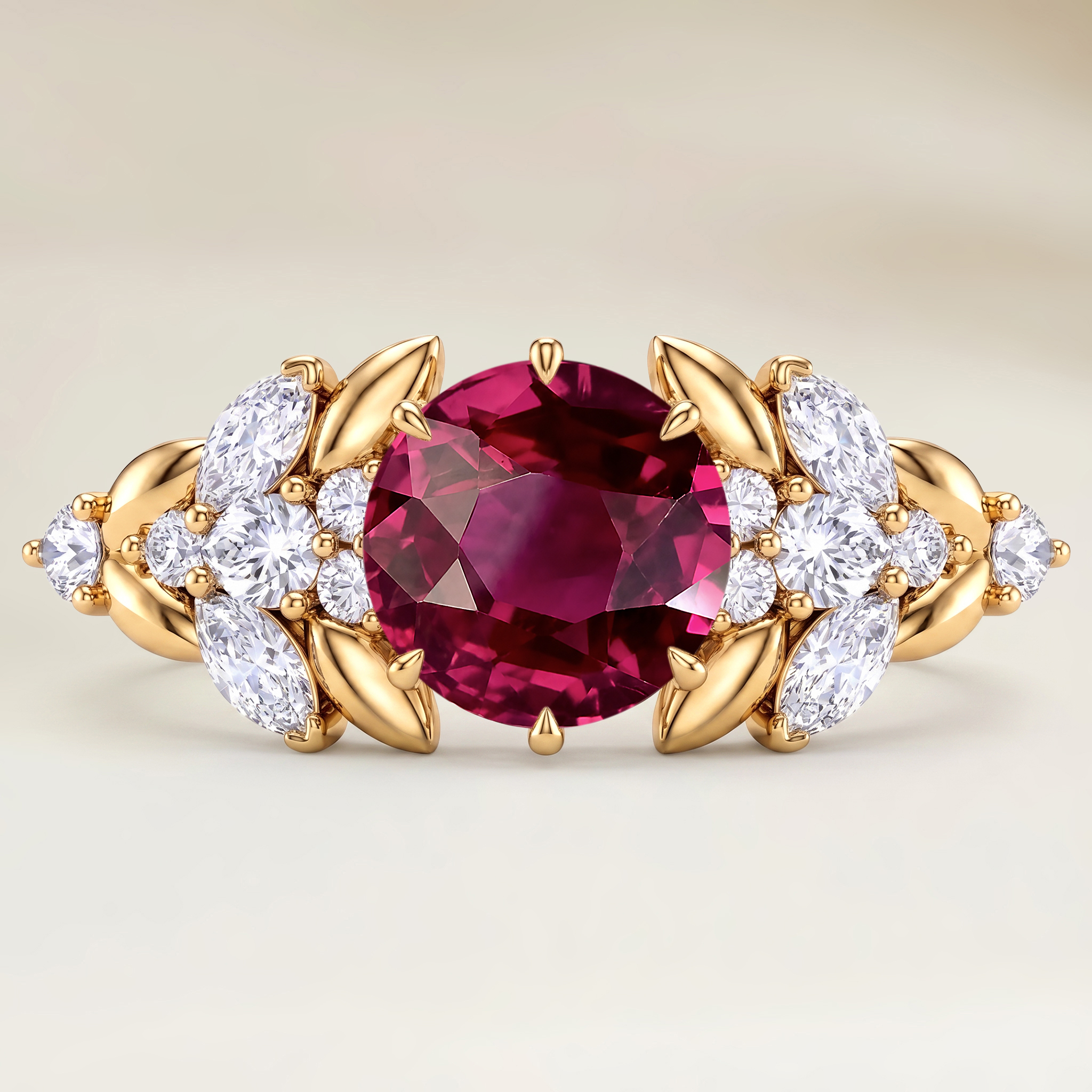
A corundum coloured red by chromium. Same formula as sapphire, same hardness, same absence of cleavage planes, sometimes from the same deposit — only the chromium concentration separates them.
| Characteristic | Ruby | What this means |
|---|---|---|
| Species | Corundum | Identical to sapphire: only chromium changes. |
| Mohs hardness | 9 | Unreservedly suitable for daily wear. Only diamond performs better. |
| Cleavage | None | Excellent toughness against impacts. |
| Colouring agent | Chromium | The same as in emerald, in green. |
| Rarity | The strongest of the four | Above 2 ct, in a beautiful colour, it is very difficult to find. |
One consequence of this kinship with sapphire is worth knowing: there is no clear boundary between a highly saturated pink sapphire and a light ruby. There is a chromium threshold, and a tipping point that is debated between laboratories — the GIA places it earlier than the SSEF. Two reports may therefore classify the same gemstone differently, with a considerable price difference.
It shifted around fifteen years ago, and many buyers are still unaware of it.
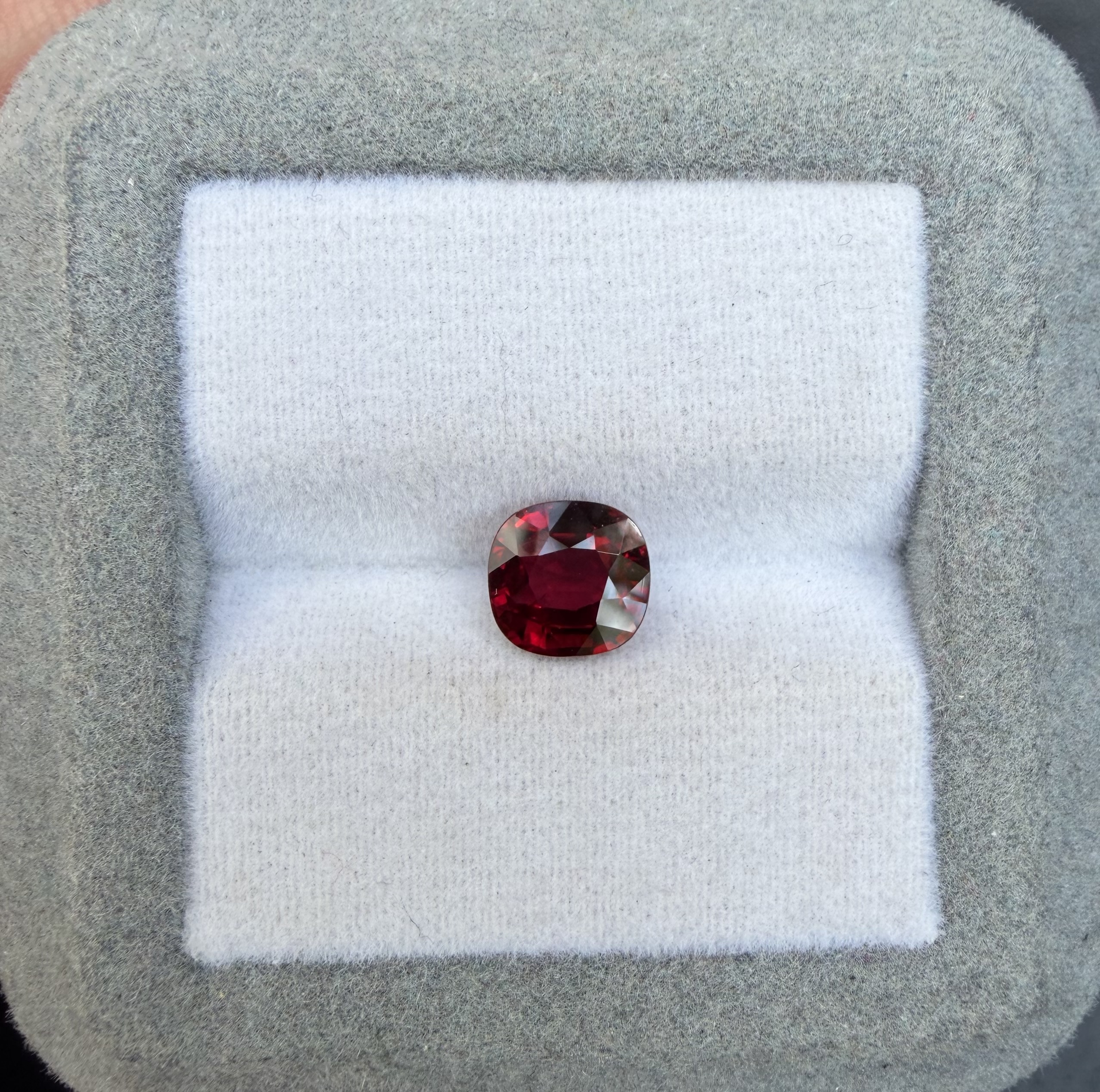
Burma Burma retains its historical prestige, that of the stones from the Mogok Valley which built the gemstone’s reputation and gave rise to the term “pigeon’s blood”. These stones remain rare on the market, and their sourcing is subject to constraints that complicate traceability.
Mozambique Mozambique has supplied most fine stones since the 2010s, through the Montepuez deposit. Its reds are pure, often highly legible, and the supply chain is better documented. This is where we purchase our entire selection.
Other origins exist — Thailand, Madagascar, Tanzania — each with their own characteristics. But the rule remains the same everywhere: origin explains a character, never a quality. A beautiful stone from Mozambique surpasses an average stone from Burma, whatever story accompanies it.
There is no standardised grading scale for ruby, unlike diamond. Four criteria matter, and the first outweighs all the others.
A pure red, without brown or pink, that holds when the light fades. This accounts for most of the value.
Heating does not diminish value. Lead glass does — and by considerable proportions.
In millimetres, not carats. Corundum is dense: at equal weight, it appears smaller.
A window in the centre — that pale area one can see through — drastically reduces the value of a beautiful colour.
A word on commercial terms, because they weigh heavily on the price. “Pigeon blood” refers to the most intense reds; some laboratories mention it according to their own criteria, while others refuse to do so, and it is not standardised between them. When it is claimed without supporting documentation, it is worthless.
Finally, inclusions are not assessed as they are in a diamond. Intersecting rutile needles—what the trade calls silk —are an excellent indication of natural origin. Conversely, a perfectly clean stone at a low price should raise questions.
This is the subject that separates a successful purchase from an unpleasant surprise, and it comes down to two cases.
Heating. A traditional, longstanding, stable heat treatment, declared on the certificate, from which the vast majority of rubies on the market benefit. It reveals a colour already present in the stone. An unheated gem is worth more, but a heated stone is by no means devalued —and its care remains identical.
Lead-glass filling. A stone so fractured that it would be unsellable is impregnated with glass that fills the cracks and makes it visually presentable, often with a highly flattering red colour. Its value bears no relation to that of a heated ruby, and it is unusually fragile : no ultrasonic cleaning, heat or acidic products. Lemon juice is enough to damage it, and a jeweller retipping a claw with a blowtorch can destroy it.
There is also the question of synthetics: ruby was the first gemstone to be industrially synthesised, as early as the beginning of the 20th century, and many antique jewels contain them. For the signatures to look for and verification methods, our guide to identify a ruby details every case.
Nature natural or synthetic, treatments undergone —particularly the absence of filling—and origin, if the laboratory gives an opinion. Without these three pieces of information, a ruby price means nothing.
Among our six Mozambique rubies in stock in September 2026, the price per carat ranges from €5,800 to €22,500, with a median of around €17,000/ct. Our mounted creations start at around €8,000.
The most instructive fact from this survey deserves to be highlighted, because it contradicts everything we think we know: the price per carat falls as weight rises. The smallest stone in the lot, a pure red 1.50 ct, stands at €22,520/ct; the largest, pinkish, falls to €5,800/ct.
In other words, in this family, colour outweighs weight to the point of reversing the usual pricing logic. The detailed figures, stone by stone, and the comparison with red spinel can be found in our article on how much does a ruby cost.
Be wary of a large ruby offered at a price that seems reasonable. Nine times out of ten, it is not a bargain — it is a more subdued colour, heavy treatment, or both.
The two alternatives we most often offer when the ruby budget does not stretch that far — and they are not judged by the same criteria.
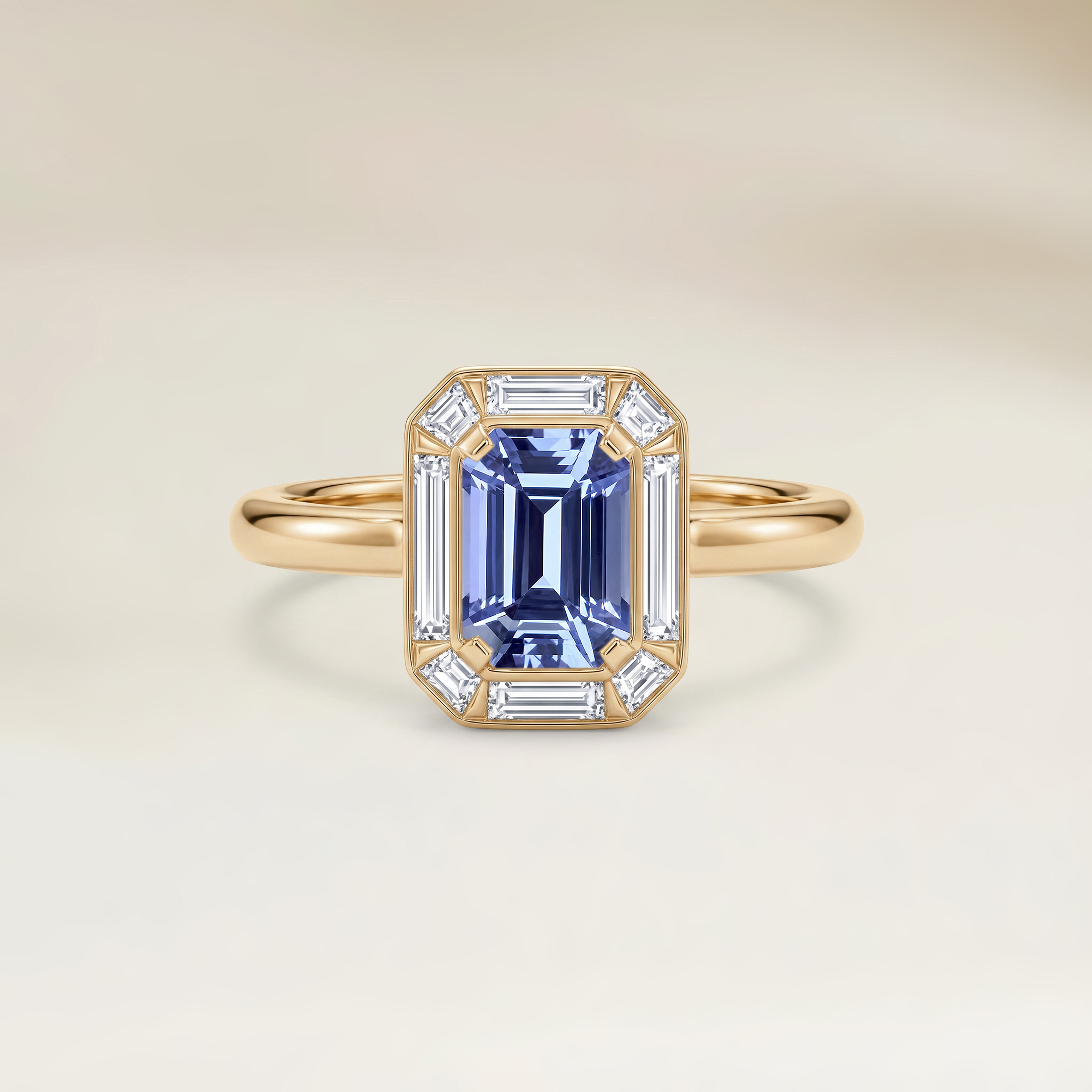
Exactly the same durability, for a median price per carat around nine times lower. A blue sapphire engagement ring starts at €2,500, compared with €8,000 for ruby. Ring set with 1.84 ct — 6 360 €.
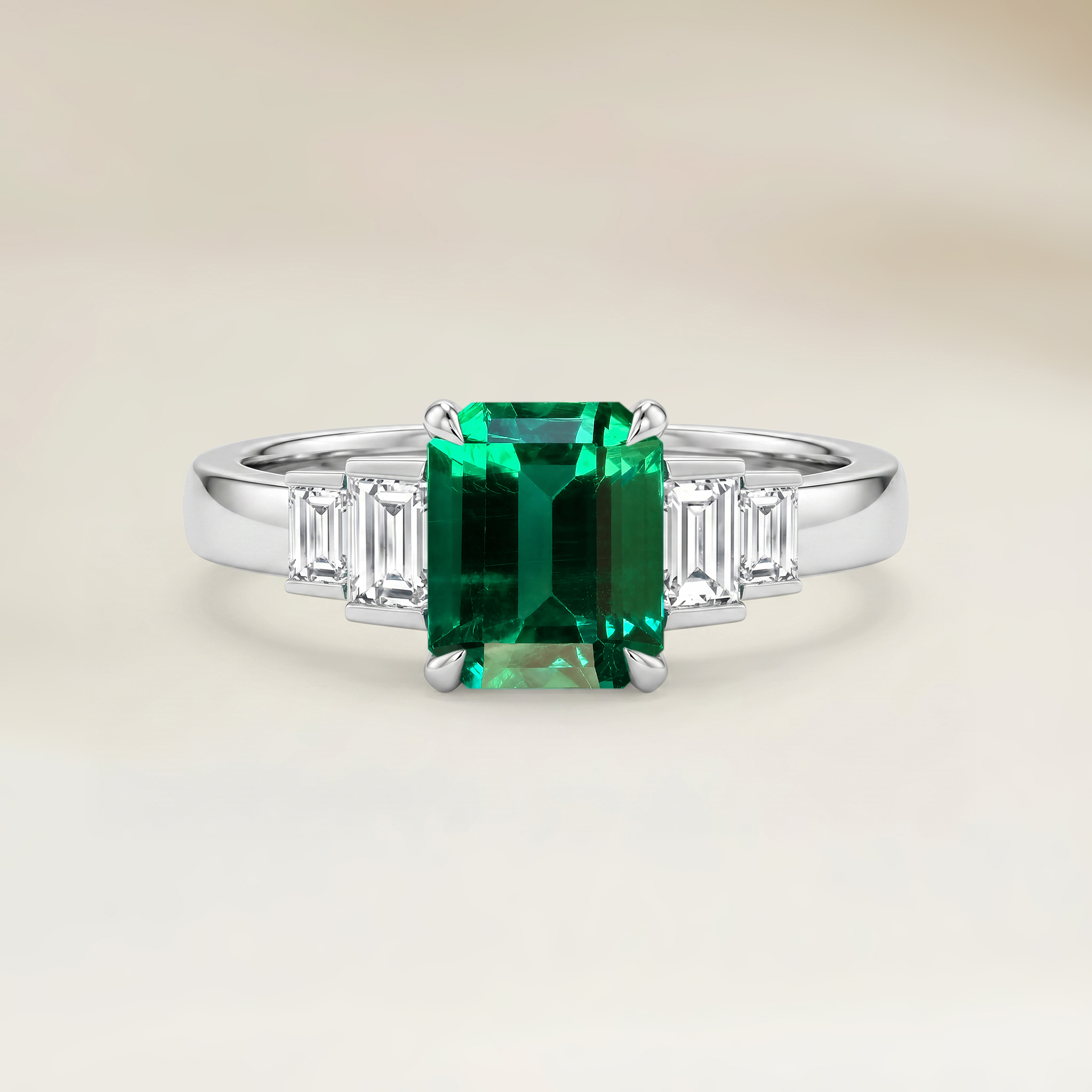
The same chromium, in green. An emerald engagement ring starts at €1,700 — but it requires a setting that protects its edges, a constraint ruby does not have. Ring set with — 10 320 €.
If it is red that matters rather than the name, there is a third option with six centuries of history: red spinel, almost never treated, whose median price per carat is less than a third of that of ruby. Several “rubies” in royal crowns have, in fact, proved to be spinels.
This is the simplest part of this guide, and it comes down to three steps.
Once a month, lukewarm water, mild soap, a soft brush — paying particular attention beneath the setting, where a film of cream and dust builds up. At 9 on the Mohs scale, nothing commonly encountered can scratch a ruby: what dulls the ring is always the underside of the setting.
Remove the ring for sport, gardening, housework and swimming. The main risk is not scratching but an impact to a prong, which loosens the setting without anything being visible.
Have the setting checked every two years. A setting that shifts can be tightened within minutes; a lost stone can never be replaced identically. This inspection is offered for life on our creations.
Corundum tolerates it very well on a sound stone, without any inclusion reaching the surface or any fracture. Never on a lead-glass-treated stone — hence the importance of the certificate, including for care.
A corundum coloured red by chromium — exactly the same mineral as sapphire. Its hardness of 9 and lack of cleavage planes make it one of the most resistant gemstones for daily wear: only diamond performs better.
Primarily from Mozambique, particularly the Montepuez deposit. Burma retains historic prestige with stones from Mogok, but they are rare and their sourcing is subject to constraints that complicate traceability.
Colour, by far: a clear red, without brown or pink, that remains legible in low light. Next come treatments, dimensions in millimetres and the quality of the cut. Origin influences price but never determines quality on its own.
A commercial term for the most intense reds, historically associated with Burma. Some laboratories mention it according to their own criteria, while others refuse to do so: it is not standardised. It drives the price up significantly — caution is advised when it is claimed without documentation.
Heating is traditional, stable and disclosed: it does not diminish the stone’s value. Lead-glass filling fills fractures to make presentable a stone that was not — its value is in no way comparable, and it is vulnerable to ultrasound, heat and acids.
Among our six stones in stock in September 2026, from €5,800 to €22,500/ct, with a median of around €17,000/ct. Our finished creations start at around €8,000. The difference does not come from weight, but from colour.
Yes, without reservation: hardness 9, excellent toughness, no cleavage planes. Care with lukewarm water and mild soap. Ultrasound is possible in the workshop on a sound stone — never on a lead-glass-treated stone.
Share this post