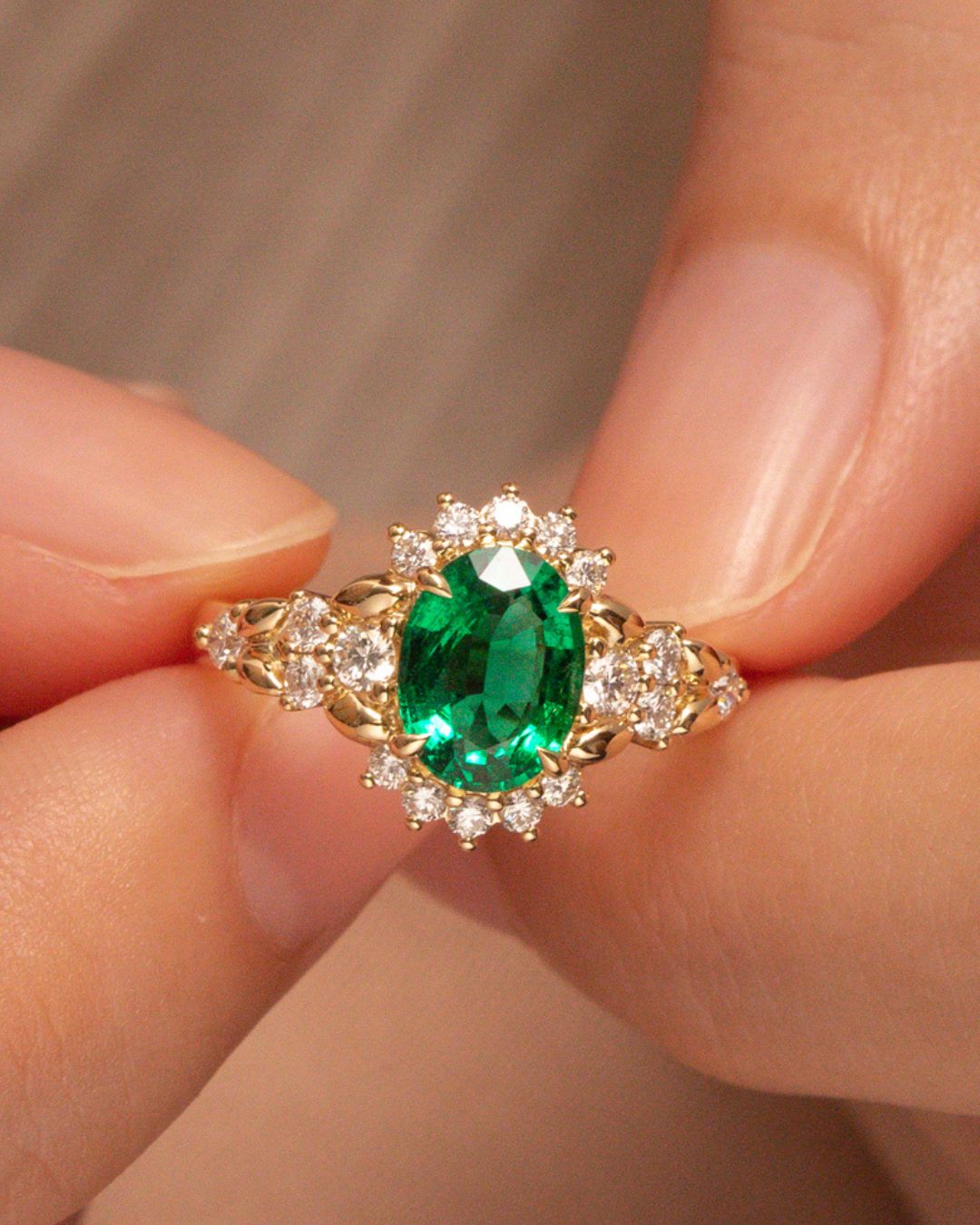
Zambian or Colombian Emerald?
Bonnot Paris22/9/2026
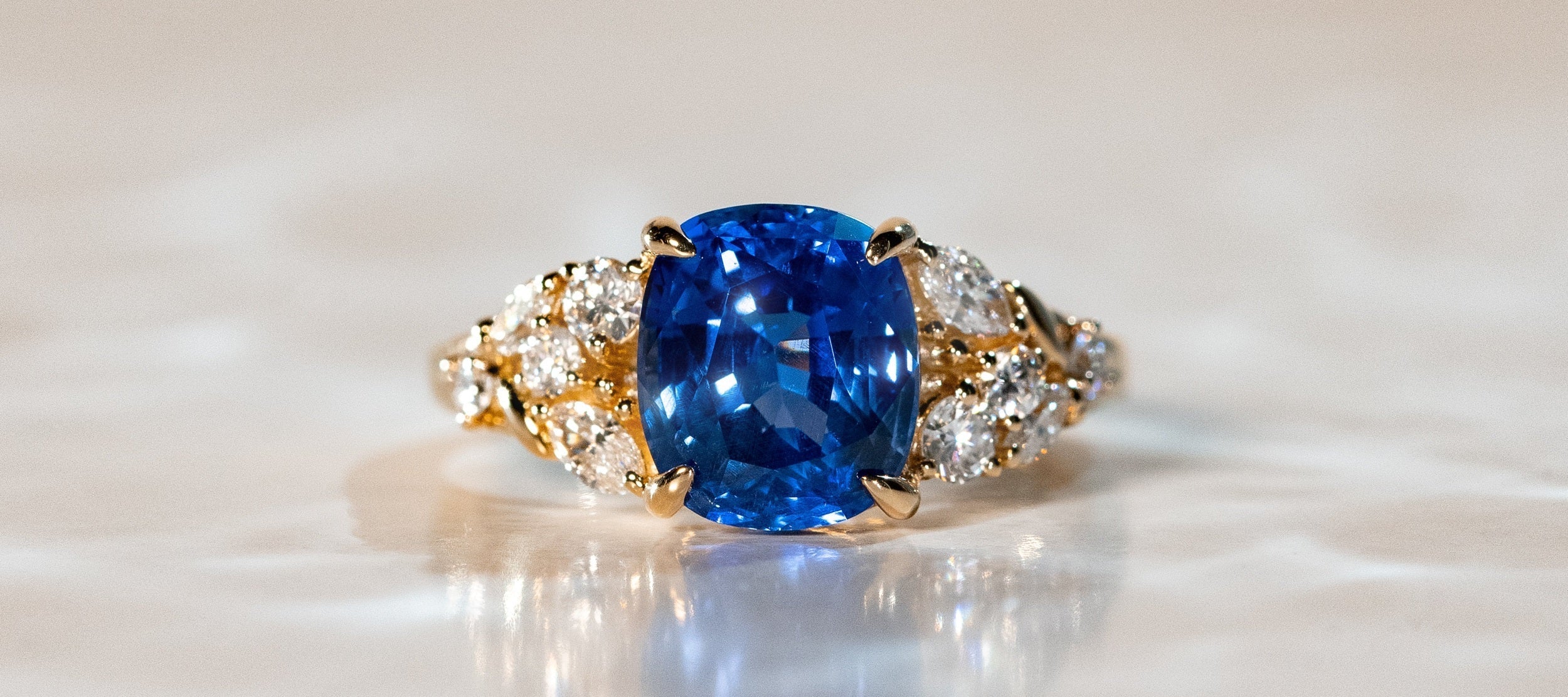



This guide is not about cleaning: the five-step method and the practices that cause damage are covered in our guide to cleaning a sapphire. Here, it is about the long term : what wears away, what can be repaired, and when the ring needs to be placed on a workbench.
Let us begin with what will pose no problem. The blue sapphire has a hardness of 9 out of 10 on the Mohs scale and, unlike diamond, it has no cleavage planes : it withstands impacts rather than chipping. It does not fade in the light, is not affected by water, and requires no maintenance treatment.
That is precisely what has made it, for centuries, the ultimate engagement stone — and one of the rare coloured gemstones that can be worn without a second thought, in every colour across our sapphire engagement rings. An emerald, on the other hand, must be re-oiled periodically; an opal cracks as it dries; a pearl can be scratched with a fingernail.
On a blue sapphire engagement ring, it is always the setting that ages, never the stone. Nineteenth-century sapphire ringsth century sapphire rings pass through our hands with an intact stone and a band that needs to be remade. This is the right way to think about care: the gemstone is secure, the metal must be monitored.
This is the most common surprise, and the one that causes the most concern — wrongly so. White gold is an alloy that is naturally grey-yellow, coated in the workshop with a thin layer of rhodium which gives it its cool, almost silvery sheen. This layer wears away.
It disappears between one and three years depending on how intensively it is worn, and always in the same place first: beneath the band, where the ring rubs against the neighbouring finger and everything the hand touches. The yellow tint of the alloy reappears underneath, then spreads to the sides.
Rhodium plating can be reapplied in the workshop at a modest cost, and the ring comes back looking exactly as it did on the first day. The problem is not the wear — it is discovering it without having been warned. A client who does not know this thinks it is a manufacturing defect; an informed client knows they have an appointment in two years. That is why we say so before the purchase, not after.
Two practical consequences. First, yellow gold and rose gold are not rhodium-plated : they do not go through this cycle, and simply develop a patina. Then, platinum does not lose material: it develops a surface patina, a satin grey that many prefer to new, and a simple polish restores its shine if desired. With a blue sapphire, white gold and platinum enhance the coolness of the blue, while yellow gold warms it — all three have their merits, but they do not age in the same way.
Here is the point that truly matters, and the only one that can be costly. The prongs holding the stone are metal — therefore softer than the sapphire they hold. They gradually thin at the top, over the years. A prong that has lost half its thickness still looks like a prong.
Hold the ring close to your ear and shake it gently. If the stone moves, even imperceptibly, you can hear it — a very faint click. A moving stone is not lost yet, but it will be. Do this twice a year: it takes five seconds.
A loosening prong can be tightened in a few minutes at a jeweller’s bench. A lost stone, however, can never be replaced identically — a sapphire is unique in its colour, and finding the same shade in the same size is a matter of luck. That is the full imbalance: a few minutes in the workshop versus an irreplaceable stone.
Settings do not all wear at the same rate. A bezel setting, in which the metal completely surrounds the stone, is the most protective. A four high-prong solitaire is the most exposed — it is also the one that showcases the stone best. A halo protects the centre stone but increases the number of small set diamonds, and therefore the points to monitor. You will see these differences in our blue sapphire engagement rings, where each creation specifies its setting type.
| What happens | After how long | What can be done |
|---|---|---|
| Worn rhodium | 1 to 3 years | Rhodium plating in the workshop. The result is identical to new. |
| Micro-scratches | From the first year | Polishing. To be spaced out: each polishing removes a little material. |
| Thinned prongs | 5 to 15 years | The check that matters They are tightened, or remade if necessary. |
| Band thinned by wear | 15 to 30 years | It can be reinforced with added metal, or remade identically. |
| Resizing | When life decides | Two to three sizes without difficulty on a plain band. Difficult, or even impossible, on an eternity-set band. |
If you know that the size is likely to change — pregnancy, weight fluctuations, hands that swell in summer — a plain band, or one set only on the upper half, is the sensible choice. Full pavé is superb and can hardly be resized. It cannot be corrected afterwards, and it is exactly the kind of point we address in bespoke creation.
Warm water, mild soap, a soft brush, and above all under the stone — that is where the film of cream and sebum builds up and dulls the gem. The full method is in our cleaning guide.
The ear test. Shake the ring close to your ear: if the stone moves, you can hear it. It is the only check you can carry out yourself, and it is the one that prevents the worst.
Setting inspection with a loupe, deep cleaning, and rhodium plating when the time comes. A moving prong can be repaired; a lost stone cannot.
Chlorine attacks gold alloys and weakens solder points: a ring that regularly goes to the swimming pool may fail years later, without warning. Remove it as well for gardening, DIY and the gym — impacts against a hard object are what loosen prongs. On the other hand, neither tap water nor sleep damages a sapphire : the ring fears tools, not water.
Because white gold is not white : it is a grey-yellow alloy covered with a layer of rhodium, which wears away in one to three years depending on wear. The colour first reappears beneath the band. This is not a hidden defect — the rhodium plating can be redone in the workshop, and the ring comes out looking as it did on the first day.
Once a year for a ring worn every day. It is the only truly important check. Between visits, do the ear test: if the stone moves, you can hear it.
No. Hardness 9 out of 10, no cleavage planes, no sensitivity to light or water, and no maintenance treatment required — unlike emerald, which is re-oiled. What ages on a sapphire ring is the setting. See the blue sapphire engagement rings.
Most often, yes, two to three sizes without difficulty on a plain band. It is far more delicate on a band set all the way around, where the operation may be impossible. This is decided at the design stage, not ten years later.
Neither will damage a sapphire. However, remove it for gardening, DIY, sport and the swimming pool : chlorine weakens solder joints, and impacts loosen prongs. A ring fears tools, not water.
For an unfractured, unfilled sapphire, yes. But not for the setting if a prong is already weakened—the vibrations finish what wear has begun. Details for each stone can be found in our guide to cleaning precious stones.
Share this post