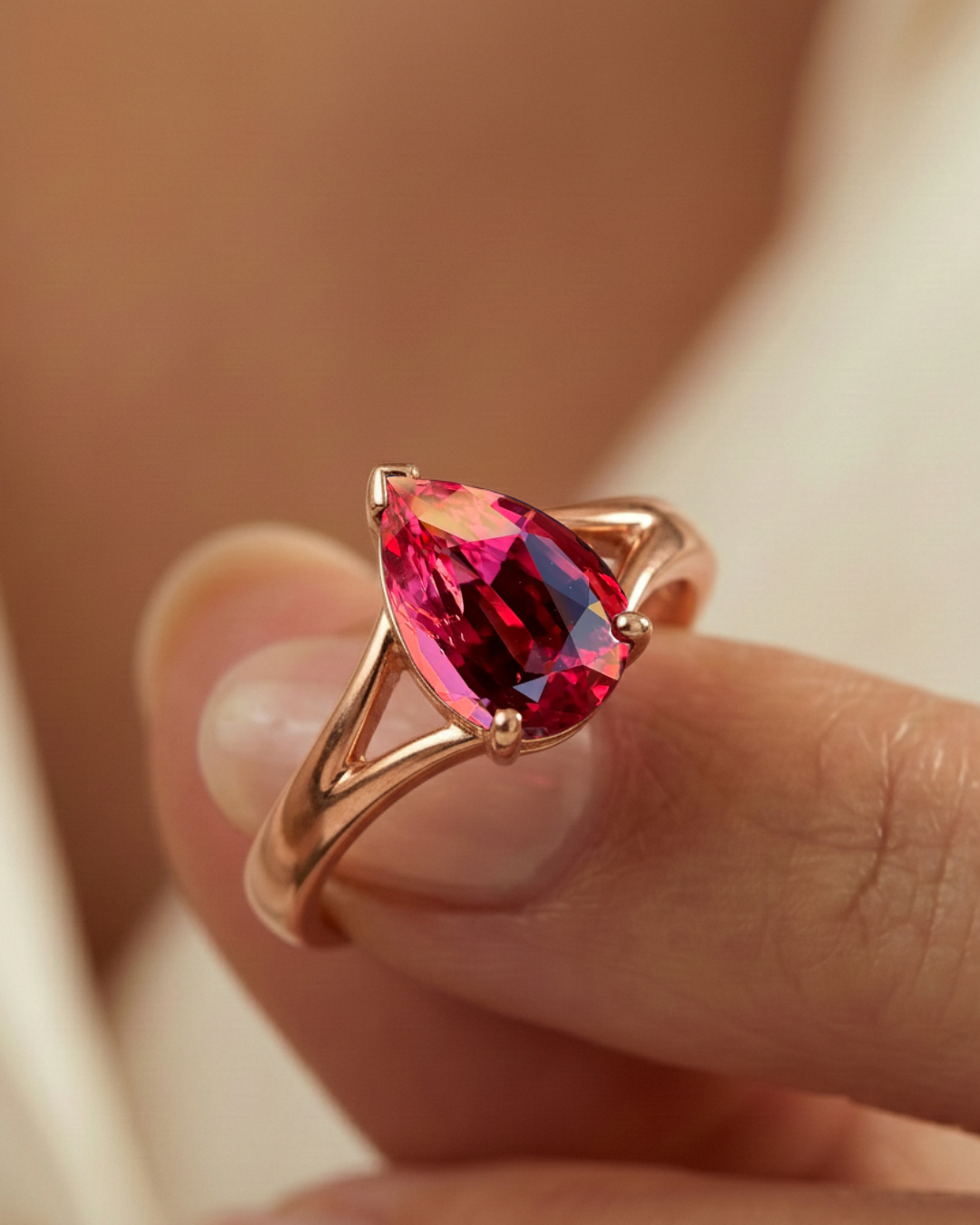
Émeraude de Zambie ou de Colombie ?
Bonnot Paris22/9/2026
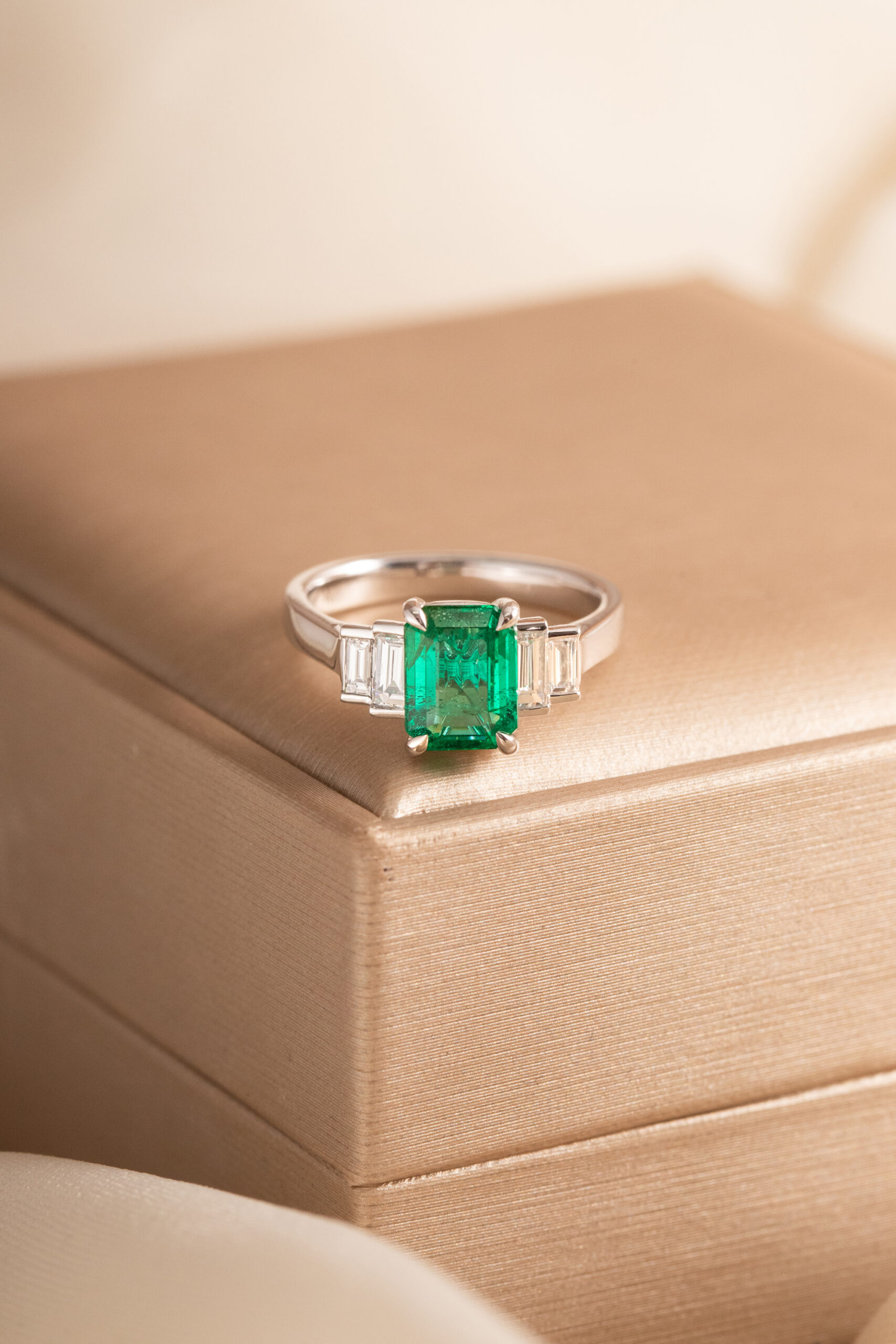



At this stage, one might have imagined a gemstone of permanence. Instead, the green of spring arrives: the emerald embodies hope and renewal, and the Middle Ages attributed to it the power to protect those in love.
This article explains what the stone represents, which ring to offer depending on what she already wears, what a bespoke creation truly costs, and the emerald’s only real constraint — one that is decided in the design and never afterwards.
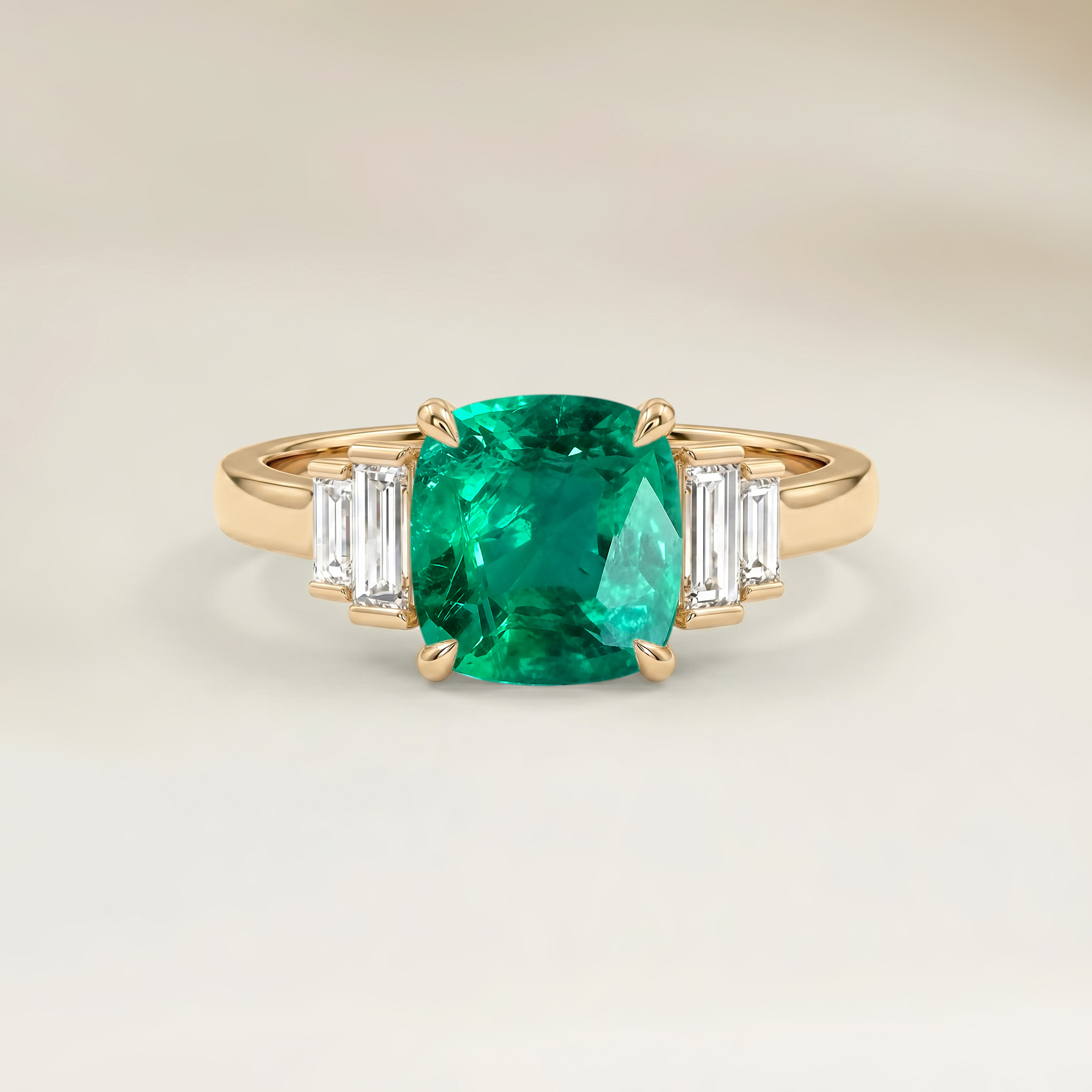
The green of the emerald has always been that of spring and vegetation coming back to life. From this stem its three traditional meanings: hope, renewal, protection for lovers.
What makes the connection meaningful at forty years is that it celebrates not the time that has passed, but what begins again. After four decades, offering a stone of renewal rather than yet another symbol of solidity says something more alive.
A word on this gemstone’s other distinctive feature, one unique among the great stones: one accepts, and indeed expects, it to be imperfect. Its natural inclusions — what the trade calls the jardin — are part of its identity. An emerald without flaws is a suspicious emerald.
To place this fortieth year among the anniversaries associated with a gemstone.
| Year | Anniversary | What it opens up |
|---|---|---|
| 16 years | Sapphire | Ten colours, hardness 9, the deepest stock. |
| 20 years | Porcelain | Not a gemstone: the choice remains entirely free. |
| 35 years | Ruby | Red corundum, the rarest of the four great gemstones. |
| 40 years | Emerald | The green of beryl, and a protective setting to consider. |
| 50 years | Gold | The metal, not the stone: everything becomes possible again. |
If the anniversary you are planning is sooner, the sapphire wedding anniversary follow exactly the same logic at sixteen years of age — with ten colours available where the emerald offers only one.
Three directions, depending on what she already wears and what you want to say.
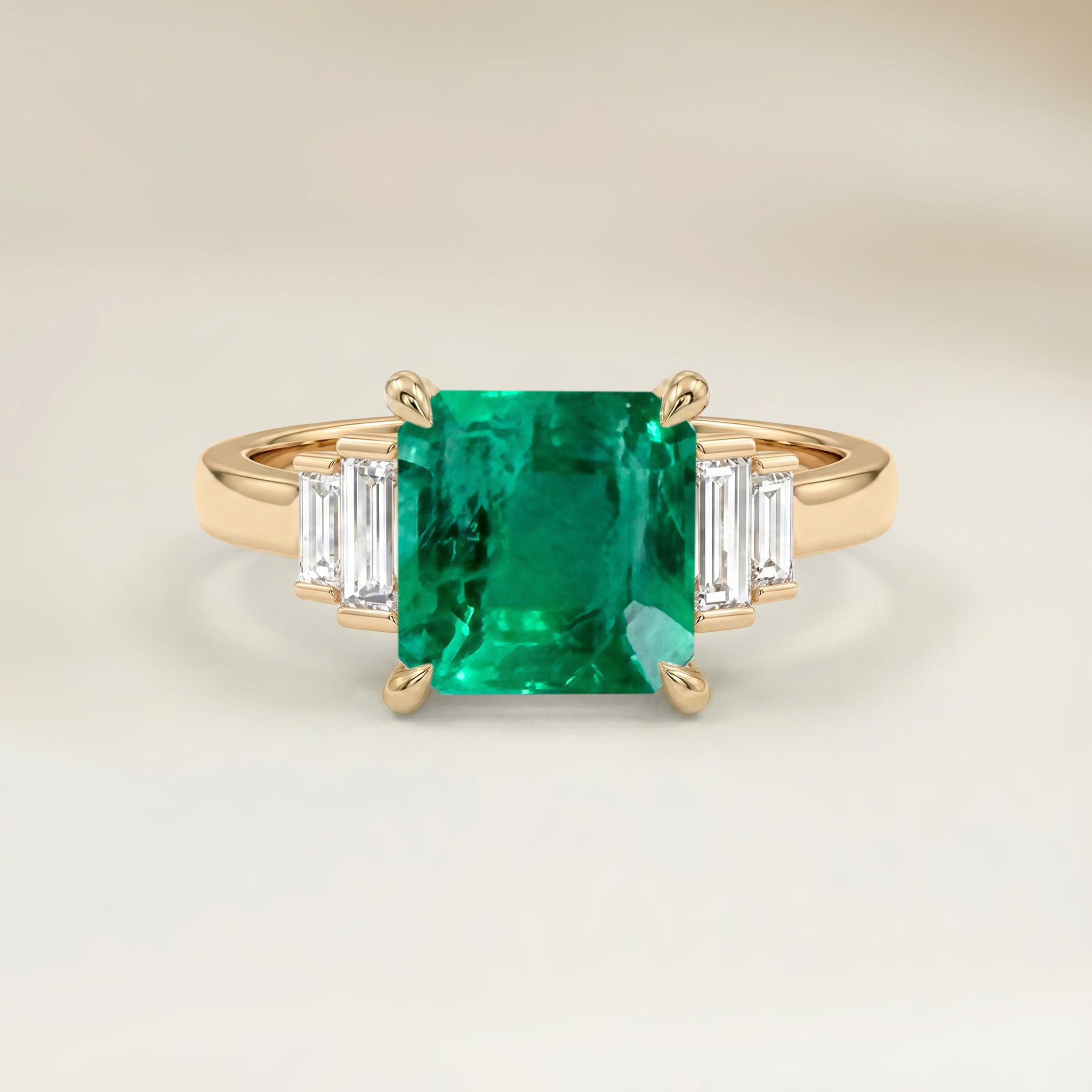
The centre stone. A emerald engagement ring — it is from this collection that we draw, with settings that do not change according to the occasion — built around a gemstone of one to two carats. It is the most classic gesture, and the most legible.
The Toi&Moi. Two stones that answer each other, often an emerald and a diamond. The design is asymmetrical, very personal, and it tells of two paths rather than just one — which, at forty, feels rather fitting.
Reassembly. After forty years of daily wear, the underside of the band has flattened and the prongs have become loose, while the stone has not shifted by a millimetre. Restoring the original ring costs the price of the setting alone.
The emerald lies between 7.5 and 8 on the Mohs scale, compared with 9 for sapphire, and its inclusions make it sensitive to sharp impacts. It requires a setting that protects its corners — a bezel setting or a low setting. This is not prohibitive: it should be anticipated in the design, not discovered afterwards.
A green variety of beryl — another mineral species than corundum — coloured by chromium and sometimes vanadium. The same family produces aquamarine, in blue.
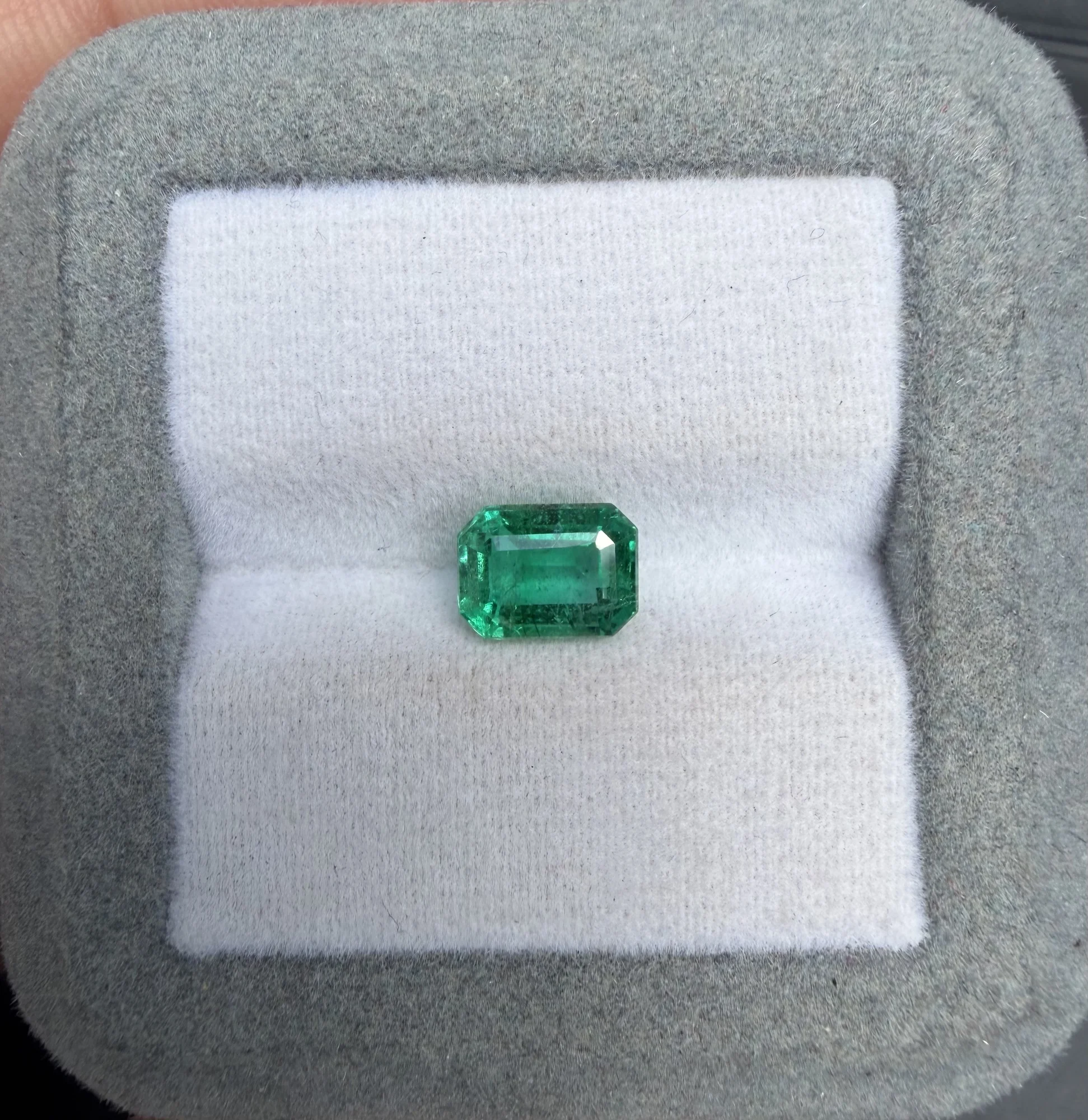
Two characteristics distinguish it from sapphire, and both work in its favour when purchasing. It is less dense : at equal weight, it offers a larger visible surface area. And it starts at a lower price — our set creations start from €1,700, compared with €2,500 for sapphire.
All our natural emeralds are published online with their characteristics, degree of oiling and price. Oiling deserves a word: almost all emeralds receive a colourless oil that fills surface fissures. It is a traditional and accepted practice, declared on the certificate — these are not coloured resins, which we refuse.
Three countries dominate global production, and each has its own character.
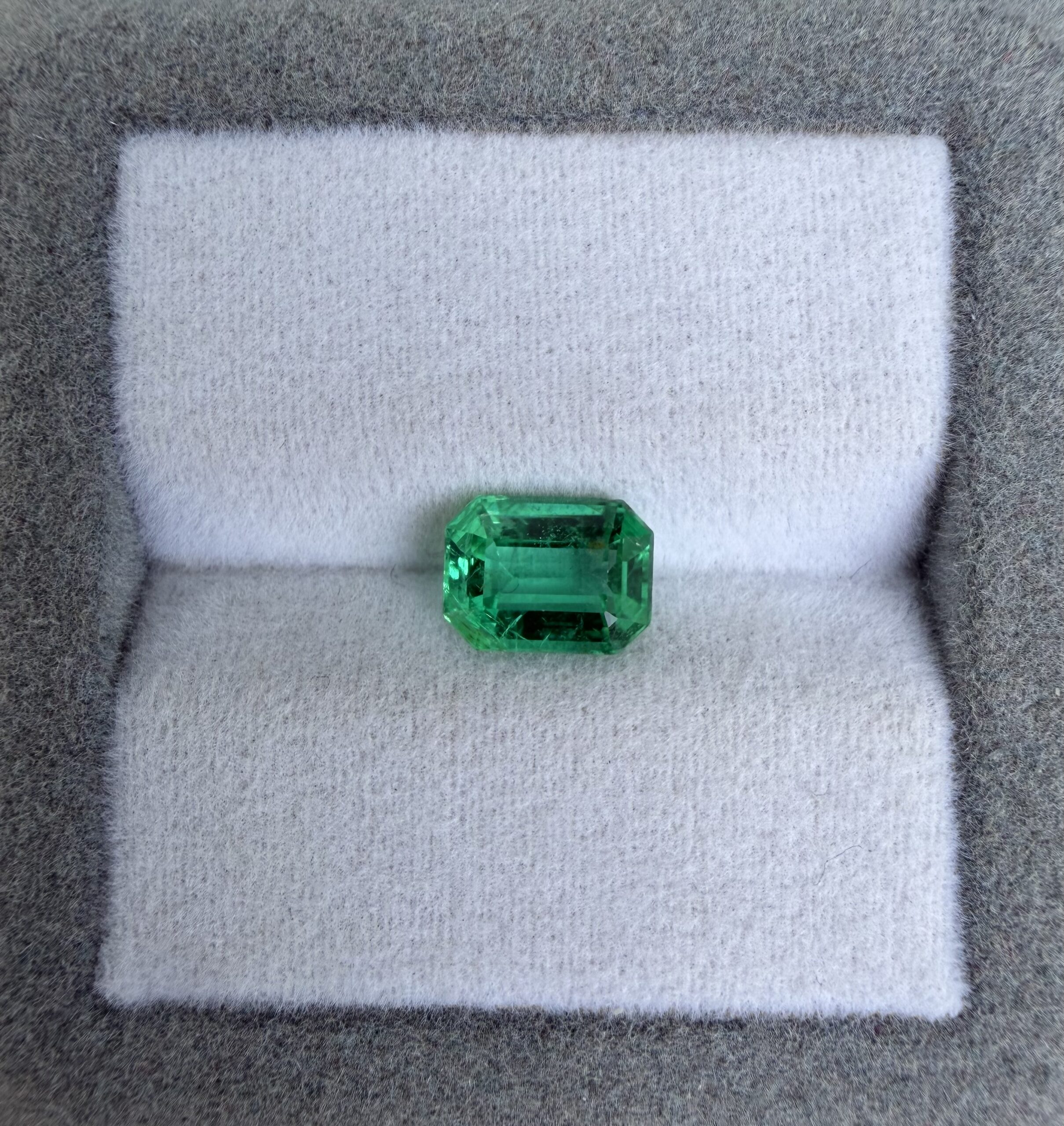
Colombia Colombia retains its historic prestige: the Muzo and Chivor deposits have supplied the market for five centuries, with greens that are often purer, sometimes slightly yellowish. Brazil completes the offering with lighter shades.
Our selection, meanwhile, is Zambian. Our Zambian emeralds are purchased in Jaipur, where they are cut, and selected for their evenness of colour and transparency — a more bluish green, generally cleaner than the Colombian average. A Colombian emerald is sourced by us through a dedicated search.
As always: origin explains a character, never a quality. A beautiful Zambian stone surpasses an average Colombian stone, and the reverse is also true.
| Budget | What this allows |
|---|---|
| From €1,700 | A beautifully coloured emerald of small carat weight, on a simple 18-carat gold setting. |
| €4,000 to €10,000 | A 1 to 2 ct stone with a pronounced green, fully customised setting. The heart of our projects. |
| €10,000 to €17,000 | Intense green, minor oiling or a fine weight, diamond surround or complex setting. |
| Price of the setting alone | Resetting an existing stone — from €1,250 for a simple design. |
One point of precision that changes the way you search: there is no grading scale for emeralds. Within our own stock, the difference in price per carat within the same weight range reaches a factor of three — and it is not the weight that accounts for this difference, but the vibrancy of the green. The numerical details, range by range, can be found in our article on how much an emerald costs.
Our consistent advice: colour before weight. At €8,000, between 1.5 ct of vibrant green and 2 ct of a duller green, the difference in surface area on the finger is measured in tenths of a millimetre; the difference in colour can be seen from three metres away.
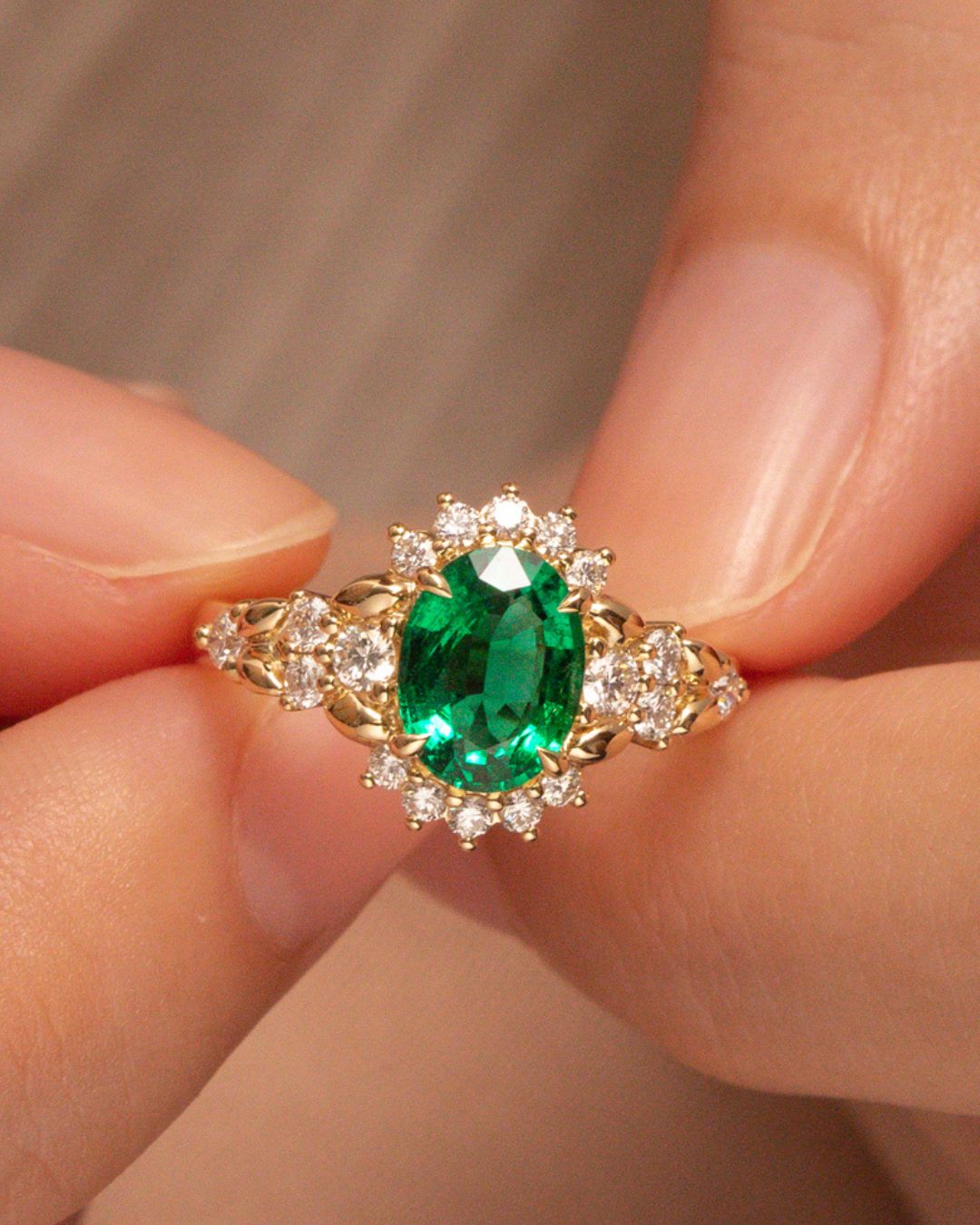
To illustrate the design we mentioned above — two stones answering one another rather than a single one at the centre.
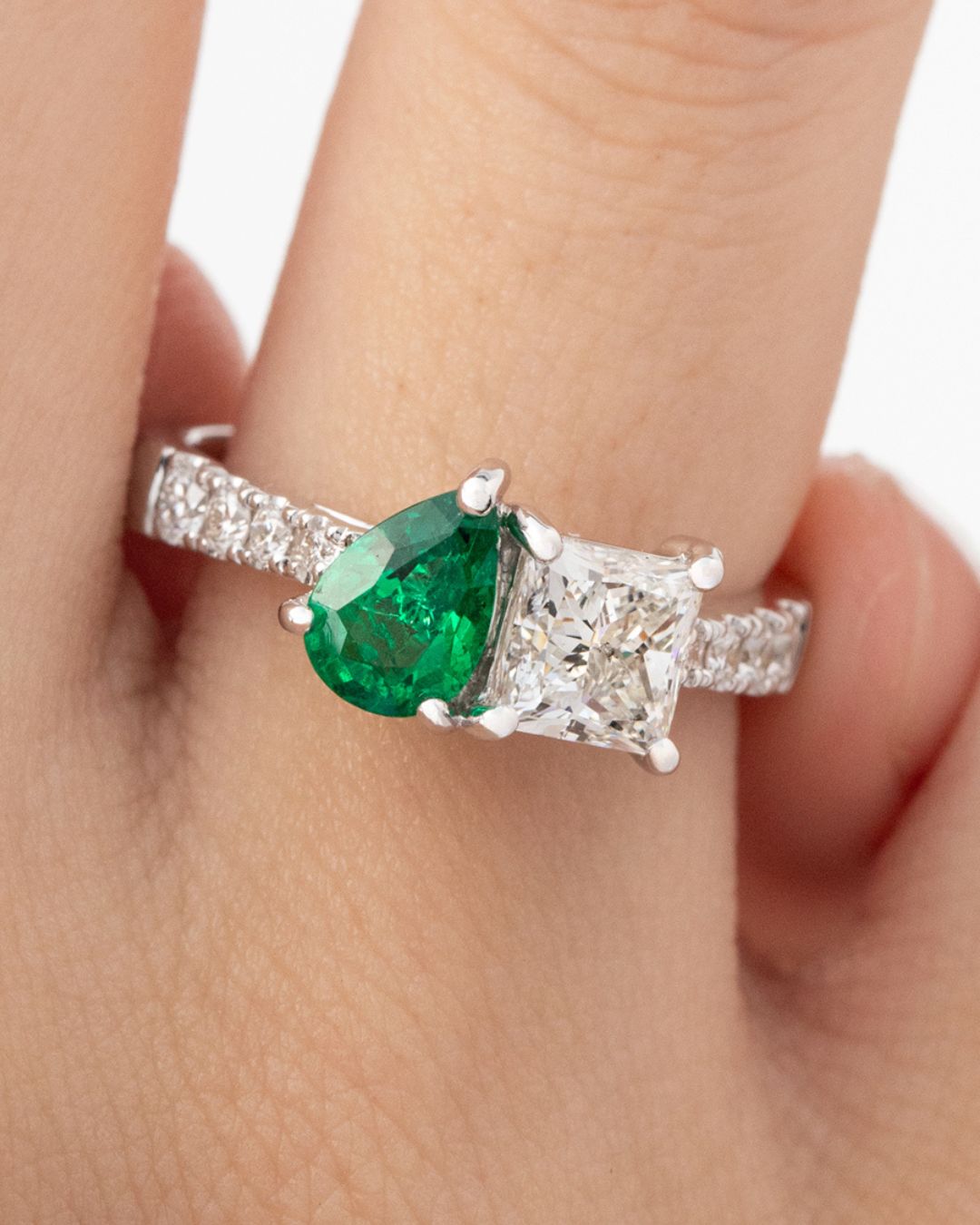
Caroline entrusted us with this project for a birth, not for a wedding anniversary — but the design suits both, which is precisely why we are showing it here. A 0.61-carat Zambian emerald and a one-carat diamond face one another, surrounded by small round diamonds.
The Toi&Moi has one specific advantage over a central stone, after forty years of marriage: it does not compete with the engagement ring. The design is different, the reading is different, and the two rings can be worn together or separately. Allow six to eight weeks between the first appointment and the presentation of the piece.
Forty years of marriage. In the French nomenclature, sapphire marks sixteen years, porcelain twenty, ruby thirty-five and emerald forty. It is the last anniversary before the golden wedding anniversary, at fifty years.
Hope, spring and renewal. In the Middle Ages, it was believed to have the power to protect those who love one another. For forty years of life together, it is a promise of renewal rather than permanence.
Our set creations start at €1,700, with the heart of the collection ranging from €4,000 to €10,000. There is no standard scale for emeralds: within our stock, the difference in price per carat within the same weight range can reach a factor of three, and it is colour that accounts for this difference.
No. Jardin refers to the stone’s natural inclusions, and it is the norm for this species: emeralds form under turbulent geological conditions that almost always trap something within them. It only becomes a problem when it clouds the stone’s face-up transparency or weakens the gem.
Yes, provided the setting protects the edges. With a hardness of 7.5 to 8 and frequent inclusions, emeralds are more vulnerable to sharp impacts than to scratches. A bezel setting or a design that shelters the corners resolves the issue.
Yes, and at forty, it is often the most fitting project: the setting has aged, worn beneath the band, while the stone remains intact. We examine the gem, take its actual dimensions and design a new setting around it. The cost is limited to the setting.
Warm water and mild soap only. No ultrasound, steam or hot water: these processes expel the colourless oil received by almost all emeralds. Over the years, the workshop can refresh the oiling.
Share this post