Zambian or Colombian Emerald?
Bonnot Paris22/9/2026
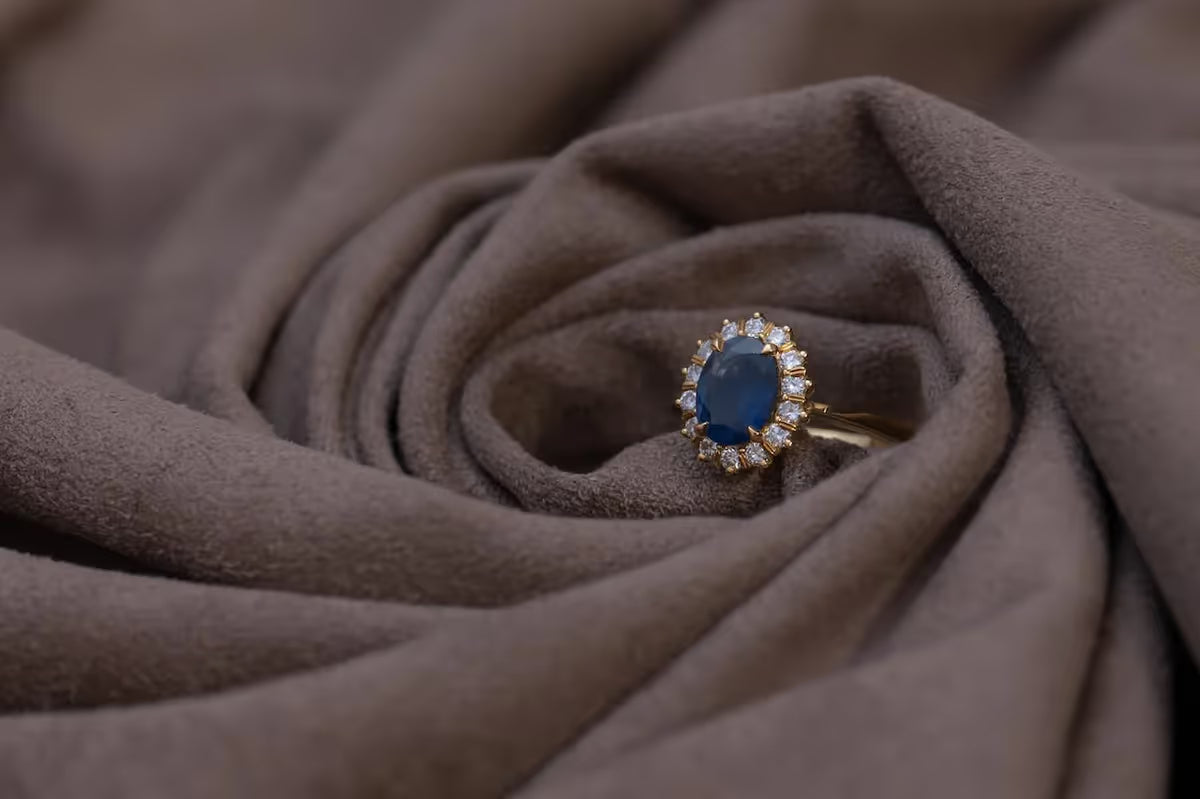



But it is also the shape that conceals the most common flaw, and the only one that no photograph reveals. We devote section 02 to it, because it is the first thing to check in an oval — before colour, before the certificate, before the price.
This is its true purpose. A stone elongated along the axis of the finger visually refines its line — an effect that is particularly striking on short or broad hands, and the reason why so many people choose the oval without being able to explain why.
At the same weight, an oval offers around 10% more visible surface area than a round. It does not weigh more: it distributes its weight differently. On a coloured stone, where colour is judged face-up, that tenth makes a considerable difference.
An emerald cut imposes a certain classicism; a marquise imposes its character. The oval accommodates everything — a pared-back solitaire, diamond halo, floral surround, Art Deco. It is the shape to choose when the setting has not yet been decided.
And one more discreet reason, which affects the price: the oval follows the natural shape of the corundum crystal quite closely. The cutter therefore loses less material than when cutting a round, retains more weight, and this saving is reflected in the price per carat. This is also why large sapphires are easier to find in oval than in round.
Look at an oval straight on, in daylight. A dark area often runs across its centre, perpendicular to its length, forming two triangles that meet. This is the bow tie — bow-tie among English speakers—and it appears in all elongated cuts: oval, pear, marquise, elongated cushion.
It is not a flaw in the material. It is a geometric consequence: in an elongated stone, the central facets return light at such an angle that they mainly reflect what lies above them—that is, you, your hand, your sleeve. They therefore return shadow rather than light.
A slight bow tie is normal and disappears as soon as the hand moves. A pronounced bow tie creates a permanent dark band that does not brighten under any lighting and consumes the centre of the stone—that is, the exact area one looks at. The difference between the two lies solely in the quality of the cut, and it can be seen only on the actual stone. No catalogue photograph shows it, because stones are photographed under ring lighting that erases it.
This is the most practical reason why an oval should not be bought from a screen. On a dark blue sapphire , a pronounced bow tie can shift the stone from deep blue to dull blue as soon as it leaves the display case. We systematically reject them during selection—see our guide to gemstone cuts.
Not all ovals are alike. The criterion that distinguishes them is the length-to-width ratio : the length in millimetres divided by the width. It appears on the certificate and can be calculated from the dimensions in ten seconds.
| L/W ratio | What it looks like | Verdict |
|---|---|---|
| less than 1.30 | A squat oval, close to round. The elongating effect disappears. | You might as well choose a round |
| 1,30 – 1,35 | A subtle, rounded oval. Suits slender fingers that do not need elongating. | Good |
| 1,35 – 1,45 | The sweet spot The classic balance. Clearly elongates without ever appearing stretched. | The safe choice |
| 1,45 – 1,50 | An elongated oval, elegant and slightly more assertive. The bow tie becomes more noticeable. | To be checked in hand |
| above 1.50 | The silhouette shifts towards a marquise. The bow tie becomes markedly more pronounced. | For discerning connoisseurs only |
An oval is worn along the finger, never across it. It may seem obvious, but the consequence is less so: on a ring with an elongated stone, a setting that rotates is immediately noticeable, whereas it would go unnoticed with a round stone. If the fingers are slender at the base, allow for this in the design — a slightly wider band or an inner counterweight resolves the issue.
Here is something people often discover in the showroom, and rarely beforehand: a one-carat sapphire is smaller than a one-carat diamond.
The carat measures weight, not size. And sapphire is denser than diamond — approximately 4.00 versus 3.52. At equal weight, it therefore occupies less volume. In practical terms:
| 1-carat stone | Approximate diameter |
|---|---|
| Round diamond | 6.5 mm |
| Round sapphire | 6.0 mm — therefore visibly smaller |
With approximately 10% more visible surface area than a round stone of the same weight, an oval almost exactly compensates for the shortfall caused by sapphire’s density. A one-carat oval sapphire presents roughly like a one-carat round diamond. This is probably not the reason why the shape became established for sapphire — but it is a good one.
The practical consequence: never compare two stones by their weight. Compare them by their dimensions in millimetres, which are always stated on the certificate. This is the only figure that tells you what will be seen on the hand. Details of price ranges can be found in our sapphire price guide.
| Setting | What it brings to an oval |
|---|---|
| Solitaire 4 or 6 prongs |
Nothing to distract from the colour. Demanding: it forgives neither a pronounced bow tie nor uneven colour. Best reserved for stones that are sure of themselves. |
| Diamond halo | Most sought-after Visibly enlarges the stone and revives its colour through contrast. It is also the most forgiving setting for a stone whose centre is not perfectly bright. |
| Shouldered solitaire | Two side stones extend the line of the oval and add width to the finger. The most natural pairing with this shape. |
| Daisy / floral surround | A corolla of diamonds that softens the silhouette. The most timeless style, and the one that ages best. |
| Trilogy or toi et moi | Two or three ovals aligned, possibly in different colours. The most personal setting — and the one that requires the greatest care in matching the stones. |
Metal is not neutral. On a blue sapphire, white gold and platinum emphasise the freshness of the blue, yellow gold softens and warms it, rose gold creates a bold contrast that must be embraced. On a teal sapphire or a green sapphire, yellow gold almost always works better than white.
To see how they look when set: blue sapphire engagement rings, teal sapphire rings, or the entire sapphire collection. Our creations show ovals set in real pieces, while bespoke creation makes it possible to design the setting around the stone rather than the other way round.
We source directly from our offices in Sri Lanka, where our team works on the market every day, as well as in Thailand and Jaipur. Part of our stock of ovals — particularly larger sizes and unheated stones — never appears on the website. If you cannot find what you are looking for, tell us the dimensions and colour you have in mind: that is often how it begins. On the question of heated or not, see our dedicated guide.
Three reasons: it elongates the finger, it offers around 10% more surface area at the same weight, and it suits every setting. It also costs slightly less per carat, because it follows the crystal’s natural shape more closely.
A shadowed area that crosses the centre of an elongated stone. If slight, it is normal and invisible when worn. If pronounced, it creates a permanent dark band across the centre of the stone. It is the first thing to check in an oval, and it can only be seen on the actual stone — catalogue photographs erase it.
Between 1.30 and 1.50, ideally 1.35 to 1.45. Below this, the oval approaches a round shape and loses its appeal. Above this, it moves towards a marquise and the bow-tie effect becomes more pronounced. The ratio appears on the certificate.
Yes. Sapphire is more dense — 4.00 versus 3.52 — so at the same weight, it occupies less volume: 6.0 mm versus 6.5 mm in a round shape. The spread of the oval almost exactly offsets this difference, making it the most effective shape for a sapphire.
The halo is the most requested for stones from 1 to 2 carats: it enlarges the stone and revives its colour. The solitaire is more demanding; the side-stone solitaire naturally extends the oval’s line. See the blue sapphire engagement rings.
Yes, and it is even the predominant shape in almost every shade — pink, yellow, padparadscha, violet. The complete colour chart is in our guide to sapphire colours.
Share this post