Zambian or Colombian Emerald?
Bonnot Paris22/9/2026



Every week, we meet people who arrive with a photo found online and a simple question: “how much for the same one?” The honest answer is that there is no “same one”. The centre stone represents the main part of the price, it is unique by nature, and it determines what the setting can do.
This guide follows the actual order of a project. It does not tell you which ring to choose — that is your business — but the order in which to make decisions, and which ones become costly if made too late.
This is the only methodological rule we defend without qualification. The stone determines the budget, proportions and colour of the project. The setting is designed around its actual dimensions : the height of the basket, the spacing of the prongs and the curve of the band all depend on millimetres known only once the gem has been selected.
The reverse order — choosing a design, then looking for a stone that fits it — has two effects. It drastically restricts the choice, because a setting designed for a 7 × 5 mm oval will accommodate very little else. And it encourages compromises on colour, which is precisely what you will look at every day.
The primary factor of value. A stone that retains its colour in low light is worth more than an extra half-carat.
The real question is not “pure or included” but “lively or cloudy”. A slightly included yet transparent stone comes out ahead.
We look for the absence of a window — that pale area at the centre that allows you to see through the stone — and proper symmetry.
Traditional heating accepted and disclosed. Beryllium, lead glass and irradiation: never.
We look at each stone in daylight, then in a room lit in the evening. If the colour collapses, it does not make it into the collection. A stone that is too dark loses its light as soon as the light fades; a stone that is too pale loses its character. See all our stones →
Let us talk numbers, since that is the question no one dares to ask first. The tiers below are those of our sapphire collection in September 2026. The stone accounts for the bulk of the cost; the setting ranges from 1 250 € for a simple design to 10 000 € and more for extensive pavé or calibrated-stone work.
| Budget | What it allows |
|---|---|
| From €2,500 | A 0.7 to 1 ct stone in a beautiful colour, set in an understated 18-carat gold setting. |
| €5,000 to €8,000 | A 1 to 2 ct stone, with a pronounced colour and a fully bespoke setting. The heart of our projects. |
| €8,000 to €15,000 | A rarer or unheated stone, a diamond surround or a complex setting. |
| €15,000 and above | Exceptional origin, treatment or quality — padparadscha or unheated royal blue of 2.5 ct and above. |
These tiers apply to sapphires. The other families do not start at the same point: emerald begins lower, at around 1 700 €, and ruby considerably higher, at around 8 000 €, because it is the rarest of the four great gemstones above two carats.
For a given budget, always prioritise colour over weight. A 1.5 ct unheated teal sapphire with a lively blue-green makes a far more beautiful ring than an ordinary 2 ct blue sapphire. This is the trade-off we recommend nine times out of ten, and the one we are thanked for having insisted upon.
A carat is a weight, not a size. It is the most common misconception, and it is costly: you pay for a number that cannot be seen on the finger.
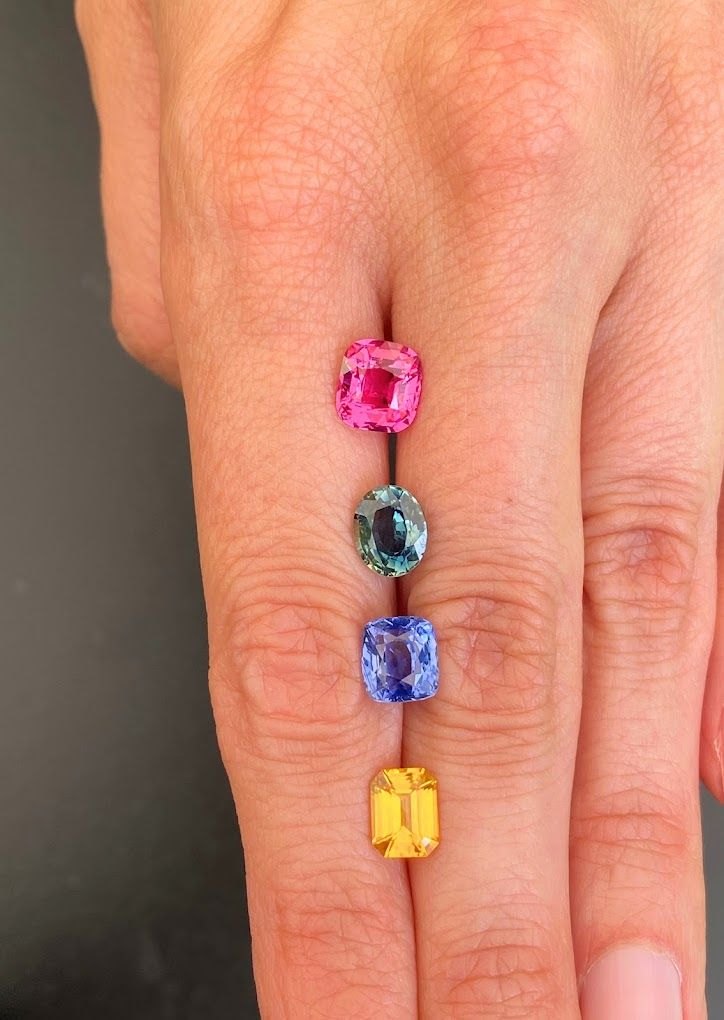
Two two-carat stones can differ by a millimetre and a half in diameter depending on their depth. Many gems are cut deep to retain weight: they weigh more for the same visible surface area. And corundum — sapphire and ruby — is denser than diamond: at the same carat weight, it appears smaller.
A few benchmarks measured from our own stock, rather than a theoretical table:
| Shape and weight | Observed dimensions |
|---|---|
| Round ~1 ct | Diameter from 5.6 to 6.7 mm |
| Oval ~1.5 ct | From 6.7 × 5.1 mm to 8.4 × 6.6 mm (47 stones) |
| Cushion ~2 ct | From 6.6 × 5.6 mm to 8.1 × 6.5 mm |
| Oval ~2.5 ct | From 8.2 × 6.7 mm to 9.8 × 7.6 mm |
Ranges recorded from Bonnot Paris stock, updated in August 2026.
Before buying, ask for the dimensions in millimetres, not just the carat weight — and a video of the stone on a hand. A seller who does not provide them is selling you a number, not a gem.
One question comes before all others: do you prefer a discreet, spectacular, vintage or decidedly contemporary ring? The rest is technical. Here are the three styles we design most often.
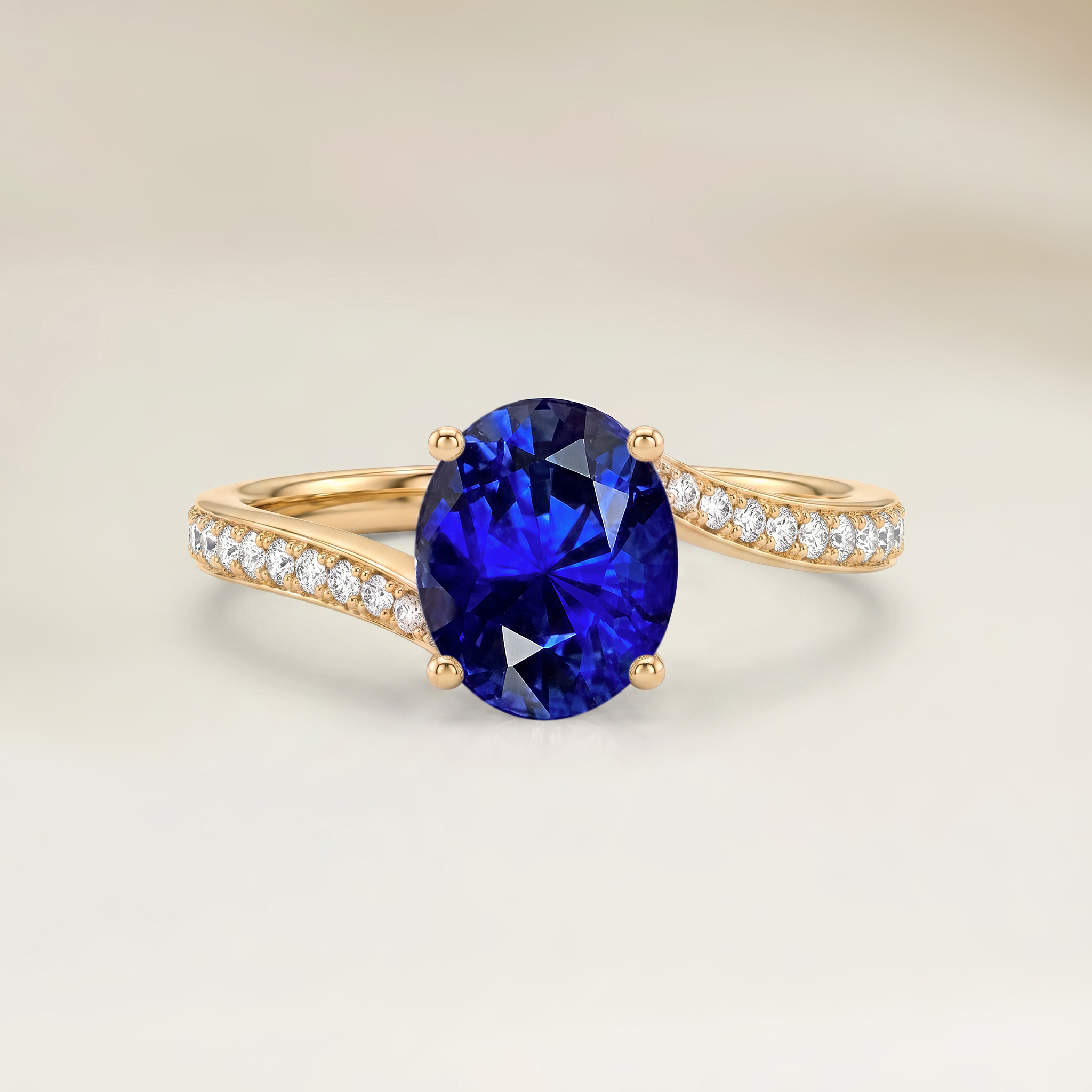
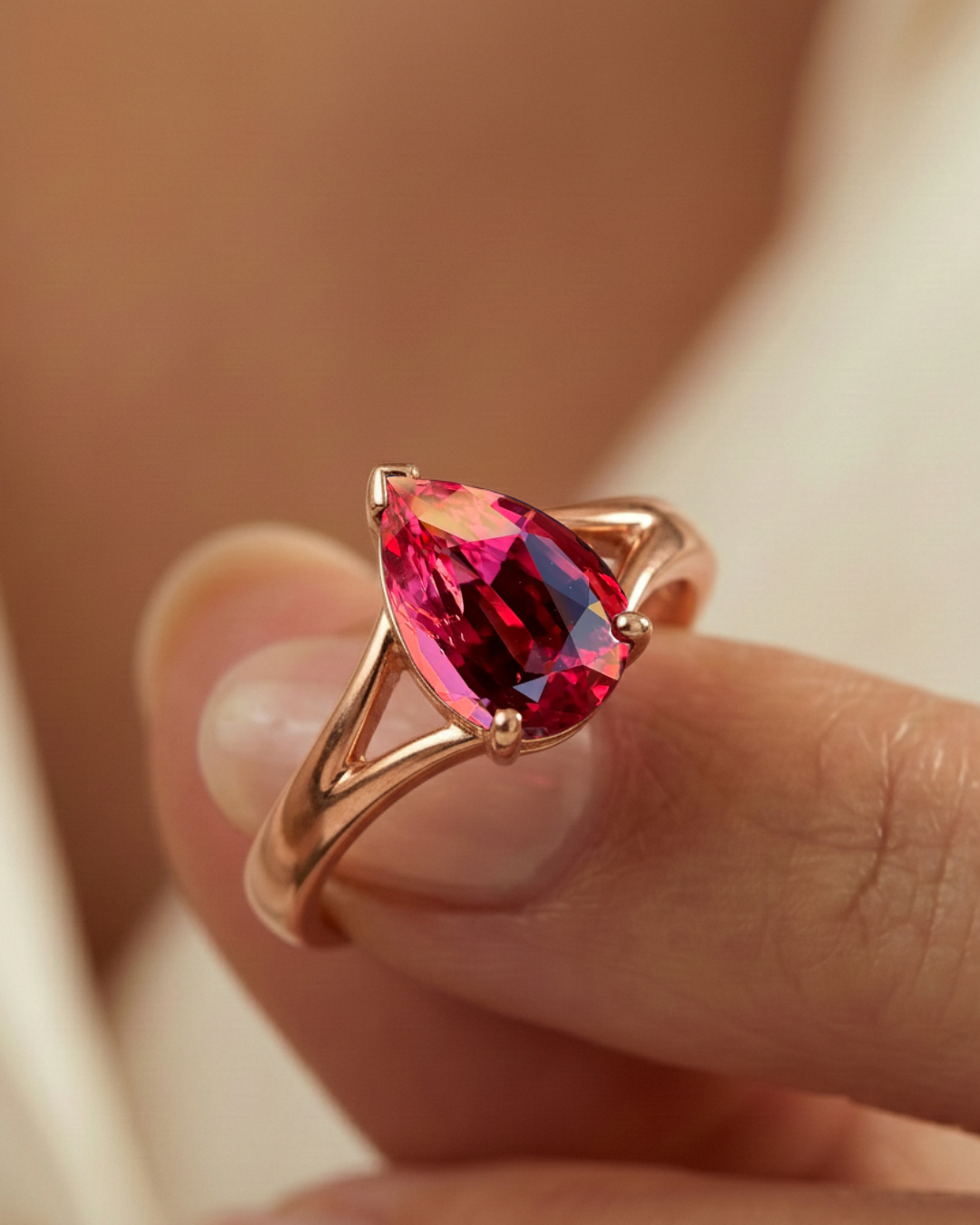
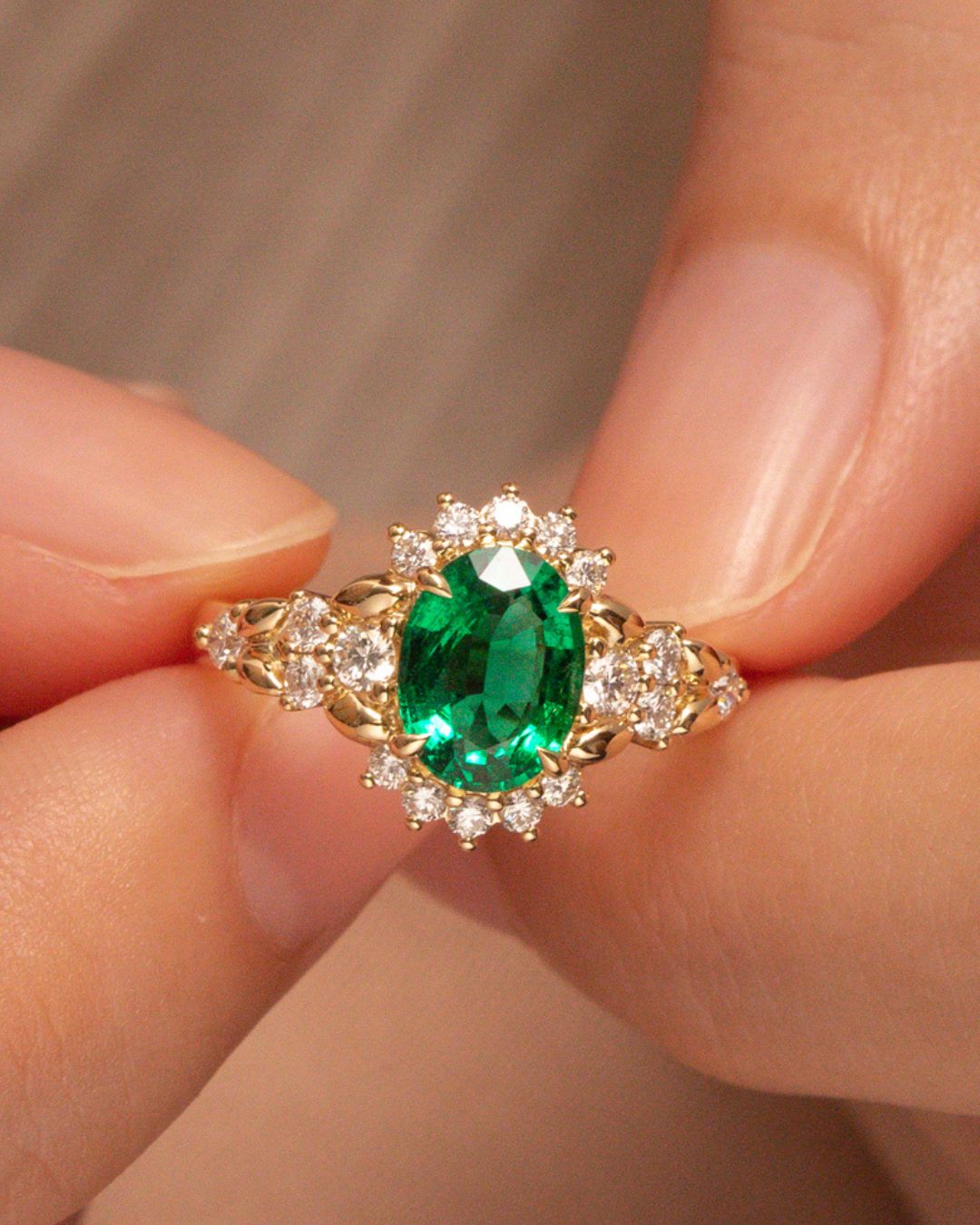
1.55 ct blue sapphire · €5,520
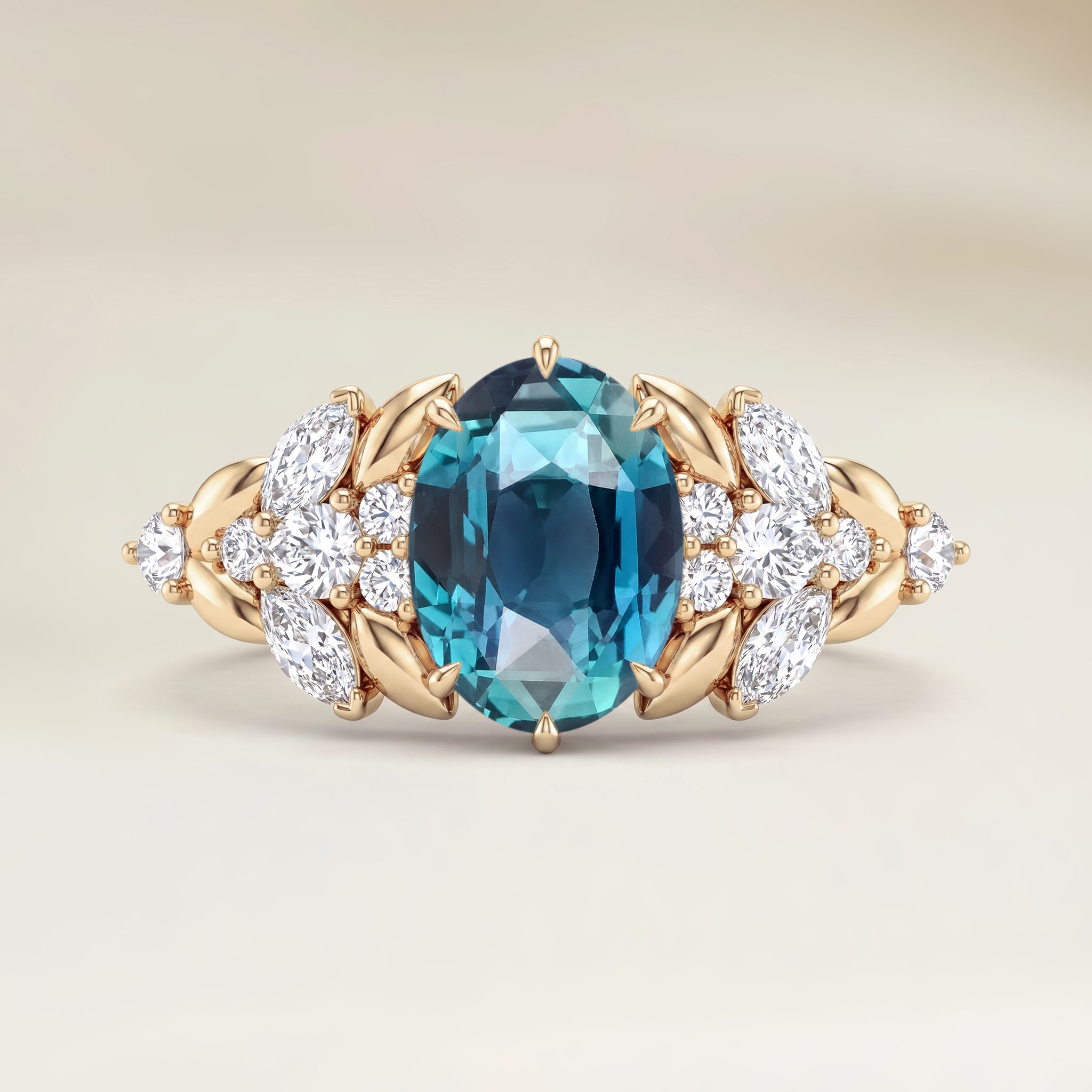
2.01 ct teal sapphire · €8,520

Pink sapphire 2.55 ct · €15,000
Creations available, prices observed in September 2026.
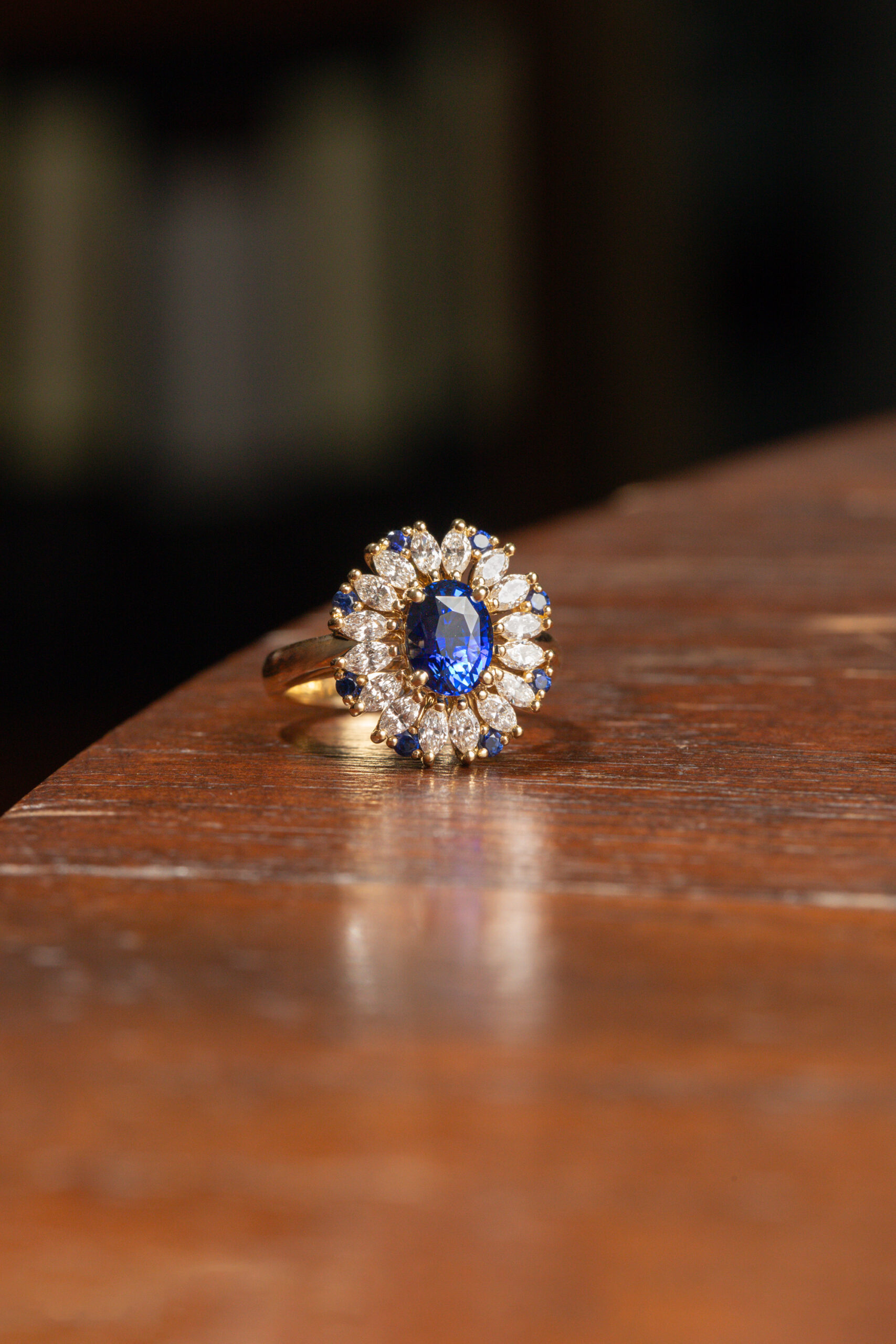
The floral design is particularly well suited to shades between blue and green: it is the design we most often recommend for a teal sapphire engagement ring, because the petal-shaped marquise diamonds broaden the perception of a colour that changes with the light.
Two other designs recur regularly. The daisy surround, a halo of diamonds that visually enlarges the stone and intensifies its colour through contrast — the most spectacular. And the low bezel setting, where the stone is encircled by metal, its edges protected: the safest for a very active hand, at the expense of a little light.
“Will a wedding band sit flush against this ring?” If so, say so at the first appointment. A high-set solitaire leaves an unsightly gap beneath the wedding band; a low setting or a curved band resolves this from the outset. It is infinitely easier to plan for than to correct. How to choose your wedding band →
The metal is not a finishing detail: it changes the perception of the gemstone. This choice is always made with the stone in hand, placing it in turn on each sample.
| Metal | What it does | Care |
|---|---|---|
| Yellow gold | Warms the stone, extending warm tones. The metal of vintage and Art Deco settings. | No surface treatment. |
| White gold | Sharp contrast, maximises the brilliance of accompanying diamonds. | Rhodium plating to be renewed every 2 to 3 years. |
| Platinum | Cool whiteness, the densest metal — it secures important stones. | Naturally white, without rhodium plating. |
| Rose gold | Softens and adds a rosy hue. Best reserved for warm, light tones. | No surface treatment. |
One practical point that is rarely mentioned: white gold is rhodium-plated. This is a surface layer that wears away and is reapplied in the workshop. If the idea of recurring maintenance bothers you, platinum resolves the matter definitively — more expensive to buy, carefree for life.
For a stone intended for an engagement ring, we require an independent laboratory report before approving the project. The laboratory is chosen according to the value of the gemstone: a local report, ICA, IGI or Bellerophon for most stones, GRS above a few thousand euros, SSEF or Gübelin for exceptional stones.
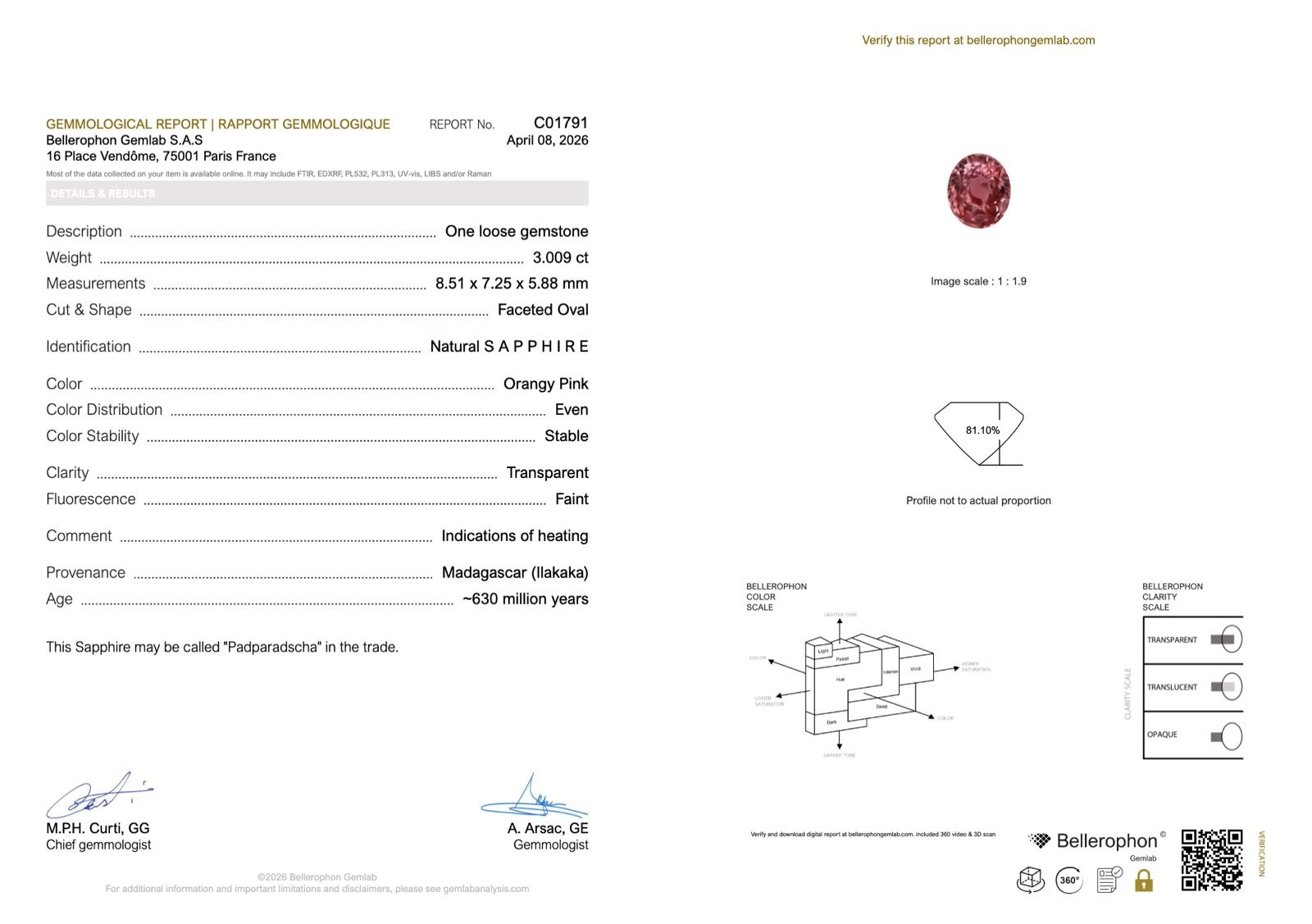
Identification must clearly state natural corundum or sapphire. Any other wording should raise concern. Weight and dimensions : millimetres are more meaningful than carats. Treatment : “no indication of heating” for an unheated stone; any other process must be disclosed. Origin, stated only when the laboratory can reach a conclusion — “origin undetermined” is not a flaw in the stone. Finally the laboratory and a verifiable number.
It establishes neither the quality nor the value of the gemstone. A report confirms a nature, a weight and treatments — it does not replace your eye, nor a comparison between two stones placed side by side. It is a necessary condition, never a sufficient one.
Two decidedly unromantic subjects, yet these are what spoil poorly prepared proposals.
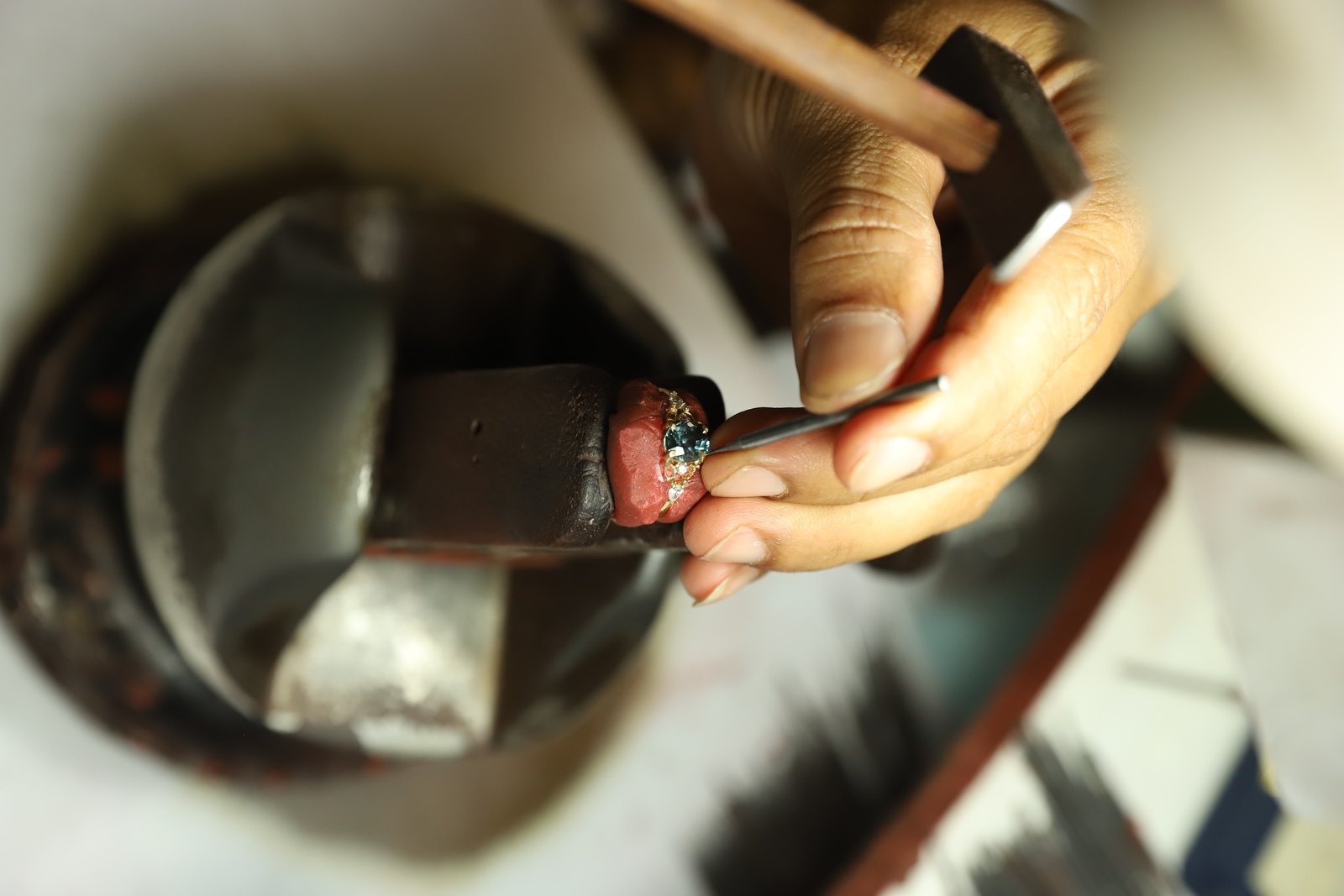
The schedule. Allow six to eight weeks between the first appointment and the presentation of the jewel: one to two weeks for stone selection and design, then three to five working weeks for production once the stone has arrived at the workshop. A rare stone may require additional sourcing time — in that case, we present several gemstones as they arrive.
The size. The most reliable method is still to discreetly borrow a ring already worn on the left ring finger and have it measured. Please note: a ring worn on another finger will not provide the correct size — the difference between the ring finger and the middle finger often reaches one and a half sizes.
The the first resizing is complimentary on our creations. A ring that is slightly too large on the day of the proposal is no problem; a ring that will not fit is. Which finger to wear it on →
With the stone. It determines the budget, proportions and colour; the setting is then designed around its actual dimensions. Reversing this order forces the stone into a design that was not conceived for it — and costs more to correct.
Our sapphire creations start at €2,500 for a 0.7 to 1 ct stone in a beautiful colour on a simple setting. The majority of projects fall between €5,000 and €8,000, allowing for a 1 to 2 ct stone and a fully bespoke setting. Emerald starts at around €1,700, ruby at around €8,000. Prices observed in September 2026.
Millimetres. A carat is a measure of weight: two 2 ct stones can differ by one and a half millimetres in diameter depending on their depth, and as corundum is denser than diamond, it appears smaller at the same weight. What matters is the visible surface on the finger.
The solitaire leaves all the space to colour. Floral and halo settings make the stone appear larger — this is the design we most often recommend for a teal sapphire engagement ring. Art Deco frames it and calls for a step cut. A low bezel setting is the safest option for a very active hand.
For a stone intended for an engagement ring, we require an independent laboratory report before approval. It specifies the nature, weight, dimensions, treatments and often the origin. The laboratory is chosen according to the value of the gemstone — and a certificate alone never establishes a stone’s quality.
Six to eight weeks between the first appointment and delivery of the jewel. Once the stone and design have been approved and the stone has arrived at the workshop, production takes three to five working weeks. A rare stone may require additional sourcing time.
Yes. We send detailed photos and videos of each selected stone, filmed under different lighting conditions and without colour retouching, then provide follow-up via WhatsApp or email. The ring is handed over in person in Paris or shipped by insured carrier. Book a video appointment →
Each family has its own collection and guide. To start with the stone rather than the ring, everything can be explored from the precious stones.
Share this post