Zambian or Colombian Emerald?
Bonnot Paris22/9/2026



In France, an engagement ring is worn on the ring finger of the left hand, the fourth finger from the thumb. This is the custom, shared by most of Western Europe and the English-speaking world. It is not a rule: no text requires it, and no ceremony checks it.
At the workshop, we see more or less every possible variation — and they all work. This guide sets out the convention, its origins, and above all the few practical points that truly matter when having a ring made: wearing it alongside the wedding band, its size, and the stone’s resistance to everyday wear.
Wide bands, never for engagements.
The pointing finger: highly visible, unapologetic.
The widest, often chosen by default.
Engagement ring and wedding band. The custom in France.
Signet ring, fine rings, second band.
Left hand in France. The five fingers, from thumb to little finger, with the custom associated with each.
The explanation everyone knows is called the vena amoris : a vein that the Ancients believed directly connected the left ring finger to the heart. The Egyptians are said to have conceived of it, the Romans to have adopted it, and the West has retained it.
To put it plainly: anatomy has disproved the belief. All fingers are supplied with blood in the same way, and no vein is an exception. What has survived is the gesture—and that is more than enough. A convention need not be true to be beautiful, or to endure for two thousand years.
There is a second reason, more prosaic and probably more decisive. For most right-handed people, the left ring finger is the least used finger on the least used hand. A ring there receives fewer knocks, rubs less, catches less. For a piece of jewellery that is never removed, this is no minor detail.
On a ring worn for fifteen years, wear is not visible on the stone but on the underside of the band, flattened by contact with neighbouring fingers. This can be repaired—rhodium plating, an addition of metal—and that is precisely why one chooses a metal that ages well rather than one that shines on the first day.
The left hand is far from universal. A considerable part of Europe wears the ring on the right, for reasons that are far from incidental: in the Eastern Christian tradition, the right hand is the hand of blessing and oath.
| Country | Hand | What explains the custom |
|---|---|---|
| France | Left | Latin, then Anglo-Saxon heritage. Engagement ring and wedding band on the same finger. |
| Germany, Austria | Right | Engagement on the left, then moved to the right on the wedding day. |
| Russia, Poland | Right | Orthodox and Central European Catholic tradition. |
| Norway, Denmark | Right | Consistent Nordic custom, for both rings. |
| Spain | Right | Mostly on the right, with regions that do the opposite. |
| India | Right | The left hand is traditionally reserved for other uses. |
| Brazil | Right | Ring on the right during the engagement, on the left after marriage. |
These customs overlap, and that is perfectly fine. A Franco-German couple wearing one on the left and the other on the right is doing nothing wrong. When the question arises during our appointments, it is generally settled in one sentence: the ring is worn on the side that feels meaningful to you.
This is the real question, and it always comes afterwards: two rings, one ring finger. Custom dictates that the wedding band is put on first, closest to the heart, with the engagement ring worn above it. This order dates back to the wedding ritual: on the day, the engagement ring is slipped onto another finger, the wedding band is put on, then the engagement ring is put back.
Three arrangements coexist today, and none prevails: both stacked on the left ring finger, the most common; separated, with the wedding band on one side and the engagement ring on the other; or the engagement ring reserved for special occasions, a common choice among those who work with their hands. If you opt for the first, everything depends on the profile of the wedding band.
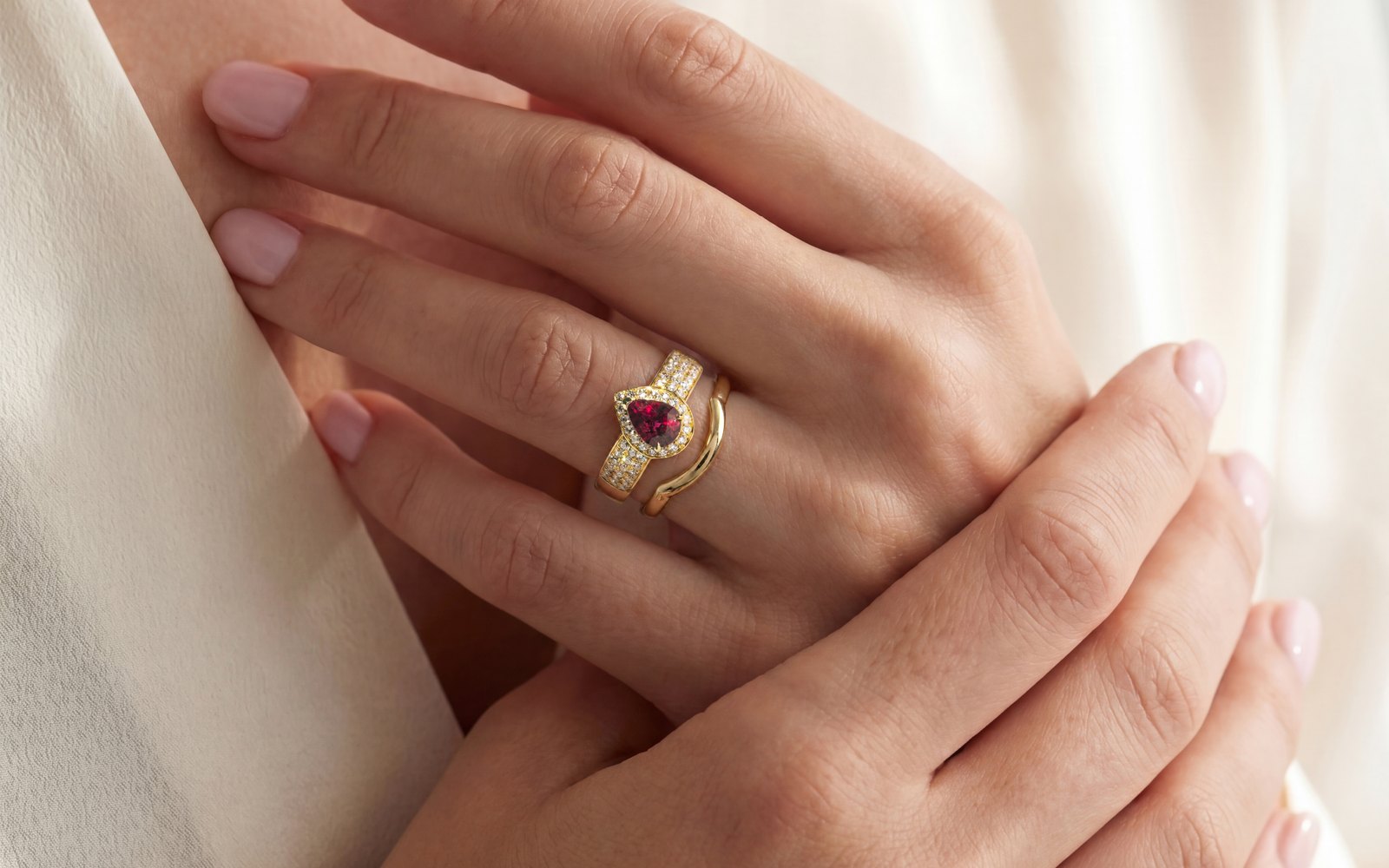
Essential beneath a halo setting, a pear shape or a low-set stone: the curve follows the design of the ring and eliminates any gap between the two bands. It is designed from the actual ring, never from a sketch.
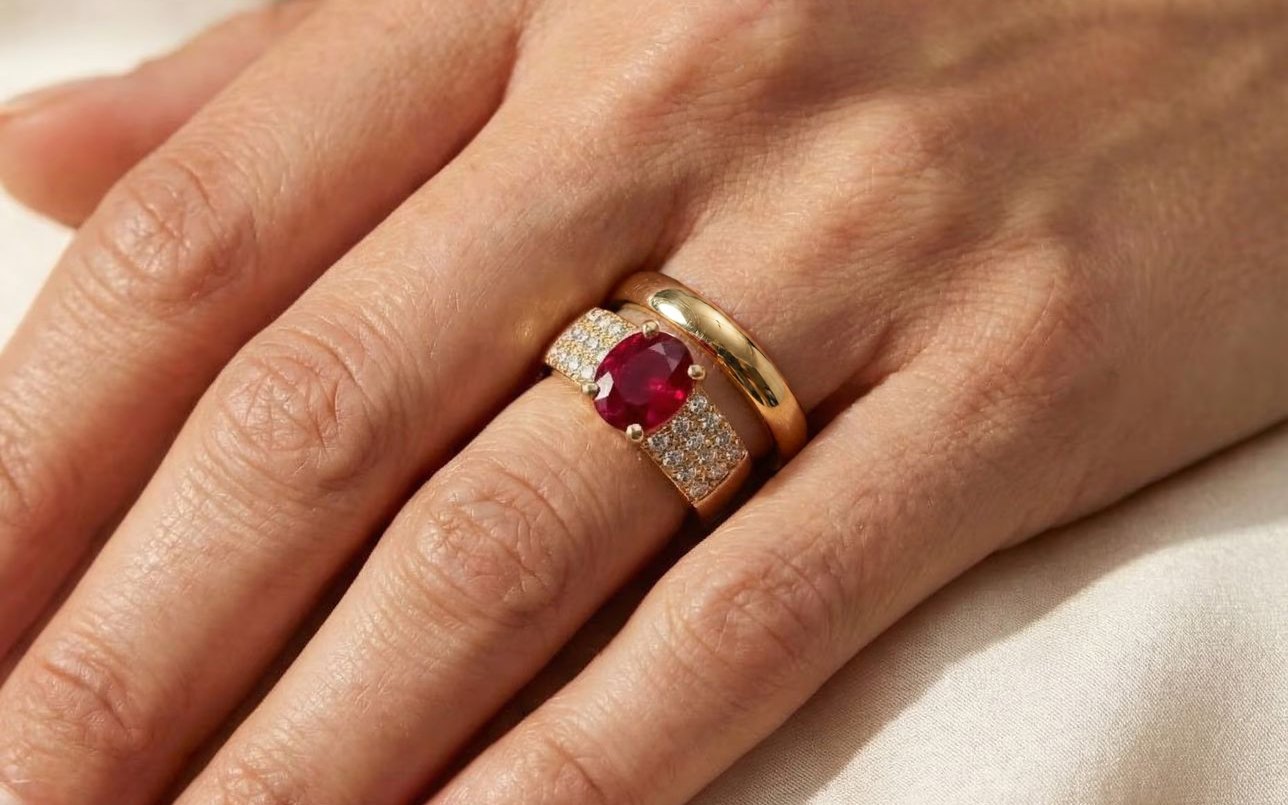
It is suitable whenever the stone is set high enough to allow it to pass. A slight space between the two bands is normal, and often more elegant than constant contact—which, incidentally, eventually wears down both.
As for wearing the two rings on two different fingers, this is increasingly common and perfectly legitimate: a three-carat stone is not always comfortable to wear at the office or at the gym. Two rings, two uses—provided you consider it at the design stage, as a right ring finger almost always requires a different size from the left.
“Will this ring be worn alone or with a wedding band?” If the answer is the latter, it needs to be addressed in the design, not afterwards: a setting designed from the outset to accommodate a band avoids a costly resizing two years later. See the making process →
There are good reasons not to follow convention, and they are almost always practical. Surgeons, healthcare professionals, chefs, craftspeople, athletes: many professions prohibit rings on the hands, or make them risky. This is not a minor detail to work around, but a factor to take into account.
The alternatives work very well. The index finger puts the stone in the spotlight and gives a more assertive look. The middle finger, being wider, accommodates substantial bands. The little finger is suited to fine rings and small stones. And a chain makes an excellent option: the ring can then be worn as a pendant and put back on the finger in the evening.
One point to bear in mind, however: each finger has its own circumference, and the difference between the ring finger and the middle finger often reaches one and a half sizes. A ring cannot be transferred from one finger to another without going through the workshop.
The finger has been chosen; all that remains is to measure it—often in secret. French sizing corresponds to the inner circumference in millimetres: a size 52 measures 52 mm around. Four points make the difference between a ring that fits perfectly and one that needs resizing.
Borrow a ring already worn on the left ring finger, and only that finger. A middle-finger ring will be one and a half sizes too large.
At the end of the day, at a normal temperature. A finger measured upon waking or after exercise can vary by a full size.
A wide band feels tighter. Above 4 mm, an additional quarter to half size is generally allowed for.
A plain band is easily resized. A fully pavé band, much less so: it is best to get it right.
Proposing with a ring that is slightly too large is not a problem: resizing is included in our bespoke creations. A ring that is too small and will not go on the day, however, takes something away from the moment. When in doubt, choose a larger size. Prepare your proposal →
A ring worn on the ring finger is worn every day, for a lifetime. It knocks against door handles, dips into washing-up water, and gathers dust beneath the setting. This rules out certain stones and points to others — this is where the choice of finger and the choice of gemstone come together.
| Stone | Hardness (Mohs) | Daily wear on the ring finger |
|---|---|---|
| Diamond | 10 | Without reservation. The absolute benchmark for durability. |
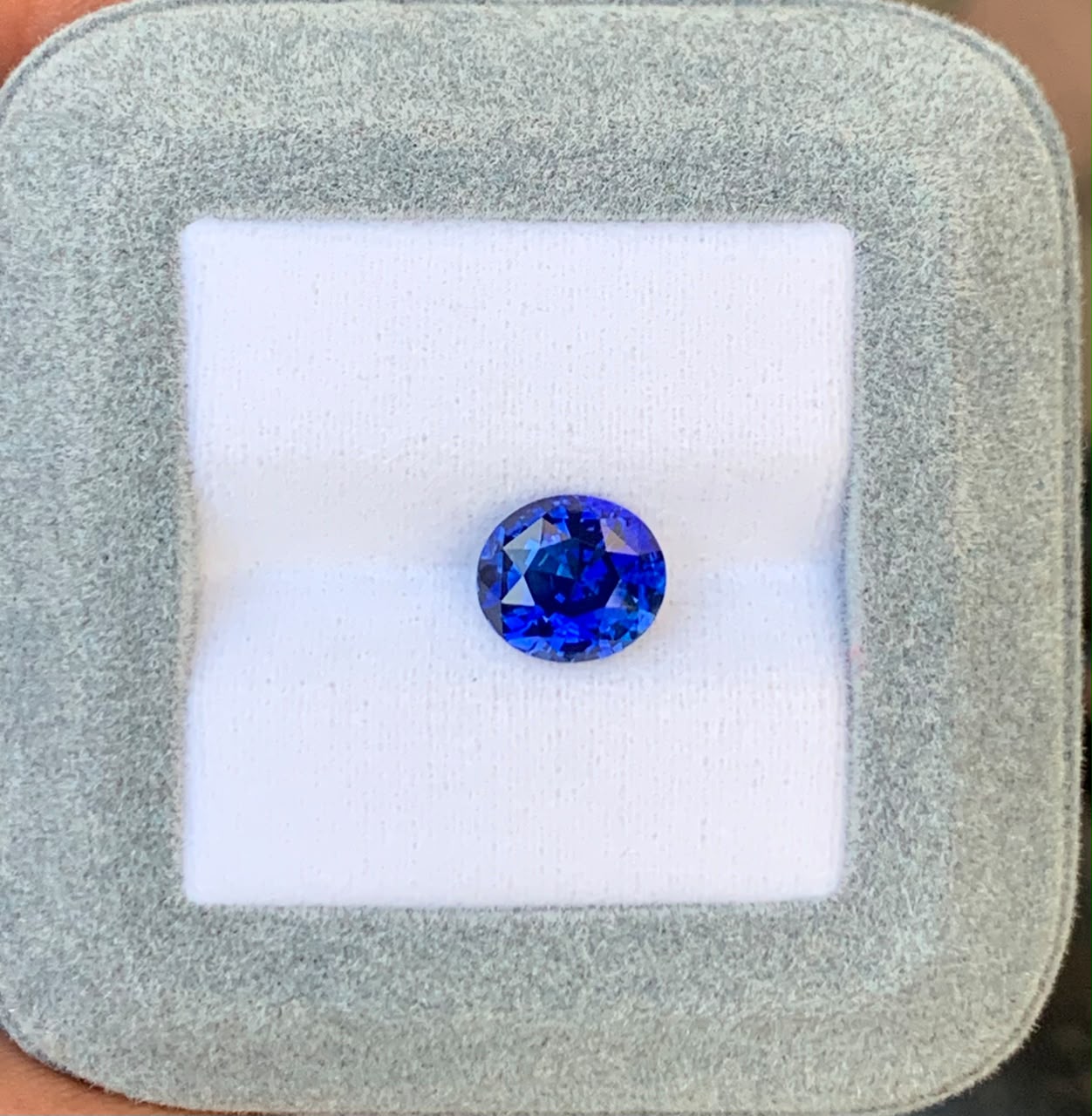
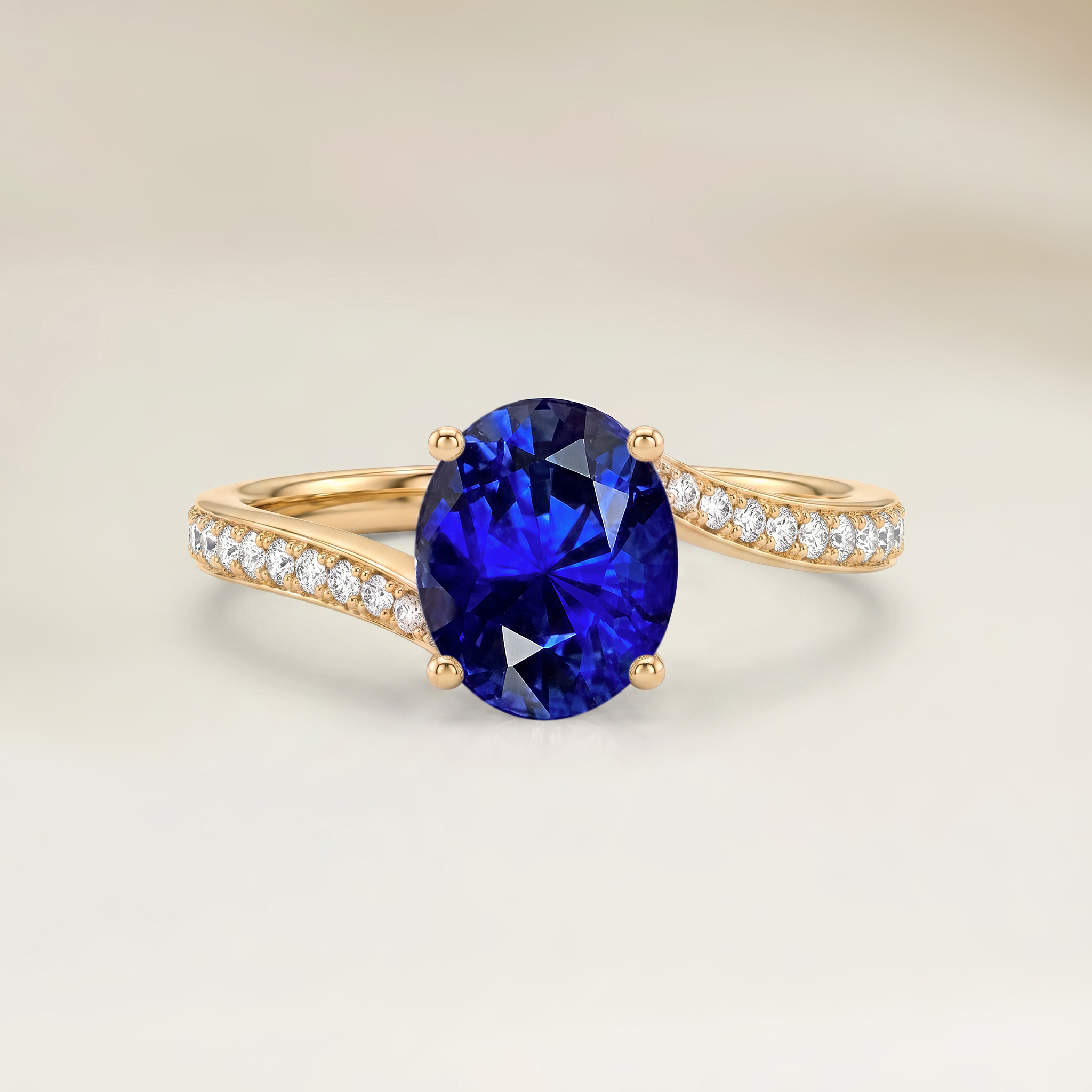
| Sapphire | 9 | Without reservation. The best colour / durability ratio on the market. |
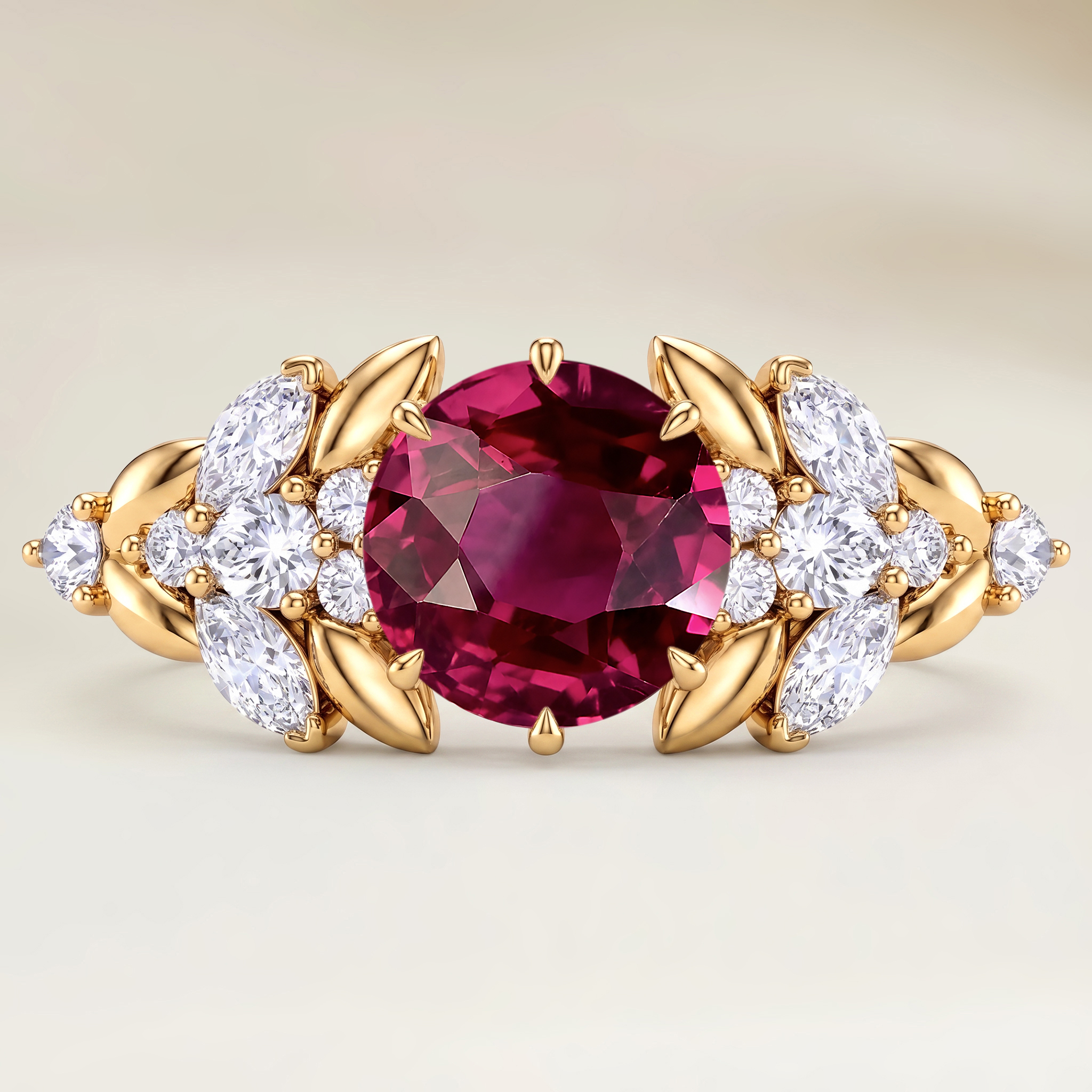
| Ruby | 9 | Without reservation. The same mineral as sapphire, with the same strength. |
| Emerald | 7,5 – 8 | Yes, with a protective setting. Its inclusions make it sensitive to impacts. |
| Opal, pearl | 5 – 6,5 | Not recommended for the ring finger. Best reserved for dress rings. |
Corundum — sapphire and ruby — is the natural choice for a ring that is never removed: 9 out of 10 on the Mohs scale, just behind diamond. A ruby engagement ring withstands twenty years on the left ring finger without flinching, and the same applies to sapphire engagement rings, in every colour.
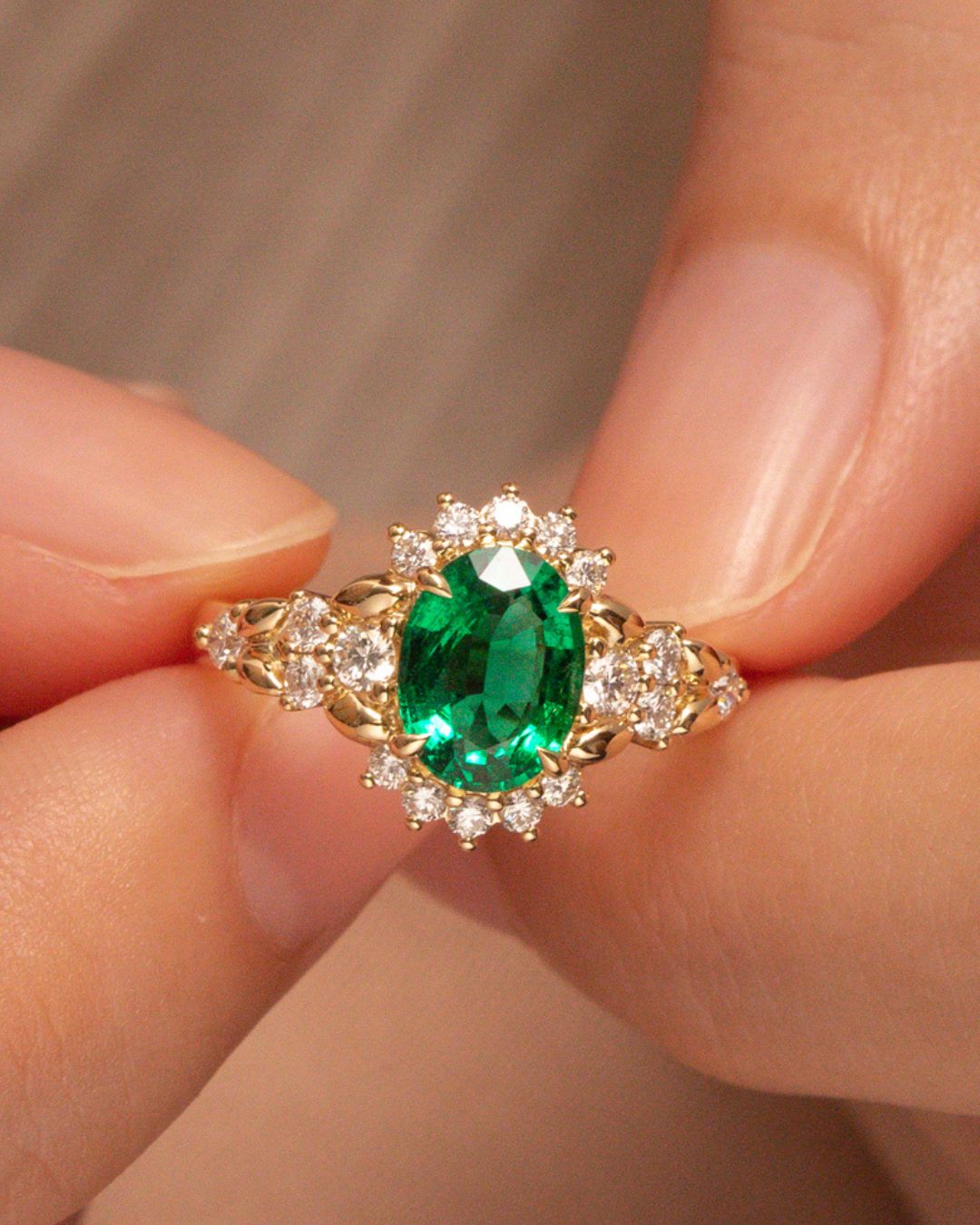
Emerald requires a little more care, without being ruled out for all that. Its hardness remains respectable; it is its structure, almost always threaded with inclusions, that makes it sensitive to sharp impacts. An emerald engagement ring wears very well every day, provided the setting protects the stone’s corners — which is exactly what the so-called “emerald” cut, invented for this purpose, does.
View the collection →
View the collection →
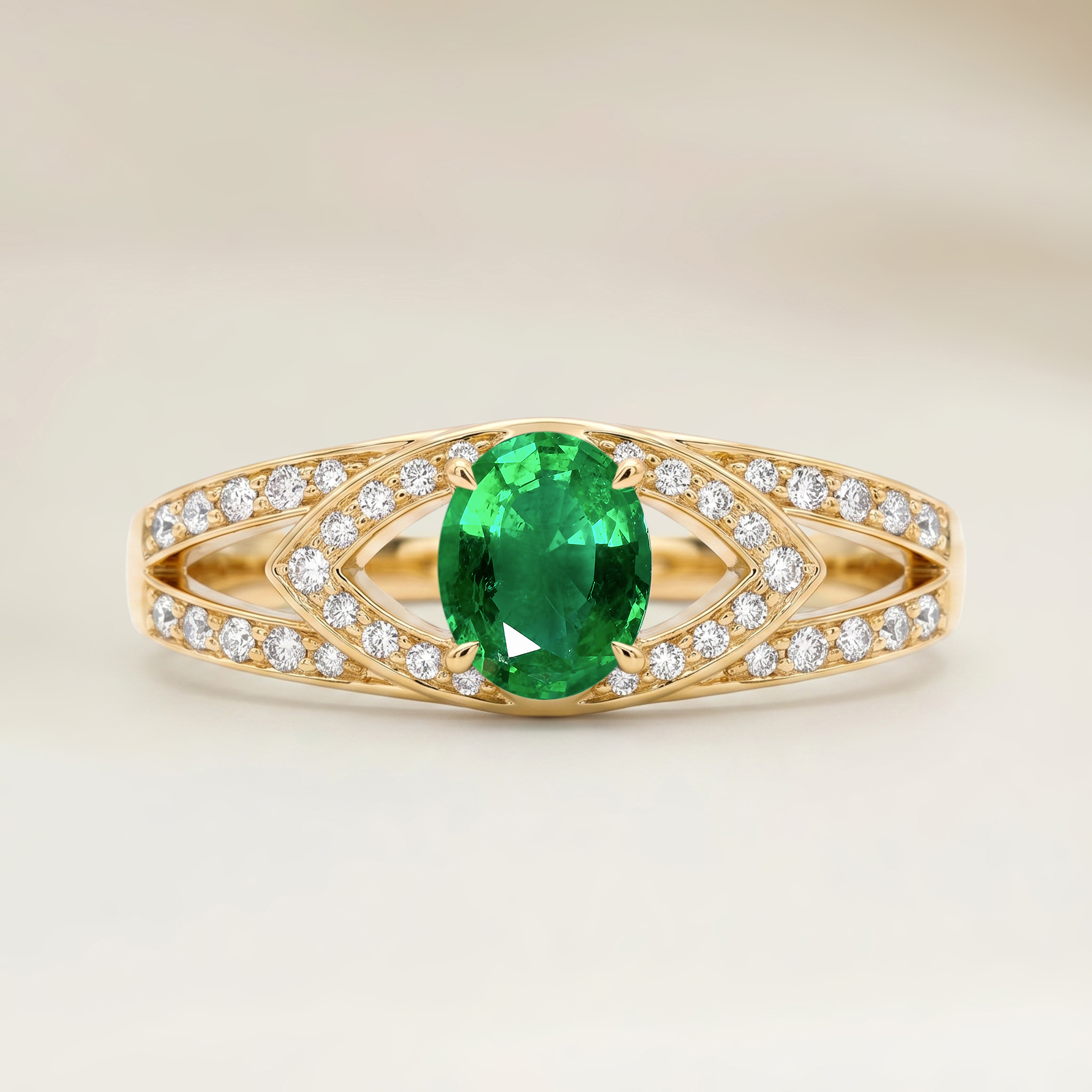
View the collection →
Creations from our workshop, set in Paris in 18-carat gold or platinum.
We are often asked which stone “holds up” best. The real answer lies less in the stone than in the setting : an emerald in a bezel setting will last longer than a sapphire mounted on four overly fine prongs. The choice of finger, gemstone and setting form one and the same trade-off. How to choose an engagement ring →
On the ring finger of the left hand, the fourth finger from the thumb. This is French custom, shared by most of Western Europe and the English-speaking world. Nothing requires it: it is a convention, not a rule.
The tradition comes from the vena amoris, a vein that the Ancients believed connected this finger directly to the heart. Anatomy has disproved the belief: all fingers are supplied with blood in the same way. The custom, however, has endured. There is also a practical reason: for most people, the left ring finger is the least used finger on the less-used hand.
In Germany, Austria, Russia, Poland, Norway, Denmark, Spain and much of Central and Eastern Europe. In India, as the left hand is traditionally reserved for other uses, the ring is worn on the right. In Brazil, it often moves from the right hand to the left on the wedding day.
Custom has it that the wedding band is put on first, closest to the heart, with the engagement ring worn above it. In practice, three options coexist: both stacked on the same finger, the wedding band on the left and the engagement ring on the right, or the engagement ring reserved for special occasions. The workshop can also design a wedding band contoured to fit the ring.
Borrow a ring already worn on the left ring finger and have it measured, or note its inner diameter. A ring worn on another finger will not give the correct size. Measure at the end of the day, at a normal temperature. The size can then be adjusted in most cases — except for a fully pavé-set band.
Sapphire and ruby, both rated 9 on the Mohs scale, are the most durable after diamond: a ruby engagement ring is entirely suitable for everyday wear. An emerald engagement ring, between 7.5 and 8 and often included, requires a protective setting and a little attention: it is a matter of setting, not a prohibition.
Yes. The index finger, middle finger or little finger are all perfectly suitable, and some people wear it as a pendant. The only real constraints are professional or practical: manual trades, gloves, medical equipment. The choice of finger belongs to the person wearing the ring.
All our creations are designed for a specific finger and made in Paris in 18-carat gold. Loose stones, meanwhile, can be explored from the precious stones.
Share this post