Zambian or Colombian Emerald?
Bonnot Paris22/9/2026



This is what sets it apart. Sapphire and ruby are judged by their colour and transparency; emerald is judged by its green and by the inclusions it tolerates. Its jardin is not a manufacturing accident: it is its signature.
This guide explains what it is, what oiling changes, where the stones come from, why a cut bears its name, and above all which setting it requires —the only real constraint of an emerald ring.
A green variety of beryl —a mineral species distinct from corundum—coloured by chromium and sometimes vanadium. The same family produces aquamarine, in blue, and morganite, in pink.
| Characteristic | Emerald | For comparison |
|---|---|---|
| Species | Beryl | Corundum for sapphire and ruby |
| Mohs hardness | 7,5 – 8 | 9 for corundum |
| Density | Lower | At equal weight, it appears larger than a sapphire |
| Inclusions | Expected: the “garden” | Penalising in a sapphire |
| Common treatment | Colourless oil | Heating in corundum |
Note the line on density, rarely mentioned yet useful: the emerald is less dense than corundum. At equal weight, it offers a larger visible surface area. This is one of the reasons why we think in millimetres on the finger rather than carats.
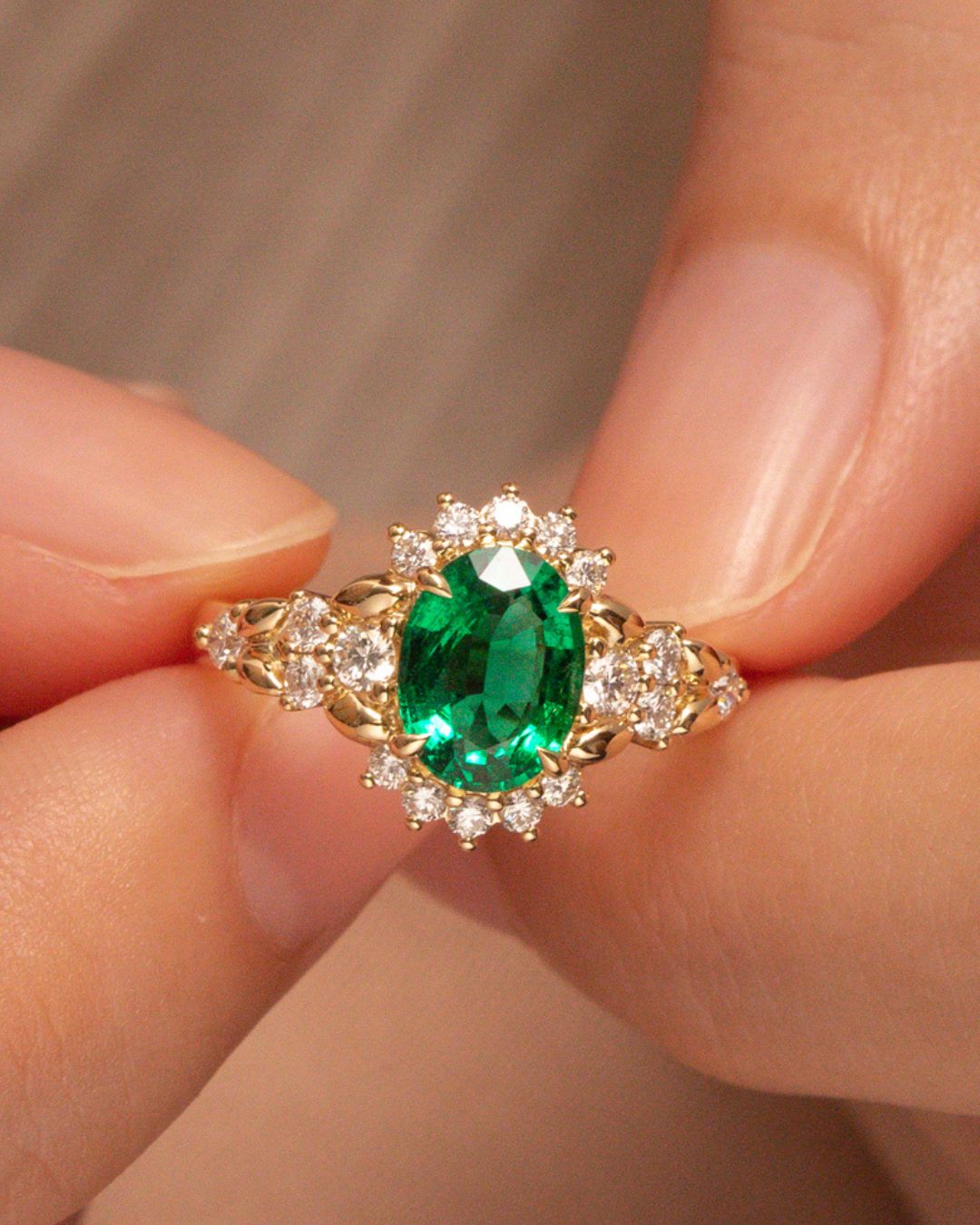
The trade calls garden the full set of an emerald’s natural inclusions: tiny crystals, veils, healed fissures, sometimes bubbles. Viewed under a loupe, it does indeed resemble a landscape.
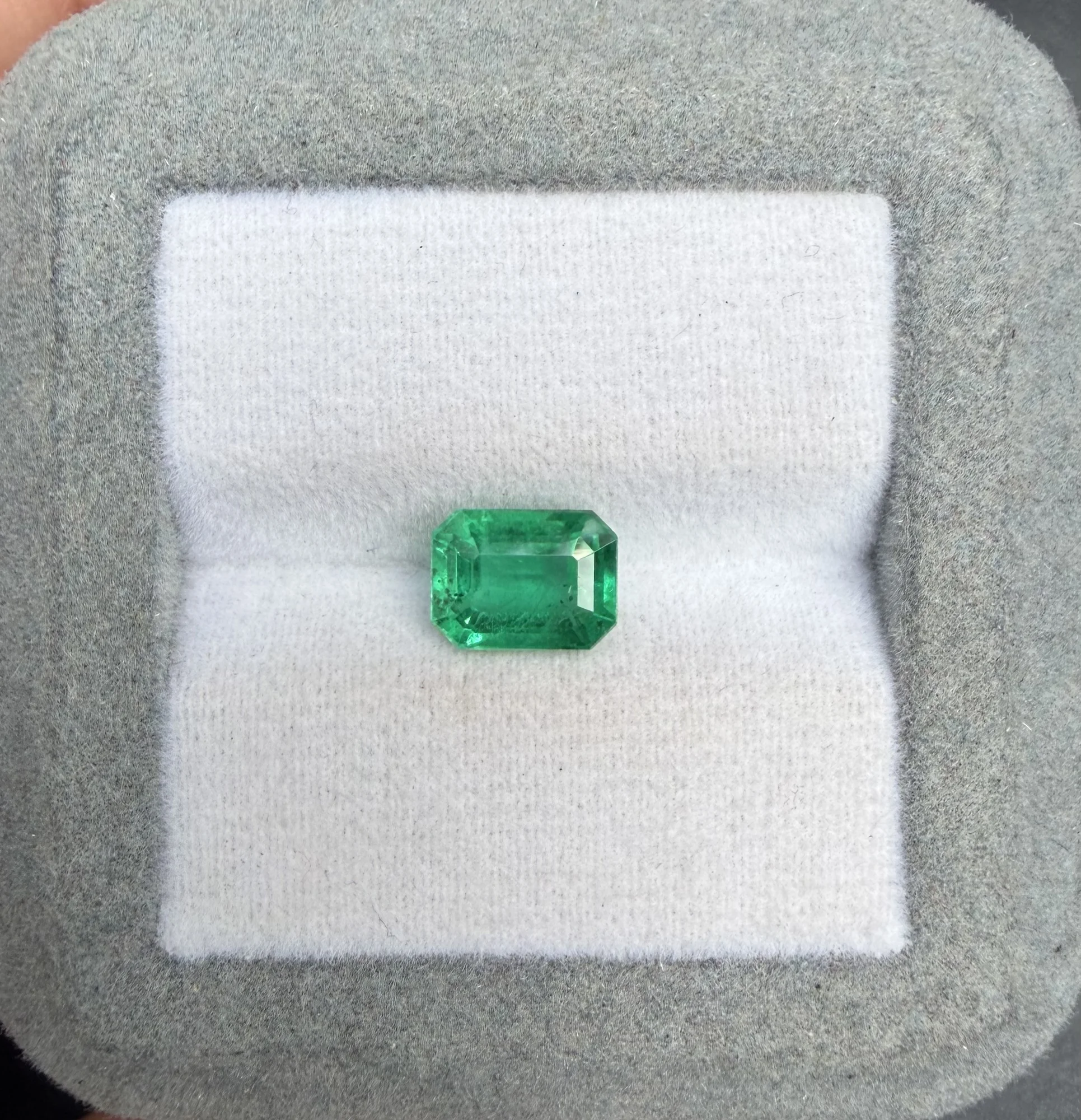
Contrary to popular belief, it is not a flaw — it is the norm for the species. Emeralds form under turbulent geological conditions that almost always trap something. The world’s finest stones have a garden.
It becomes a problem in only two cases: when it clouds the transparency face-up, that is, when the stone appears milky when viewed from above, and when a significant fissure reaches the surface and weakens the gem. The rest is a matter of character.
An emerald perfectly clean under a loupe, sold at a low price. It is not impossible, but it is rare and comes at a very high price. On a modest budget, perfection points towards a hydrothermal synthetic or another green species.
The vast majority of emeralds receive colourless oil which fills surface fissures and improves the readability of the green. It is an ancient, traditional practice accepted by the market — not a deception, provided it is disclosed.
What matters is the degree, and the laboratory report always specifies it.
| Degree | What it means | Effect on value |
|---|---|---|
| None | The stone has received no treatment. Rare. | Significant premium |
| Minor | Few fissures to treat initially. | Better valued |
| Moderate | The most common case on the market. | Benchmark |
| Coloured resins | They conceal fractures and age poorly. | Excluded from our selections |
The final line is the only red line. Coloured resins and polymers are refused, without exception: they fill significant fractures, change in appearance over time, and the stone is worth very little once the treatment has been identified. The certificate always mentions them — this is the first thing to check.
Three countries dominate global production, and each has its own character.
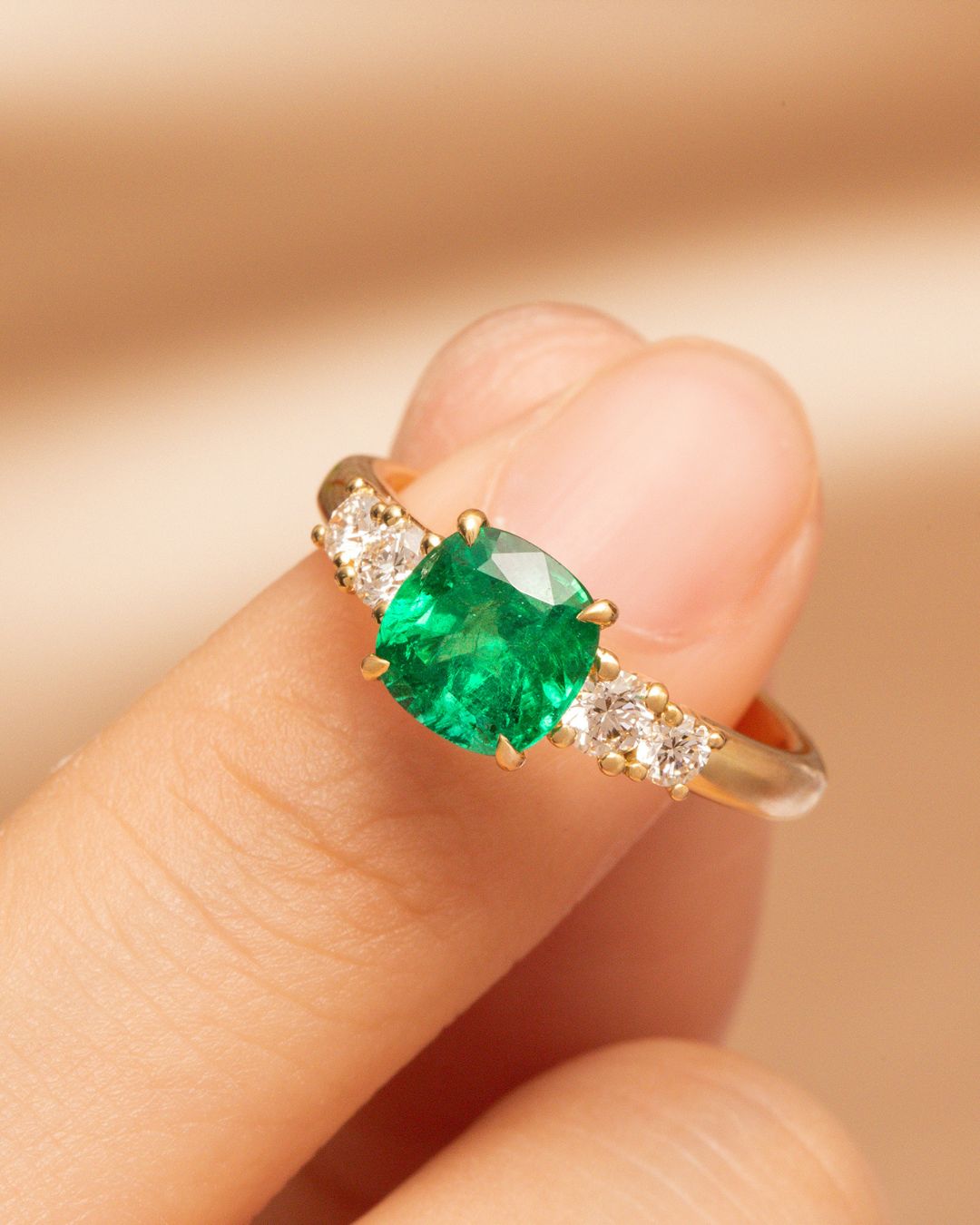
Colombia Colombia retains its historic prestige — the Muzo and Chivor deposits have supplied the market for five centuries — and produces greens that are often purer, sometimes slightly yellowish. Zambia produces bluer greens, generally cleaner and more even. Brazil completes the offering with lighter shades.
Let us be frank about what we have: our current selection is Zambian. We buy these stones in Jaipur, where they are cut, and select them for their consistency of colour and transparency. A Colombian emerald is sourced by us through a dedicated search, with the lead time this entails.
Origin explains a character, never a quality. A beautiful stone from Zambia surpasses an average stone from Colombia, and the reverse is also true. Moreover, a laboratory only determines origin when the inclusions allow it — “origin undetermined” is not a flaw in the gemstone.
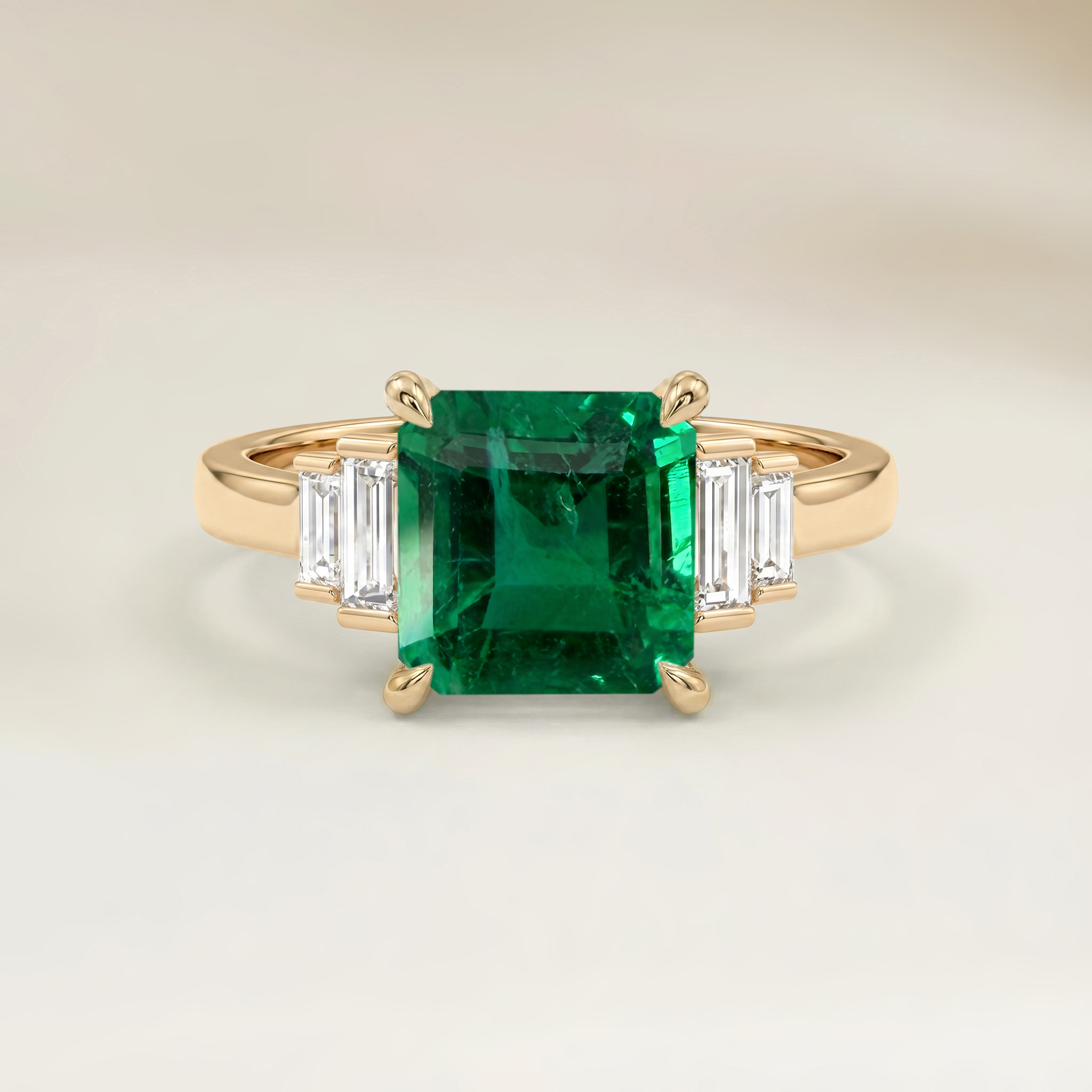
A cut bears the name of this stone, and it is not a tribute: it is a technical solution.
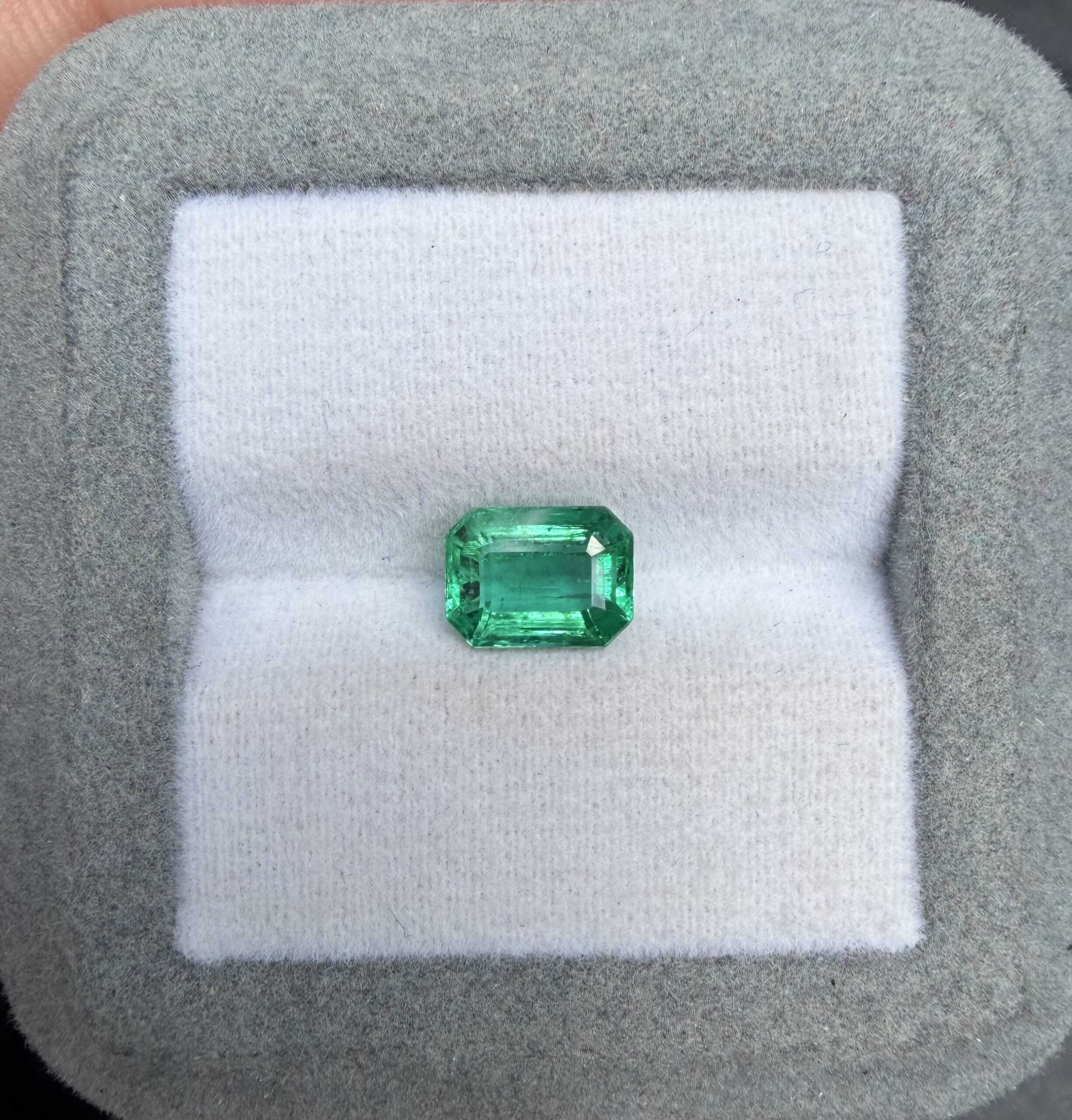
Two reasons explain this. First, protection : a stone criss-crossed with inclusions does not withstand sharp corners well, as they concentrate stress and chip. Cutting the corners removes the weak points. Then, the way colour is read : the long step facets create a mirror effect rather than sparkle, unfolding the green in broad areas — exactly what one wants to see in an emerald.
A useful point of vocabulary, because it causes confusion when buying: “emerald cut” refers to a shape, not a stone. Sapphires, diamonds and tourmalines can be cut in an emerald cut. Conversely, an emerald can be oval, cushion or pear-shaped.
This is the only real practical difference between an emerald ring and a sapphire ring, and it is resolved through design.
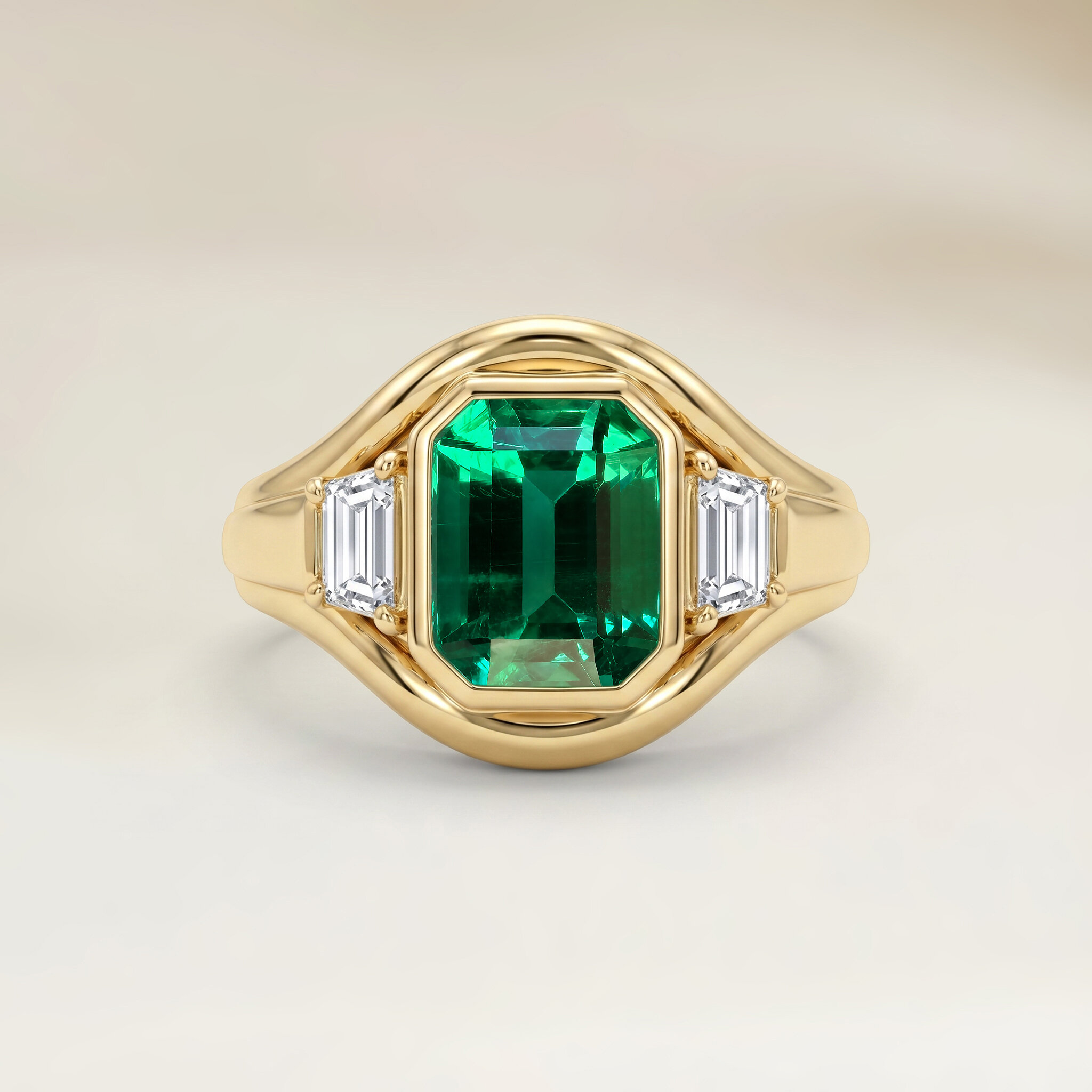
Bezel setting, corners protected by metal, lowered setting: the stone fears sharp impacts more than scratches. This design resolves the question for thirty years. Set ring — 11 040 €.
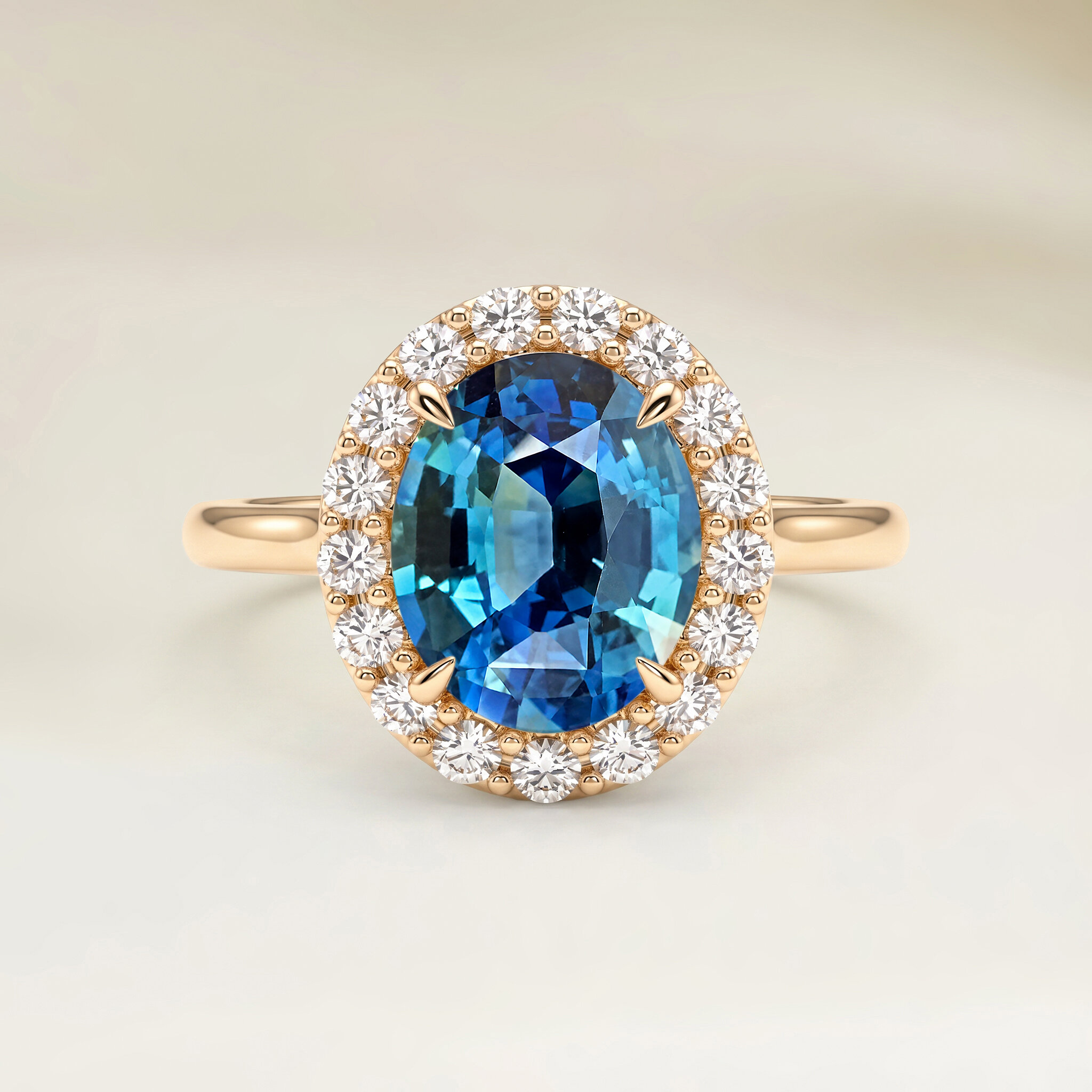
Hardness 9, no cleavage plane: every setting is possible, including the most openwork designs. A sapphire engagement ring can be designed without having to consider this question. Set ring — 7 440 €.
This is not about giving up on emeralds — we set them every week. It is about knowing beforehand, not afterwards. In practical terms: a bezel setting or a design that protects the corners, and the ring should be removed for gardening, sport and housework. That is all.
A note for projects involving two rings: beneath an emerald, we almost always design a notched wedding band, even when the geometry would allow a straight band. Repeated metal-on-stone friction against the stone’s edges is the most underestimated risk in these pairings.
If it is green that appeals to you more than the emerald itself, another family is worth considering — and we regularly offer it during appointments.
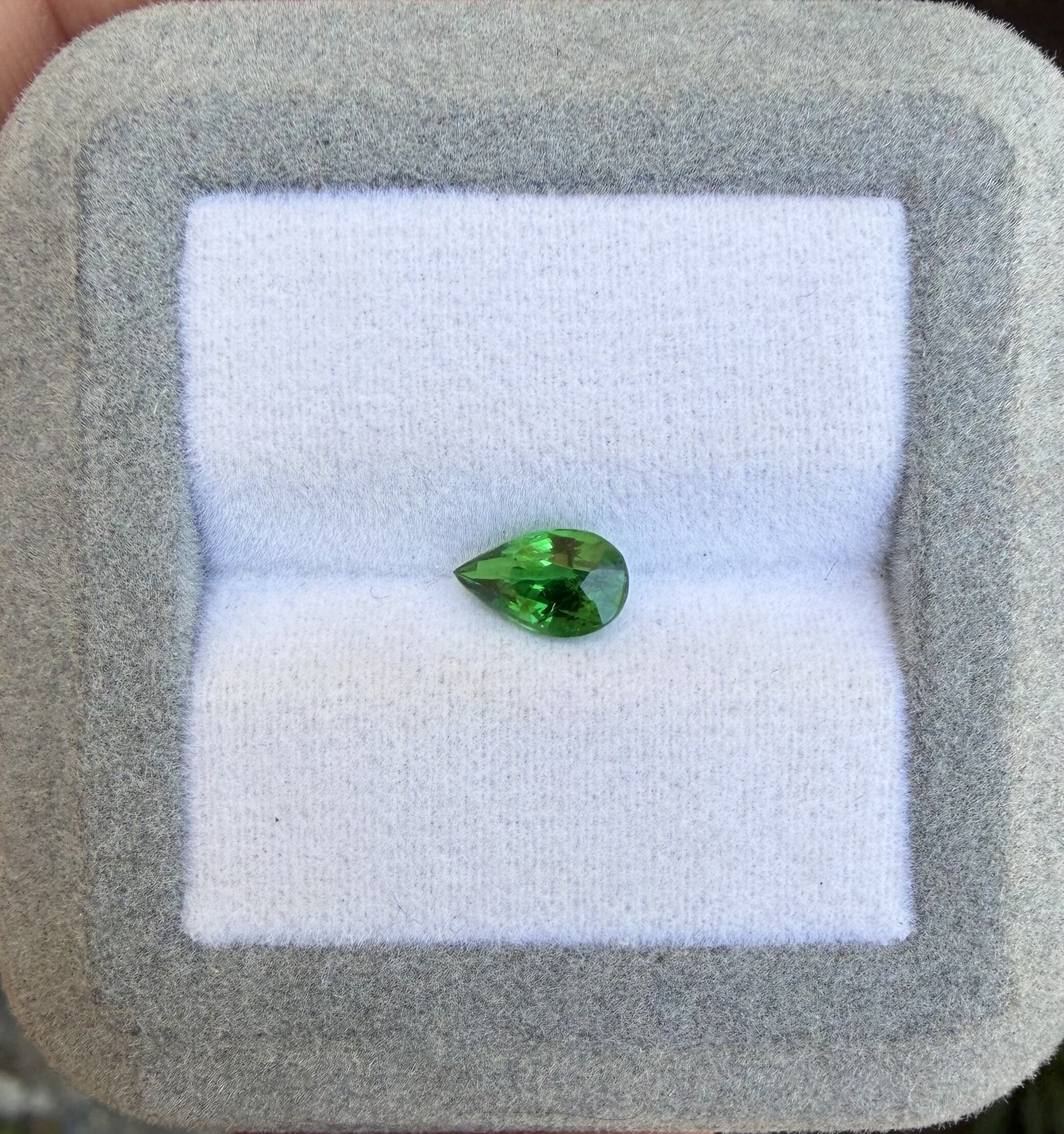
Tsavorite is a green garnet discovered in East Africa around fifty years ago. It has three advantages: a green often more vivid than that of an emerald of equivalent grade, generally greater transparency — the jardin is foreign to it — and, above all, no treatment, as garnets are neither heated nor oiled.
Two reservations, stated frankly. Its hardness of 7 to 7.5 is comparable to that of emerald: the same setting precautions apply. And large tsavorites are rare — beyond two carats, prices quickly catch up with those of emerald. In ring sizes, however, a tsavorite garnet engagement ring remains a very serious alternative.
Price. There is no price scale for emeralds: their value depends first on the intensity and vibrancy of the green, then on transparency, the degree of oiling and size. Within the same weight range, the difference in price per carat in our stock can reach a factor of three. Our set creations start at 1 700 €, and the heart of the collection lies between €4,000 and €10,000. Detailed figures can be found in our emerald price guide.
Care. Warm water and mild soap, a soft brush, once a month — paying particular attention beneath the setting, where a film of cream and dust accumulates. And two absolute prohibitions: no ultrasound, no steam. These methods expel the oil, and the stone loses clarity.
The good news in return: over the years, the workshop can refresh the oiling. This is normal maintenance, comparable to rhodium plating a white gold ring — not a repair.
Remove the ring before applying hand cream, cleaning or gardening. With an emerald, the main risk is not scratching but a sharp impact on an edge — a door handle, a worktop. Have the setting checked every two years, complimentary for life on our creations. Caring for your gemstones →
A green variety of beryl, coloured by chromium and sometimes vanadium. Hardness 7.5 to 8, compared with 9 for sapphire. It is almost always crossed by inclusions — the jardin — and oiled in the vast majority of cases.
No: it is the norm for the species, and attests to the stone’s natural origin. It only becomes a problem when it impairs face-up transparency or weakens the gem. A perfectly clean emerald at a low price should, on the contrary, raise questions.
A traditional and accepted practice: a colourless oil fills surface fissures and improves the readability of the green. The laboratory report always specifies the degree — none, minor, moderate. A lightly oiled stone is rarer, and therefore more highly valued at equivalent quality. Coloured resins and polymers, however, are excluded from our selections.
Mainly from Colombia, Zambia and Brazil. Colombia retains its historic prestige and produces greens that are often purer; Zambia produces more bluish greens that are generally cleaner. Our current selection is Zambian; a Colombian emerald is sourced through a dedicated search.
Because it was designed for this stone: its clipped corners protect the edges of a gem sensitive to impact, while its long step facets unfold the green like a mirror. It is a shape, not a stone — sapphires and diamonds are also cut in an emerald cut.
Yes, provided the setting protects the edges. Emeralds fear sharp impacts more than scratches: a bezel setting or a design that shelters the corners resolves the issue, and the ring should be removed for gardening, sport and housework.
Lukewarm water and mild soap only. No ultrasound, steam or hot water: these methods expel the oil. Over the years, the workshop can refresh the oiling — this is normal maintenance, not a repair.
All loose stones, with their characteristics and prices, can be explored from the emerald.
Share this post