Zambian or Colombian Emerald?
Bonnot Paris22/9/2026
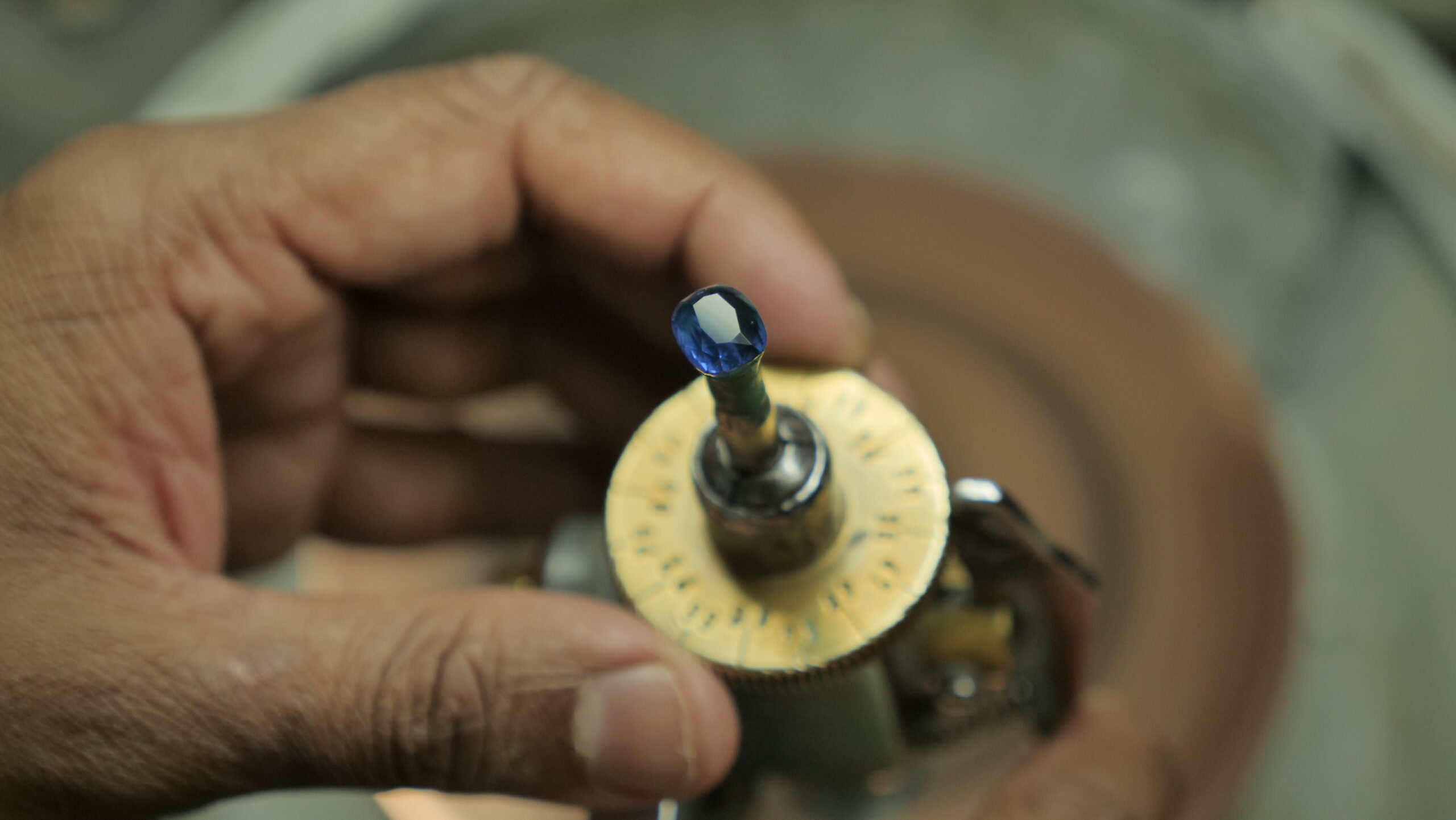



Cutting a gemstone means giving it shape, proportions and facets to reveal its colour, brilliance and play of light. The facets guide light into the heart of the stone, then return it to the eye: this is how brilliance, depth and that “life” that seems to animate it are born. The lapidary works like a sculptor — releasing a silhouette hidden within the material, whether it is a sapphire or a tourmaline.
Since 2002, the term “semi-precious stone” has been prohibited in trade in France. Aside from diamond, sapphire, ruby andemerald, we refer to a fine stone — see our guide to recognising a precious stone.
It affects both beauty and value. A cut that is too deep or too shallow lets light escape: the stone appears dull, even if it is pure and well coloured. A skilfully executed cut, on the other hand, offers crisp brilliance, regular scintillation and inner clarity.
Between two otherwise identical stones, the difference is immediately apparent: one lights up, the other fades. It is the only one of the four grading criteria that does not depend on nature, but entirely on the human hand — and it is also the one you can judge for yourself, with a little practice.
| Shape | What it offers | Who it suits |
|---|---|---|
| Brilliant — round | The benchmark Maximum sparkle and symmetry, with proportions designed for optimal light return. Conceals inclusions well. | Long, slender fingers |
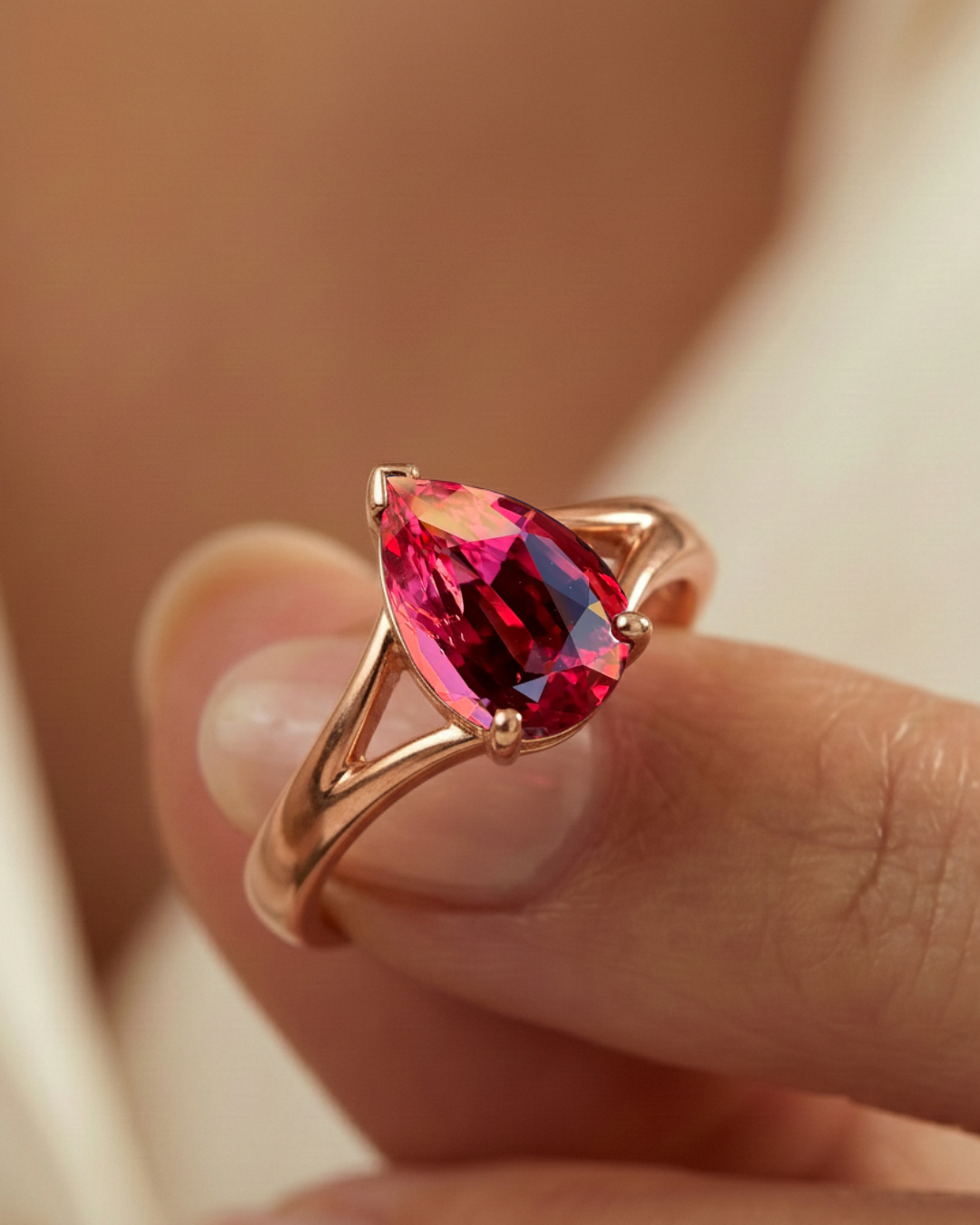
| Oval · Pear · Marquise | Elongated shapes with fluid elegance, which give greater volume at equal weight. | Short fingers — they elongate the line |
| Cushion | A square with rounded corners, softer than the princess cut. An excellent carrier of colour. | Almost everyone |
| Emerald cut — rectangular with cut corners | Broad planes that open up the stone: one looks inside rather than at the surface. Absolute classicism. | Short fingers, very pure stones |
| Princess — square | A modern, graphic look, while retaining plenty of brilliance. Superb on spinels. | Contemporary styles |
| Baguette | A small, pared-back, architectural rectangle. Rarely a centre stone, often used as an accent. | Art Deco spirit |
| Heart | The most demanding to execute successfully: the symmetry of the central cleft forgives nothing. | A gesture, more than a style |
The choice of shape also depends on the hand that will wear the ring — our guide on which finger to wear the engagement ring sets out what each body type calls for.
This is where the essentials are decided, and the reasoning is not the same as for a diamond. There are two families of cuts, which do not serve the same purpose.
Round brilliant, oval, pear, cushion, princess. Numerous small facets that make sparkle — and, in the process, conceal inclusions. They favour light over colour.
Emerald cut, baguette, Asscher. Broad parallel planes that open up the stone: one sees colour and transparency, in depth. Superb — but they forgive no inclusions.
Hence the practical rule: with a coloured stone, it is the colour that dictates. A sapphire of deep blue benefits from a cushion or oval cut, which show its hue in volume. A emerald of great clarity deserves a step cut that reveals it; a heavily included emerald, by contrast, will be better served by a brilliant cut.
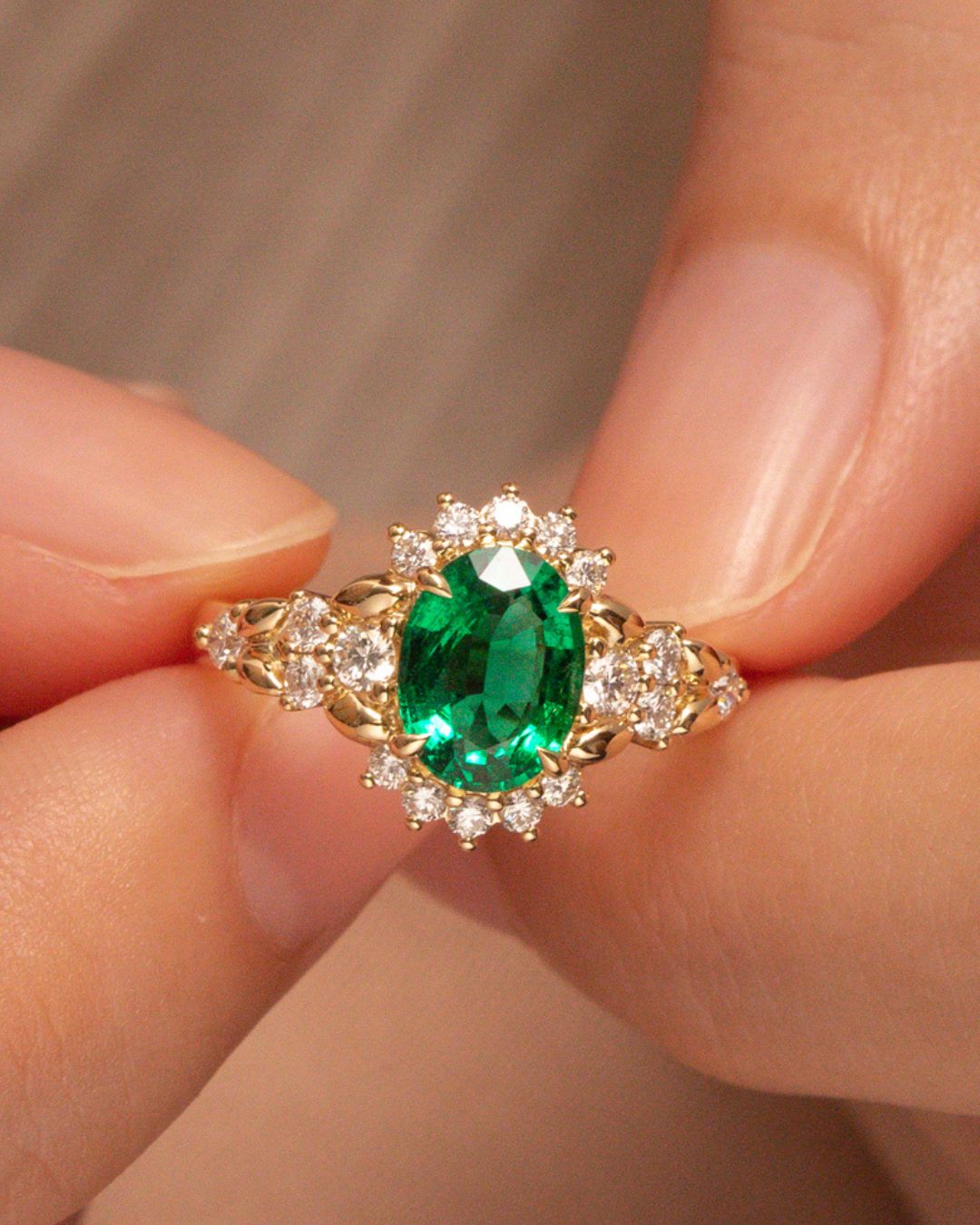
It was developed for the emerald. This stone is criss-crossed by natural fissures that make it sensitive to pressure: the rectangular shape with truncated corners eliminates sharp corners, which are the most fragile points, and limits stress during both cutting and setting. It is now used for all gemstones, but its origin was indeed a technical problem solved. Details in our guide to the price of emeralds.
One final point that only the lapidary masters: many coloured gemstones are pleochroic — they do not show the same colour depending on the crystal axis. The cutter must orient the stone so that its finest hue faces forward, even if this means sacrificing weight. It is an invisible trade-off in the finished result, and it makes all the difference.
The carat measures weight, not size. It is obvious once stated, and yet almost everyone buys as though the two were the same thing.
Yet gemstones do not have the same density. At equal weight, a dense stone occupies less volume — it therefore appears smaller when viewed from above.
| Stone | Density | Approximate diameter at 1 carat |
|---|---|---|
| Emerald | ≈ 2,7 | The most generous Appears noticeably larger |
| Diamond | 3,52 | ≈ 6.5 mm |
| Sapphire and ruby | ≈ 4,0 | ≈ 6.0 mm — smaller at the same weight |
Practical consequence: a one-carat sapphire appears smaller than a one-carat diamond, and a one-carat emerald appears larger than both. This is neither a flaw nor a scam — it is physics.
Always ask for the dimensions in millimetres, not just the weight. It is the millimetre that determines what you see on the finger, and it also determines the setting. Two one-carat sapphires can differ by half a millimetre depending on the depth of the cut — and look entirely different.
Unlike authenticity or treatments, cut quality can be assessed with the naked eye, with a little attention. It is the only criterion you can evaluate yourself.
A shallow cut is almost always an economic choice: it preserves weight. The cutter has favoured carats over beauty. Well cut, a fine stone — sapphire, rubellite, tourmaline — will have as much presence as a diamond.
Cutting combines tradition and technology. Historically, the gem cutter used discs coated with diamond powder; today’s workshop combines these traditional tools with precision machines that ensure consistent angles, from preforming to polishing.
The hand remains decisive. A few fractions of a millimetre change everything. The gem cutter observes the orientation of inclusions and the distribution of colour, then weighs up carat weight and beauty — a judgement no machine can make in their place. Each facet is polished patiently, down to the final touch that creates that crisp brilliance.
Scientifically, it all comes down to refraction: light enters through the table, bounces off the pavilion facets and returns to the eye if the angles are right. The more precise they are, the more light returns — and the more fire the stone has.
But cutting is also an emotion. A heart evokes romance, a cushion softness, a princess cut modernity, an emerald cut classicism. The shape you choose says something about you — and about the way you wish to wear light.
For an old gem with poor proportions, a slight chip or a pronounced window, recutting is sometimes the best decision. It restores brilliance and often gains in beauty what it loses in weight. This is decided stone by stone, by looking at it: for some gems, the aesthetic gain does not compensate for the lost carats. If you own a stone in this situation, let us discuss it — it can also be the starting point for a bespoke creation.
None is inherently better. Brilliant cuts sparkle and conceal inclusions; step cuts show colour and transparency but forgive nothing. For a coloured stone, it is the colour that determines the choice, not the sparkle.
Because a carat measures weight, not size. Corundum is denser than diamond (≈ 4.0 versus 3.52): at equal weight, it occupies less volume — around 6.0 mm versus 6.5 mm. Emerald, being less dense, does the opposite. Buy in millimetres as much as in carats.
A stone cut too shallow: light passes through it instead of being reflected, and a pale, lifeless area appears at the centre. Place it on printed text — if you can read through it, it is windowed. This is the most common flaw in coloured gemstones, because a shallow cut preserves weight.
Because it was developed for emeralds, whose natural fractures do not withstand pressure well. The cut corners eliminate sharp angles, the most fragile points, both during cutting and setting. It is now used for all gemstones.
Elongated shapes — oval, pear, marquise, emerald cut — lengthen the line of the finger and suit short fingers. Round and cushion cuts look particularly good on long, slender fingers. For broad fingers, opt for volume and a band of at least 2 mm.
Yes, and it is sometimes the best decision for an old stone that is poorly proportioned or windowed. Recutting restores brilliance and gains in beauty what it loses in weight — this is decided on a case-by-case basis, by examining the stone.
Share this post